Results by title
3 books match the query 'Byron, George Gordon Byron, Baron'
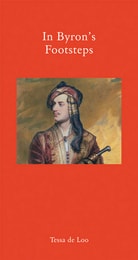
In Byron's Footsteps
Tessa de Loo
Haus Publishing, 2010
Lord Byron's Cain
Twelve essays and a text with variants and annotationsEdited by Truman Guy Steffan
University of Texas Press, 1968
Cain has been ranked as one of the two best dramatic poems written in England in the nineteenth century. Because of its religious heterodoxy, which veiled a political iconoclasm, and also because of Byron’s notoriety, Cain stirred up a storm among Tories and clergymen “from Kentish town to Pisa.” From 1821 to 1830 more was printed about its eighteen hundred alarming lines than about the twenty thousand of Don Juan. One solemn Frenchman even translated the work in order to supply his countrymen with a text that he could then rewrite and confute.
After the initial controversy, readers began to regard Cain not merely as revolutionary propaganda but as a fictional portrait of common youthful experience: a sequence of aspiration, discontent, uncertainty, confusion, misunderstood isolation, fear, frustration, anger, and finally a rash, inevitable, but futile revolt that led to a future of hopeless regret.
Truman Guy Steffan here presents a text, arrived at by collation of the first and several later editions with the original manuscript (presently in the Stark Collection of the Miriam Lutcher Stark Library at the Harry Ransom Center, the University of Texas at Austin).
The first eight essays, which comprise Part I, cover a number of literary topics: Byron’s defense of his purposes in Cain and the relevance of his dramatic theory to the poem; the characterization that is an ideological confrontation, a revelation of personal conflict, as well as a rendering of individuals who have an existence independent of the author; the principles that controlled Byron’s absorption and expansion of biblical materials; the integration of the imagery with the dramatic substance; the incongruities of the language; the metrical heterodoxy; and a description of the manuscript and of Byron’s insertions.
Part II contains the text of Cain, accompanied by notes on the variants, the manuscript cancellations and additions, certain linguistic details, and the scansion of some unusual verses. Then follow annotations on allusions, sources, and analogues, and on a few passages of the play that have elicited unusual conflict over interpretation.
Part III provides a history of Cain criticism, from the opinions of Byron’s social and literary circle and of the major periodicals and pamphlets to the more complicated contribution of the twentieth century.
This important work stands not only as a valuable addition to Byron scholarship but also as an illuminating record of the changing critical and cultural attitudes from the early nineteenth century to the 1960s. Steffan has done a remarkable job in bringing together and synthesizing an enormous body of material.
The Dangerous Lover
Gothic Villains, Byronism, and the Nineteenth-Century Seduction NarrativeDeborah Lutz
The Ohio State University Press, 2006
The dangerous lover has haunted our culture for over two hundred years; English, American, and European literature is permeated with his erotic presence. The Dangerous Lover takes seriously the ubiquity of the brooding romantic hero—his dark past, his remorseful and rebellious exile from comfortable everyday living. Deborah Lutz traces the recent history of this figure, through the melancholy iconoclasm of the Romantics, the lost soul redeemed by love of the Brontës, and the tormented individualism of twentieth-century love narratives. Arguing for this character’s central influence not only in literature but also in the history of ideas, this book places the dangerous lover firmly within the philosophy of Martin Heidegger, the Modernism of Georg Lukács, and Roland Barthes’s theories on love and longing. Working with canonical authors such as Ann Radcliffe, Charles Maturin, Lord Byron, Charles Dickens, George Eliot, and Oscar Wilde, and also with non-canonical texts such as contemporary romance, The Dangerous Lover combines a lyrical, essayistic style with a depth of inquiry that raises questions about the mysteries of desire, death, and eroticism.
The Dangerous Lover is the first book-length study of this pervasive literary hero; it also challenges the tendency of sophisticated philosophical readings of popular narratives and culture to focus on male-coded genres. In its conjunction of high and low literary forms, this volume explores new historical and cultural framings for female-coded popular narratives.