Results by title
46 books match the query 'COVID-19 Pandemic, 2020-2023'
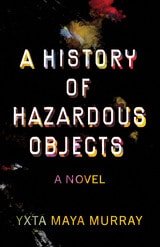
A History of Hazardous Objects
A NovelYxta Maya Murray
University of Nevada Press, 2024
Simultaneously, Laura is trying to write the history section of a Congressional report titled the National Near-Earth Object Preparedness Strategy and Action Plan. This report will advise Congress that it must develop a system to detect and deflect PHOs, and the section Laura is working on cites several historical meteorite impacts as proof that the Earth is now undefended against a significant impact event.
A story about family, love, risk, and science, A History of Hazardous Objects contemplates how experiencing trauma and pain may help us secure a safer and more just world.
After Transformation
A Lyrical History of Christian Late AntiquityMaia Kotrosits
Duke University Press, 2025
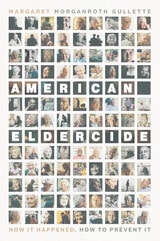
American Eldercide
How It Happened, How to Prevent ItMargaret Morganroth Gullette
University of Chicago Press, 2024
A bracing spotlight on the avoidable causes of the COVID-19 Eldercide in the United States.
Twenty percent of the Americans who have died of COVID since 2020 have been older and disabled adults residing in nursing homes—even though they make up fewer than 1 percent of the US population. Something about this catastrophic loss of life in government-monitored facilities has never added up.
Until now. In American Eldercide, activist and scholar Margaret Morganroth Gullette investigates this tragic public health crisis with a passionate voice and razor-sharp attention to detail, showing us that nothing about it was inevitable. By unpacking the decisions that led to discrimination against nursing home residents, revealing how governments, doctors, and media reinforced ageist or ableist biases, and collecting the previously little-heard voices of the residents who survived, Gullette helps us understand the workings of what she persuasively calls an eldercide.
Gullette argues that it was our collective indifference, fueled by the heightened ageism of the COVID-19 era, that prematurely killed this vulnerable population. Compounding that deadly indifference is our own panic about aging and a social bias in favor of youth-based decisions about lifesaving care. The compassion this country failed to muster for the residents of our nursing facilities motivated Gullette to pen an act of remembrance, issuing a call for pro-aging changes in policy and culture that would improve long-term care for everyone.
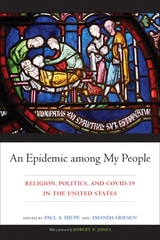
An Epidemic among My People
Religion, Politics, and COVID-19 in the United StatesEdited by Paul A. Djupe and Amanda Friesen
Temple University Press, 2023
The pandemic presented religion as a paradox: faith is often crucial for helping people weather life’s troubles and make difficult decisions, but how can religion continue to deliver these benefits and provide societal structure without social contact? The topical volume, An Epidemic among My People explains how the COVID-19 pandemic stress tested American religious communities and created a new politics of religion centered on public health.
The editors and contributorsconsider how the virus and government policy affected religion in America. Chapters examine the link between the prosperity gospel and conspiracy theories, the increased purchase of firearms by evangelicals, the politics of challenging public health orders as religious freedom claims, and the reactions of Christian nationalists, racial groups, and female clergy to the pandemic (and pandemic politics). As sharp lines were drawn between people and their governments during this uncertain time, An Epidemic among My People provides a comprehensive portrait of religion in American public life.
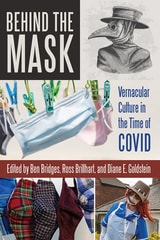
Behind the Mask
Vernacular Culture in the Time of COVIDBen Bridges
Utah State University Press, 2023
Despite vernacular’s potential nod to dominant or external culture, it is the strong connection to the local that grounds the vernacular within the experiential context that it occupies. Exploring the nature and shape of vernacular responses to the ongoing public health crisis, Behind the Mask documents processes that are otherwise likely to be forgotten. Including different ethnographic presents, contributors capture moments during the pandemic rather than upon reflection, making the work important to students and scholars of folklore and ethnology, as well as general readers interested in the COVID pandemic.
Being Human during COVID
Kristin Ann Hass, Editor
University of Michigan Press, 2021
Being Human during COVID documents the first year of the pandemic in real time, bringing together humanities scholars from the University of Michigan to address what it feels like to be human during the COVID-19 crisis. Over the course of the pandemic, the questions that occupy the humanities—about grieving and publics, the social contract and individual rights, racial formation and xenophobia, ideas of home and conceptions of gender, narrative and representations and power—have become shared life-or-death questions about how human societies work and how culture determines our collective fate. The contributors in this collection draw on scholarly expertise and lived experience to try to make sense of the unfamiliar present in works that range from traditional scholarly essays, to personal essays, to visual art projects. The resulting book is shot through with fear, dread, frustration, and prejudice, and, on a few occasions, with a thrilling sense of hope.
COVID Diagnosed the System
Lessons from the Pandemic in Massachusetts PrisonsBridget Conley
Rutgers University Press, 0
The American criminal justice system was in flux in 2020, a clash of possibilities for reform, retrenchment, and radical change—nowhere more so than in Massachusetts, which had just passed major criminal justice reform. The COVID-19 pandemic interrupted the moment with life-threatening force, ravaging people held in prisons and jails across the country. However, it did not so much create new deprivations and suffering as it exposed prisons as sites of physical, institutional, and psychological violence that do not make communities safer. At the same time, advocates for people in prisons—including many incarcerated and formerly incarcerated people—seized on the pandemic’s disruptions to demand change. Detailing the first year of the pandemic inside the Massachusetts state prison system, this book argues that the history of the pandemic inside prisons exposed both the cruelties of incarceration and the power of change when it is led by directly affected people.
COVID and Gender in the Middle East
Edited by Rita Stephan
University of Texas Press, 2023
As the coronavirus ravages the globe, its aftermaths have brought gender inequalities to the forefront of many conversations. Countries in the Middle East and North Africa have been slow to prepare for, adapt to, and mitigate the COVID-19 health crisis and its impacts on governance, economics, security, and rights. Women’s physical well-being, social safety nets, and economic participation have been disproportionately affected, and with widespread shutdowns and capricious social welfare programs, women are exiting the workplace and the classroom, carrying the caregiving burden.
With feminist foregrounding, Rita Stephan's collection COVID and Gender in the Middle East gathers an impressive group of local scholars, activists, and policy experts. The book examines a range of national and localized responses to gender-specific issues around COVID’s health impact and the economic fallout and resulting social vulnerabilities, including the magnified marginalization of Syrian refugees; the inequitable treatment of migrant workers in Bahrain; and the inadequate implementation of gender-based violence legislation in Morocco. An essential global resource, this book is the first to provide empirical evidence of COVID’s gendered effects.
COVID and...
How to Do Rhetoric in a PandemicEmily Winderman
Michigan State University Press, 2023
Capturing COVID
Media and the Pandemic in the Digital EraKatherine A. Foss
University of Massachusetts Press, 2025
When health authorities quarantined guests aboard the Diamond Princess on February 5, 2020, the cruise ship abruptly shifted from a dream vacation vessel to a public health nightmare. Over the next three weeks, 712 passengers tested positive for coronavirus, with fourteen deaths, and the ship outbreak quickly became the largest cluster of cases outside of China. Guests began to routinely share quarantine updates on social media, ranging from the quality of the ship’s food to their sense of imprisonment. These Facebook, Twitter, Instagram, YouTube, and TikTok accounts became a key source of information for news outlets like the Associated Press, and they helped to set the tone for how the media would cover and frame the pandemic for the next several years.
Unlike past outbreaks, epidemics, and pandemics, COVID-19 emerged in a 21st-century digital landscape of instant communication and abundant online platforms, with older models of news and entertainment media mingling with new types of citizen-produced content. In Capturing COVID, Katherine A. Foss makes sense of how this contemporary media landscape shaped the public’s knowledge and perceptions of the new pandemic. The book focuses on crucial media moments, including the initial reporting from Wuhan; news and social media content on the Diamond Princess quarantine; stories of inequality, stigma, and injustice; narratives of the vaccine rollout; and representations of pandemic life in popular culture. Drawing on press releases, interviews, websites, blogs, social media posts, and other publicly available materials, and guided by critical media analysis, Foss illuminates how this new digital era profoundly shaped the progression of the pandemic. This media landscape kept people informed and connected, but also led to the politicization of the virus, rampant mis/disinformation, and stigmatizing messaging that contributed to public distrust and division. Capturing COVID deftly helps make sense of the entire affair.
Crime, Corrections, and the COVID-19 Pandemic
Responses and Adaptations in the U.S. Criminal Justice SystemEdited by Breanne Pleggenkuhle and Joseph A. Schafer
Southern Illinois University Press, 2025
Analyses of crime and justice in an unprecedented time
While COVID-19 lockdowns affected nearly everyone worldwide, feelings of anxiety and fear were exacerbated for those already entangled in the criminal justice system. Scholars recognized the unique opportunity to study crime and the justice system’s response during this period, though they soon realized that determining the pandemic’s effects would be a complicated, nuanced process.
Crime, Corrections, and the COVID-19 Pandemic features analyses and findings from more than thirty contributors in eleven essays. The collection examines the multifaceted social, economic, cultural, legislative, and policy responses to COVID-19 and their impacts on crime and justice. It also explores how professionals across the criminal justice system—police officers, campus police officers, attorneys, judges, correctional staff, and community supervision agents—adapted to unprecedented challenges.
The book provides real-world evidence of how unconventional solutions and groundbreaking practices were implemented in response to a global crisis. Contributors analyze how incarcerated individuals, their families, and their supervisors dealt with the fear of transmission, medical care, and death. Their findings, which are necessarily dependent on timing, place, measurement, and operationalization, include both change and stasis, both negative and positive outcomes. For instance, while minor and property-related offenses initially declined, violent crimes like homicide and intimate partner violence increased. Drug usage patterns changed, leading to a rise in opioid overdoses, and despite the rise in digital interactions, there was no significant difference in self-reported cybervictimization. Furthermore, rates of gang-related crimes did not decrease. Policy and public health responses reshaped criminal activities, influencing the methods and motivations behind theft, child and elder abuse, and other offenses. This volume includes in-depth examinations of certain often-overlooked crimes, such as labor trafficking, and provides direct insights into the job challenges faced by criminal justice professionals, from probation personnel to labor rights advocates.
Emerging innovations in health risk management within correctional facilities led to increased awareness and focus on specific types of crime. Responses to the pandemic revealed significant challenges, such as burnout among justice system personnel, difficulties in adapting and innovating, and challenges in providing services to vulnerable populations.
Through diverse perspectives and empirical approaches ranging from advanced statistical analysis to qualitative interviews, Crime, Corrections, and the COVID-19 Pandemic offers a comprehensive exploration of the complexities that affect research results. It showcases the resilience and innovation within the criminal justice field and details the challenges professionals in this area tackled during a universally trying time, presenting valuable lessons for future crises.
Democracy in the Time of Coronavirus
Danielle Allen
University of Chicago Press, 2022
The COVID-19 pandemic has demonstrated some of the strengths of our society, including the rapid development of vaccines. But the pandemic has also exposed its glaring weaknesses, such as the failure of our government to develop and quickly implement strategies for tracing and containing outbreaks as well as widespread public distrust of government prompted by often confusing and conflicting choices—to mask, or not to mask. Even worse is that over half a million deaths and the extensive economic devastation could have been avoided if the government had been prepared to undertake comprehensive, contextually-sensitive policies to stop the spread of the disease.
In Democracy in the Time of Coronavirus, leading political thinker Danielle Allen untangles the US government’s COVID-19 victories and failures to offer a plan for creating a more resilient democratic polity—one that can better respond to both the present pandemic and future crises. Looking to history, Allen also identifies the challenges faced by democracies in other times that required strong government action. In an analysis spanning from ancient Greece to the Reconstruction Amendments and the present day, Allen argues for the relative effectiveness of collaborative federalism over authoritarian compulsion and for the unifying power of a common cause. But for democracy to endure, we—as participatory citizens—must commit to that cause: a just and equal social contract and support for good governance.
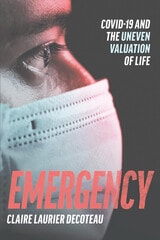
Emergency
COVID-19 and the Uneven Valuation of LifeClaire Laurier Decoteau
University of Chicago Press, 2024
The COVID-19 pandemic inaugurated a state of emergency unprecedented for most Americans. Some could observe this emergency from the relative safety of their homes, but those in marginalized communities, without access to the same privileges, were forced to risk their health and well-being.
In Emergency, sociologist Claire Laurier Decoteau documents and theorizes the emergencies of COVID-19 by looking at the experiences of Chicagoans and the policies that shaped their lives. She describes the uneven racial impact of COVID-19 on Black and Latinx Chicagoans as a crisis within a crisis, caused by a convergence of emergencies: a state of emergency that protected white supremacy and wealth, the slow emergencies racially marginalized populations have faced for decades due to the long-term gutting of care infrastructure and deindustrialization, and the sacrifice “essential workers” were asked to make to protect the United States economy. As Decoteau shows, the city’s “racial equity” project used data to determine which communities would be given scarce resources, but once positivity or death rates declined, resources were retracted and redistributed elsewhere. City officials thus attempted to manage these converging emergencies by manipulating epidemiological data and orchestrating systems for interpreting that data. Decoteau makes clear that the emergencies precipitated by COVID-19 long predated the pandemic, and that we will continue to live with their compounding crises if we do not tackle their structural underpinnings.
Going Virtual
Programs and Insights from a Time of CrisisSarah Ostman
American Library Association, 2021
- COVID-19 Misinformation Challenge, featuring an email quiz, to encourage participants to separate fact from fiction;
- weekly virtual storytimes;
- community cooking demonstrations via Zoom;
- an online grocery store tour, complete with tips about shopping healthy on a budget;
- a virtual beer tasting that boasted 80 attendees;
- socially distanced "creativity crates" for summer reading;
- an online Minecraft club for kids ages 6 and up;
- a Zoom presentation about grieving and funerals during COVID, featuring the director of a local funeral home;
- Art Talk Tuesday, a one-hour, docent-led program;
- a virtual lecture on the history of witchcraft, presented by a public library in partnership with a university rare book room, that drew thousands of viewers;
- "knitting for knewbies" kits for curbside pickup;
- Songs from the Stacks, an ongoing virtual concert series in the style of NPR’s “Tiny Desk”;
- a pink supermoon viewing party that included people howling at the moon together from their homes on Facebook Live;
- and many others
Hollywood Shutdown
Production, Distribution, and Exhibition in the Time of COVIDBy Kate Fortmueller
University of Texas Press, 2021
By March 2020, the spread of COVID-19 had reached pandemic proportions, forcing widespread shutdowns across industries, including Hollywood. Studios, networks and production companies, and the thousands of workers who make film and television possible, were forced to adjust their time-honored business and labor practices. In this book, Kate Fortmueller asks what happened when the coronavirus closed Hollywood.
Hollywood Shutdown examines how the COVID-19 pandemic affected film and television production, influenced trends in distribution, reshaped theatrical exhibition, and altered labor practices. From January movie theater closures in China to the bumpy September release of Mulan on the Disney+ streaming platform, Fortmueller probes various choices made by studios, networks, unions and guilds, distributors, and exhibitors during the evolving crisis. In seeking to explain what happened in the first nine months of 2020, this book also considers how the pandemic will transform Hollywood practices in the twenty-first century.
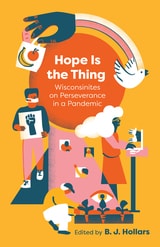
Hope is the Thing
Wisconsinites on Perseverance in a PandemicB. J. Hollars
Wisconsin Historical Society Press, 2021
As the one hundred essays and poems gathered here demonstrate, hope comes in many forms: a dad dance, a birth plan, an unblemished banana, a visit from a neighborhood dog, the revival of an old tradition, empathy. The contributors are racially, geographically, and culturally diverse, representing a rough cross section of Wisconsin voices, from truck driver to poet laureate, from middle school student to octogenarian, from small business owner to seasoned writer. The result is a book-length exploration of the depth and range of hope experienced in times of crisis, as well as an important record of what Wisconsinites were facing and feeling through these historic times.
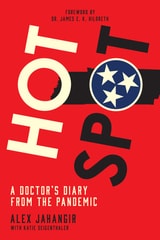
Hot Spot
A Doctor's Diary From the PandemicDr. Alex Jahangir
Vanderbilt University Press, 2022
What followed was a year of unprecedented challenge and scrutiny. Jahangir, who immigrated to the US from Iran at age six, grew up in Nashville. He thought he knew the city well. But the pandemic laid bare ethnic, racial, and cultural tensions that daily threatened to derail what should have been a collective effort to keep residents healthy and safe.
Hot Spot is Jahangir's narrative of the first year of COVID, derived from his op notes (the journal-like entries surgeons often keep following operations) and expanded to include his personal reflections and a glimpse into the inner sanctums of city and state governance in crisis.
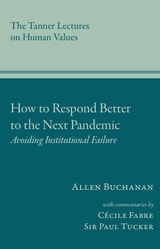
How to Respond Better to the Next Pandemic
Remedying Institutional FailuresAllen Buchanan, with contributions by Cécile Fabre and Sir Paul Tucker
University of Utah Press, 2024
In How to Respond Better to the Next Pandemic Allen Buchanan argues that, contrary to widespread opinion, the primary cause of flawed COVID-19 policy was not defective leadership, but rather institutional failure. Decisions were made through processes that lacked the most basic safeguards against the large-institution “yes-man” and group-think phenomena and included virtually no provisions for holding decision makers accountable. More fundamentally, policy makers did not fulfill the crucial duty to provide plausible public justifications for their decisions. They disguised the fact that scientific opinion was divided on the appropriateness of the policies they endorsed and labeled those who disagreed with them as anti-scientific. In some cases, they responded to criticism, not by engaging it on the issues, but by branding their critics as quacks.
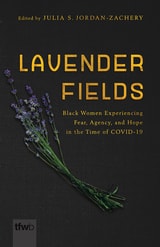
Lavender Fields
Black Women Experiencing Fear, Agency, and Hope in the Time of COVID-19Edited by Julia S. Jordan-Zachery
University of Arizona Press, 2023
Black women and girls in the United States are among the hardest hit by the pandemic in terms of illnesses, deaths, evictions, and increasing economic inequality. Riffing off Alice Walker’s telling of her search for Zora Neal Hurston, the authors of these essays and reflections offer raw tellings of Black girls’ and women’s experiences written in real time, as some of the contributors battled COVID-19 themselves.
The essays center Black girls and women and their testimonies in hopes of moving them from the margin to the center. With a diversity of voices and ages, this volume taps into the Black feminine interior, that place where Audre Lorde tells us that feelings lie, to access knowledge—generational, past, and contemporary—to explore how Black women navigate COVID-19. Using womanism and spirituality, among other modalities, the authors explore deep feelings, advancing Black feminist theorizing on Black feminist praxis and methodology.
In centering the stories of Black girls and women’s experiences with COVID-19, this work brings much-needed justice and equity to conversations about the pandemic. Just as Walker worked diligently to find Hurston, Lavender Fields attempts to “find” Black women amid all we are experiencing, ensuring visibility and attention.
Contributors
Tamaya Bailey
reelaviolette botts-ward
Kyrah K. Brown
Brianna Y. Clark
Kenyatta Dawson
LeConté J. Dill
Maryam O. Funmilayo
Brandie Green
Courtney Jackson
Sara Jean-Francois
Julia S. Jordan-Zachery
Angela K. Lewis-Maddox
Annet Matebwe
Mbali Mazibuko
Radscheda Nobles
Nimot Ogunfemi
J. Mercy Okaalet
Chizoba Uzoamaka Okoroma
Peace Ossom-Williamson
Elizabeth Peart
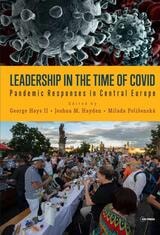
Leadership in the Time of Covid
Pandemic Responses in Central EuropeMilada Polisenská
Central European University Press, 2023
The Covid pandemic has put all modern societies to a serious test of resilience. The interdisciplinary research on which this book is based examined how four European governments behaved in these circumstances. During the months of the crisis, the team of experts coordinated by the editors of this volume took a close look at the decision-making processes in the Czech Republic, Hungary, Poland, and Slovakia – the so-called Visegrad Four.
The inquiries focused on experiences from the academic, health, economic and social fields. The methods of comparison included surveys, interviews, discourse analysis, for which the adaptive leadership theory provided the conceptual framework.
The conclusions are both academic and practical. Aside the description of the pandemic responses, the research had a formative dimension: how can an adaptive leadership approach better help societies manage the health and societal impacts of similar challenges? The spectrum of emerging anti-democratic tendencies in the region provided the specific context of the exercise. The four states face varying degrees of democratic backsliding as well as illiberal influences that have affected their response to the pandemic, which gives this research on the Visegrad Four a worldwide resonance.
Mothering in the Time of Coronavirus
Amy Lutz, Sujung (Crystal) Lee, and Baurzhan Bokayev
University of Massachusetts Press, 2025
When stay-at-home orders during the COVID-19 pandemic erased the division between home and school, many parents in the United States were suddenly expected to become their children’s teachers. Despite this new arrangement, older gender norms largely remained in place, and these extra child rearing responsibilities fell disproportionately on mothers. Mothering in the Time of Coronavirus explores how they juggled working, supervising at-home learning, and protecting their children’s emotional and physical health during the outbreak.
Focusing on both remote and essential workers in central New York, Amy Lutz, Sujung (Crystal) Lee, and Baurzhan Bokayev argue that the pandemic transformed an already intensive style of contemporary American child rearing, in which mothers are expected to be constantly available to meet their children’s needs even when they are working outside the home, into extremely intensive mothering. The authors investigate the consequences of this shift, and how it is influenced by issues such as class and race. They also bring attention to how and why current public policies are not conducive to the de-intensification of motherhood. Locating their study within larger intersections of gender, family, and education, they contend that to fully appreciate the broader social consequences of COVID-19, we must understand the experiences of mothers.
Ohio under COVID
Lessons from America's Heartland in CrisisKatherine Sorrels, Vanessa Carbonell, Danielle Bessett, Lora Arduser, Edward Wallace, and Michelle L. McGowan, Editors
University of Michigan Press, 2023
In early March of 2020, Americans watched with uncertain terror as the novel coronavirus pandemic unfolded. One week later, Ohio announced its first confirmed cases. Just one year later, the state had over a million cases and 18,000 Ohioans had died. What happened in that first pandemic year is not only a story of a public health disaster, but also a story of social disparities and moral dilemmas, of lives and livelihoods turned upside down, and of institutions and safety nets stretched to their limits.
Ohio under COVID tells the human story of COVID in Ohio, America’s bellwether state. Scholars and practitioners examine the pandemic response from multiple angles, and contributors from numerous walks of life offer moving first-person reflections. Two themes emerge again and again: how the pandemic revealed a deep tension between individual autonomy and the collective good, and how it exacerbated social inequalities in a state divided along social, economic, and political lines. Chapters address topics such as mask mandates, ableism, prisons, food insecurity, access to reproductive health care, and the need for more Black doctors. The book concludes with an interview with Dr. Amy Acton, the state’s top public health official at the time COVID hit Ohio. Ohio under COVID captures the devastating impact of the pandemic, both in the public discord it has unearthed and in the unfair burdens it has placed on the groups least equipped to bear them.
One Planet, Many Worlds
The Climate ParallaxDipesh Chakrabarty
Brandeis University Press, 2023
Climate change represents a deep conundrum for humans. It is difficult for humans to give up the unequal and yet accelerating pursuit of a good life based on an insatiable appetite for energy sourced mainly from fossil fuel. But the same pursuit, scientists insist, damages the geobiological system that supports the existence of interrelated forms of life, including ours, on this planet. The planet, seen thus, is one. The global sway of financial and extractive capital connects humans technologically, but they remain divided along multiple axes of inequality. Their worlds are many and their politics still global rather than planetary. In the narrative presented here, Chakrabarty continues to explore the temporal and intellectual fault lines that mark the collapse of the global and the planetary in human history.
Pandemic Crossings
Digital Technology, Everyday Experience, and Governance in the COVID-19 CrisisGuobin Yang
Michigan State University Press, 2024
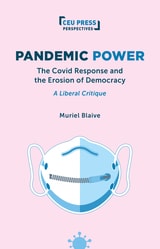
Pandemic Power
The Covid Response and the Erosion of Democracy - A Liberal CritiqueMuriel Blaive
Central European University Press, 2025
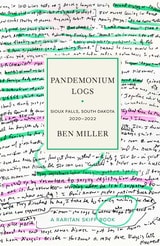
Pandemonium Logs
Sioux Falls, South Dakota, 2020–2022Ben Miller
Rutgers University Press, 2025
Balcones Prize Winner in Nonfiction
In 2015, Ben Miller and the poet Anne Pierson Wiese moved from New York City to Sioux Falls, South Dakota, to explore their midwestern roots and to focus on their writing careers. Working a day job in a hospital, Miller had a front-row seat to the COVID-19 pandemic as it moved from the coasts to the urban Midwest. Pandemonium Logs casts an unflinching eye on the state of the worker in the US health-care system during a global pandemic, giving voice to the doctors, nurses, support staff, patients, and families caught in the complex swirl of daily dilemmas and crucial choices.
In unsparing yet sympathetic prose, Ben Miller creates an intimate portrait of the impact of COVID on the diverse people of South Dakota. Through a wide range of characters—from understandably confused patients to quietly competent nurses—he explores the human complexities of the crisis: a doctor based in Mumbai who treats critically ill patients in the Dakotas via a tenuous hodgepodge of telehealth apparatus, a Hydra of six workplace trainers who together cannot train one employee to do one job, a vice president of corporate hospitality who lives to rip down safety signs as fast as nurses post them, a ninety-year-old hospital volunteer who pushes wheelchairs containing patients half his age.
In Pandemonium Logs, Miller provides precise and moving observations of ordinary people doing extraordinary things.
Pivoting during the Pandemic
Ideas for Serving Your Community Anytime, AnywhereKathleen Hughes and Jamie Santoro
American Library Association, 2020
When the pandemic suddenly forced many public libraries to close their doors or limit patron access, library staff redoubled their efforts to serve their communities in every way possible. Demonstrating their resilience by quickly pivoting to new modes of service, public libraries are continuing to offer innovative yet practical ways to connect patrons to the information and services they need and enjoy. Offering real-life examples of what it means to be a 24/7 library, this collection from the Public Library Association (PLA) and ALA Editions shares how several libraries transitioned to virtual and socially-distanced services. No matter your library’s current situation or outlook for the future, you’ll be inspired to adapt their ideas to suit the needs of your own organization. Among the initiatives and topics explored are
- homebound delivery;
- citizen science programs;
- virtual reference advice;
- services to small businesses;
- remote readers' advisory and book chats;
- early literacy storytimes;
- health services outreach;
- tech guidance for patrons;
- wifi hotspot lending; and
- tips for social media and marketing.
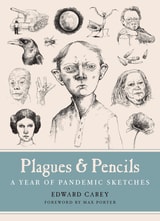
Plagues and Pencils
A Year of Pandemic SketchesEdward Carey, with a foreword by Max Porter
University of Texas Press, 2022
Honorable Mention, 2022 Nonfiction Prize, Writers' League of Texas
A remarkable collection of words and illustrations documenting the first year of the pandemic.
In March 2020, as lockdowns were imposed around the world, author and illustrator Edward Carey raced home to Austin, Texas. The next day, he published on social media a sketch of “A Very Determined Young Man.” The day after, he posted another drawing. One year and one hundred and fifty Tombow B pencil stubs later, he was still drawing.
Carey’s pencil fills the page with the marvelous and intriguing, picturing people, characters, animals, monsters, and his favorite bird to draw, the grackle. He reaches into history and fiction to escape grim reality through flights of vivid imagination—until events demand the drawings “look straight on.”
Breonna Taylor, the Brontë sisters, John Lewis, King Lear, and even the portraits that mark the progress of the year for the Very Determined Young Man combine into a remarkable document of the pandemic and its politics. For Carey, though, trapped inside a home he loves, these portraits are something more, a way to chart time, an artist’s way of creating connection in isolation. With an introduction by Max Porter, this exceptional collection from the acclaimed author of Little marks a year of a man trapped with his pencil, determined to find solace amid uncertainty.
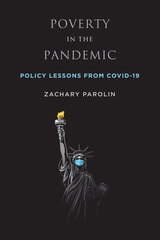
Poverty in the Pandemic
Policy Lessons from COVID-19Zachary Parolin
Russell Sage Foundation, 2023
Drawing on dozens of data sources ranging from debit and credit card spending, the first national databases of school and childcare center closures in the U.S., and bi-weekly Census-run surveys on well-being, Parolin finds that entering the pandemic in poverty substantially increased a person’s likelihood of experiencing negative health outcomes due to the pandemic, such as contracting and dying from COVID, as well as losing their job. Additionally, he found that students from poor families suffered the greatest learning losses as a result of school closures and the shift to distance learning during the pandemic.
However, unprecedented legislative action by the U.S. government, including the passage of the Families First Coronavirus Response Act (FFCRA), the Coronavirus Aid, Relief, and Economic Security (CARES) Act, and the American Rescue Plan (ARP) helped mitigate the economic consequences of the pandemic and lifted around 18 million Americans out of poverty. Based on the success of these policies, Parolin concludes with policy suggestions that the U.S. can implement in more ‘normal’ times to improve the living conditions of low-income households after the pandemic subsides, including expanding access to Unemployment Insurance, permanently expanding the Child Tax Credit, promoting greater access to affordable, high-quality healthcare coverage, and investing more resources into the Census Bureau’s data-collection capabilities. He also details a method of producing a monthly measurement of poverty, to be used in conjunction with the traditional annual measurement, in order to better understand the intra-year volatility of poverty that many Americans experience.
Poverty in the Pandemic provides the most complete account to date of the unique challenges that low-income households in the U.S. faced during the COVID-19 pandemic.
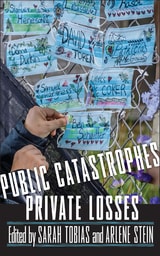
Public Catastrophes, Private Losses
Sarah Tobias
Rutgers University Press, 2025
This essay collection explores how the definition of catastrophe might be expanded to include many forms of large-scale structural violence on communities, species, and ecosystems. Using feminist methodologies, the contributors to Public Catastrophes, Private Losses trace the connections between seemingly unrelated forms of violence such as structural racism, environmental degradation, and public health crises. In contrast to a news media that focuses on mass fatalities and immediate consequences, these essays call our attention to how catastrophes can also involve slow violence with long-term effects.
The authors also consider how these catastrophes are profoundly shaped by government action or inaction, offering a powerful critique of how government neglect has cost lives and demonstrating how vulnerable populations can be better protected. The essays in this collection examine how public catastrophes imprint themselves on lives, as individuals and communities narrate, process, and grapple with legacies of loss. The book is thus a feminist intervention that challenges the binary between public and private, personal and political.
Race and Environmental Justice in the Era of Climate Change and COVID-19
Tatiana Konrad
Michigan State University Press, 2025
Race, Ethnicity, and the COVID-19 Pandemic
Edited by Melvin E. Thomas, Loren M. Henderson, and Hayward Derrick Horton
University of Minnesota Press, 2022
To understand racial disparities in COVID-19 infections and deaths, we must first understand how they are linked to racial inequality. In the United States, the material advantages afforded by whiteness lead to lower rates of infections and deaths from COVID-19 when compared to the rates among Black, Latino, and Native American populations. Most experts point to differences in population density, underlying health conditions, and proportions of essential workers as the primary determinants in the levels of COVID-19 deaths.
The national response to the pandemic has laid bare the fundamentals of a racialized social structure. Assembled by a prestigious group of sociologists, this volume examines how particularly during the first year of COVID-19, the socioeconomic impact of the pandemic led to different and poorer outcomes for Black, Latino, and Native American populations. While color-blindness shaped national discussions on essential workers, charity, and differential mortality, minorities were overwhelmingly affected. The essays in this collection provide a mix of critical examination of the progress and direction of our COVID-19 response, personal accounts of the stark difference in care and outcomes for minorities throughout the United States, and offer recommendations to create a foundation for future response and research during the critical early days.
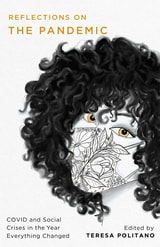
Reflections on the Pandemic
COVID and Social Crises in the Year Everything ChangedTeresa Politano
Rutgers University Press, 2024
Contributors include: Patricia Akhimie, Marc Aronson, Ulla D. Berg, Stephanie Bonne, Stephanie Boyer, Kimberly Camp, Jordan Casteel, Kelly-Jane Cotter, Mark Doty, David Dreyfus, Adrienne E. Eaton, Katherine C. Epstein, Leah Falk, Paul G. Falkowski, Rigoberto González, James Goodman, David Greenberg, Angelique Haugerud, Grace Lynne Haynes, Leslieann Hobayan, Jonathan Holloway, James W. Hughes, Naomi Jackson, Amy Jordan, Vikki Katz, Mackenzie Kean, Robert E. Kopp, Christian Lighty, Stephen Masaryk, Louis P. Masur, Revathi V. Machan, Yalidy Matos, Belinda McKeon, Susan L. Miller, Yehoshua November, Joyce Carol Oates, Mary E. O’Dowd, Katherine Ognyanova, David Orr, Gregory Pardlo, Steve Pikiell, Teresa Politano, en Purkert, Nick Romanenko, Evie Shockley, Caridad Svich, and Didier William.
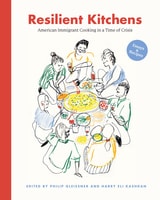
Resilient Kitchens
American Immigrant Cooking in a Time of Crisis, Essays and RecipesPhilip Gleissner
Rutgers University Press, 0
Winner of the James Beard Award for Best Book in Food Issues and Advocacy
Immigrants have left their mark on the great melting pot of American cuisine, and they have continued working hard to keep America’s kitchens running, even during times of crisis like the COVID-19 pandemic. For some immigrant cooks, the pandemic brought home the lack of protection for essential workers in the American food system. For others, cooking was a way of reconnecting with homelands they could not visit during periods of lockdown.
Resilient Kitchens: American Immigrant Cooking in a Time of Crisis is a stimulating collection of essays about the lives of immigrants in the United States before and during the COVID-19 pandemic, told through the lens of food. It includes a vibrant mix of perspectives from professional food writers, restaurateurs, scholars, and activists, whose stories range from emotional reflections on hardship, loss, and resilience to journalistic investigations of racism in the American food system. Each contribution is accompanied by a recipe of special importance to the author, giving readers a taste of cuisines from around the world. Every essay is accompanied by gorgeous food photography, the authors’ snapshots of pandemic life, and hand-drawn illustrations by Filipino American artist Angelo Dolojan.
States of Plague
Reading Albert Camus in a PandemicAlice Kaplan and Laura Marris
University of Chicago Press, 2022
As one of the most discussed books of the COVID-19 crisis, Albert Camus’s classic novel The Plague has become a new kind of literary touchstone. Surrounded by terror and uncertainty, often separated from loved ones or unable to travel, readers sought answers within the pages of Camus’s 1947 tale about an Algerian city gripped by an epidemic. Many found in it a story about their own lives—a book to shed light on a global health crisis.
In thirteen linked chapters told in alternating voices, Alice Kaplan and Laura Marris hold the past and present of The Plague in conversation, discovering how the novel has reached people in their current moment. Kaplan’s chapters explore the book’s tangled and vivid history, while Marris’s are drawn to the ecology of landscape and language. Through these pages, they find that their sense of Camus evolves under the force of a new reality, alongside the pressures of illness, recovery, concern, and care in their own lives. Along the way, Kaplan and Marris examine how the novel’s original allegory might resonate with a new generation of readers who have experienced a global pandemic. They describe how they learned to contemplate the skies of a plague spring, to examine the body politic and the politics of immunity.
Both personal and eloquently written, States of Plague uncovers for us the mysterious way a novel can imagine the world during a crisis and draw back the veil on other possible futures.
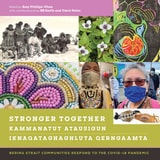
Stronger Together / Kammanatut Atausigun / Iknaqataghaghluta Qerngaamta
Bering Strait Communities Respond to the COVID-19 PandemicAmy Phillips-Chan
University of Alaska Press, 2024
The featured artists narrativize works inspired by the pandemic, from walrus ivory masks and sealskin face coverings to scenes of subsistence activities and informal family portraits. Full-color illustrations enliven the text with vibrant images of local community members, activities, and artwork from those who call this northern expanse of rolling tundra and icy seas home.
Stronger Together features hopeful and redemptive behind-the-scenes perspectives of how remote Alaskan communities endured the COVID-19 pandemic and appeals to anyone looking for hopeful and redemptive stories of this time, as well as museum, public arts, and culture program administrators; student and scholars of Indigenous and Alaska Native languages and culture; the Alaska anthropology community; artists and art enthusiasts; and those with a general interest in Alaska.

That Futebol Feeling
Sport and Play in Brazil's HeartlandDavid Faflik
Temple University Press, 2025
That Futebol Feeling captures the region’s enthrallment with “the beautiful game,” and shows us how and why play is central to the human condition. David Faflik profiles members of the most celebrated local team, Clube Atlético Mineiro (CAM), as well as its passionate, never-say-die fans, to show how futebol and fandom shape their everyday lives and perspectives. He discovers bonds of work and play, as well as pride, identity, and community. Additionally, Faflik’s analysis of Brazil’s futebol culture reflects sports fandom worldwide.
CAM stands as a symbol for a way of life in Minas Gerais, the birthplace of Pelé. Faflik interrogates what playing the game means to those who dedicate their lives to the sport. He writes, “The feelings that football inspires are the best of me.” That Futebol Feeling shares that special feeling with the rest of us.
The Five Health Frontiers
A New Radical BlueprintChristopher Thomas
Pluto Press, 2022
Covid-19 has exposed the limits of a neoliberal public health orthodoxy. But instead of imagining radical change, the left is stuck in a rearguard action focused on defending the NHS from the wrecking ball of privatization.
Public health expert Christopher Thomas argues that we must emerge from Covid-19 on the offensive - with a bold, new vision for our health and care. He maps out five new frontiers for public health and imagines how we can move beyond safeguarding what we have to a radical expansion of the principles put forward by Aneurin Bevan, the founder of the NHS, over 70 years ago.
Beyond recalibrating our approach to healthcare services, his blueprint includes a fundamental redesign of our economy through Public Health Net Zero; a bold new universal public health service fit to address the real causes of ill health; and a major recalibration in the efforts against the epidemiological reality of an era of pandemics.
The Pandemic Workplace
How We Learned to Be Citizens in the OfficeIlana Gershon
University of Chicago Press, 2024
In The Pandemic Workplace, anthropologist Ilana Gershon turns her attention to the US workplace and how it changed—and changed us—during the pandemic. She argues that the unprecedented organizational challenges of the pandemic forced us to radically reexamine our attitudes about work and to think more deeply about how values clash in the workplace. These changes also led us as workers to engage more with the contracts that bind us as we rethought when and how we allow others to tell us what to do.
Based on over two hundred interviews, Gershon’s book reveals how negotiating these tensions during the pandemic made the workplace into a laboratory for democratic living—the key place where Americans are learning how to develop effective political strategies and think about the common good. Exploring the explicit and unspoken ways we are governed (and govern others) at work, this accessible book shows how the workplace teaches us to be democratic citizens.
The Pandemic and the Working Class
How US Labor Navigated COVID-19Edited by Nick Juravich and Steve Striffler
University of Illinois Press, 2025
Nick Juravich and Steve Striffler edit a collection that examines the effects of the pandemic on workers. Sections of the book focus on specific impacts and government efforts to restructure the economy; the dramatic effect of the pandemic on the hospitality industry; educators’ response on behalf of themselves and their students; frontline healthcare workers; and the innovative forms of labor organizing that emerged during and after COVID.
Contributors: Carlos Aramayo, Kathleen Brown, Sandrine Etienne, Ismael García-Colón, Puya Gerami, Maura Hagan, Connor Harney, Devan Hawkins, Leigh Howard, Marian Moser Jones, Doris Joy, Nick Juravich, Eric Larson, Kathryn M. Meyer, Samir Sonti, Steve Striffler, Lia Warner, Andrew B. Wolf, and Jennifer Zelnick
The Time We Have
Essays on Pandemic LivingMichele Weldon
Northwestern University Press, 2024
At a time when so many are dealing with collective and personal grief, award-winning author and journalist Michele Weldon’s new collection of essays navigates the revelatory and upending nature of this extraordinary pandemic era through a lens of love and connection. Weldon explores pain and pleasure alike with emotional texture, empathy, wisdom, vulnerability, and humor. She interrogates moments of joy, despair, and triumph, offering readers the possibility for a richly cathartic experience. With honesty and agility, Weldon creates poignant intersections of her narrative with popular culture, history, media, news, consumerism, family traditions, and healthcare. Employing honest and daring language, Weldon examines the concepts of safety, importance of beloved objects, power of words, shift to remote relationships, concepts of feminism, betrayal of public lies, and more. Ultimately, with grace and heart, Weldon offers in these essays useful pathways toward framing this swath of time so that we might arrive at a sense of understanding, belonging, and peace with our new realities.
Unmasked
COVID, Community, and the Case of OkobojiEmily Mendenhall
Vanderbilt University Press, 2022
The story is both personal and political. Author Emily Mendenhall, an anthropologist at Georgetown University, grew up in Okoboji, and her family still lives there. As the events unfolded, Mendenhall was in Okoboji, where she spoke formally with over 100 people and observed a community that rejected public health guidance, revealing deep-seated mistrust in outsiders and strong commitments to local thinking. Unmasked is a fascinating and heartbreaking account of where people put their trust, and how isolationist popular beliefs can be in America's small communities.
This book is the recipient of the 2022 Norman L. and Roselea J. Goldberg Prize from Vanderbilt University Press for the best book in the area of art or medicine.
Unmasked
COVID, Community, and the Case of OkobojiEmily Mendenhall
Vanderbilt University Press, 2022
The story is both personal and political. Author Emily Mendenhall, an anthropologist at Georgetown University, grew up in Okoboji, and her family still lives there. As the events unfolded, Mendenhall was in Okoboji, where she spoke formally with over 100 people and observed a community that rejected public health guidance, revealing deep-seated mistrust in outsiders and strong commitments to local thinking. Unmasked is a fascinating and heartbreaking account of where people put their trust, and how isolationist popular beliefs can be in America's small communities.
This book is the recipient of the 2022 Norman L. and Roselea J. Goldberg Prize from Vanderbilt University Press for the best book in the area of art or medicine.
Victories Never Last
Reading and Caregiving in a Time of PlagueRobert Zaretsky
University of Chicago Press, 2022
In any time of disruption or grief, many of us seek guidance in the work of great writers who endured similar circumstances. During the first year of the COVID-19 pandemic, historian and biographer Robert Zaretsky did the same while also working as a volunteer in a nursing home in south Texas. In Victories Never Last Zaretsky weaves his reflections on the pandemic siege of his nursing home with the testimony of six writers on their own times of plague: Thucydides, Marcus Aurelius, Michel de Montaigne, Daniel Defoe, Mary Shelley, and Albert Camus, whose novel The Plague provides the title of this book.
Zaretsky delves into these writers to uncover lessons that can provide deeper insight into our pandemic era. At the same time, he goes beyond the literature to invoke his own experience of the tragedy that enveloped his Texas nursing home, one which first took the form of chronic loneliness and then, inevitably, the deaths of many residents whom we come to know through Zaretsky’s stories. In doing so, Zaretsky shows the power of great literature to connect directly to one’s own life in a different moment and time.
For all of us still struggling to comprehend this pandemic and its toll, Zaretsky serves as a thoughtful and down-to-earth guide to the many ways we can come to know and make peace with human suffering.
WPAing in a Pandemic and Beyond
Revision, Innovation, and AdvocacyTodd Ruecker
Utah State University Press, 2025
The chapters in this collection include a variety of voices who have been involved in writing program administration in recent years to reflect on the work done in this moment of crisis. Through both short vignettes and longer chapters, this book explores the complicated interactions between WPA work and navigating times of crisis to provide insights for moving forward. Authors explore a variety of topics including professional development, curricular change, advocating in the face of intransigent administrations and others, caring for students, and taking time for self-care. Pointing to specific actions for continued advocacy, WPAing in a Pandemic and Beyond will be of great interest to WPAs and writing studies scholars.
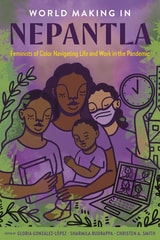
World Making in Nepantla
Feminists of Color Navigating Life and Work in the PandemicGloria González-LópezSharmila RudrappaChristen A. Smith
University of Texas Press, 2025
Writings from feminist scholars of color about their experiences during the pandemic.
Bringing uncertainty, fear, and change, the COVID-19 pandemic shook the world, altered people’s lives, and sparked a wave of introspection. Underserved communities—people of color, women, and queer people among them—were affected the most, and their experiences, in turn, reflected hope and opportunities to reinvent themselves individually and collectively. Drawing on Gloria Anzaldúa’s use of nepantla—the Náhuatl word meaning “in-between space,” the en medio and a liminal space between worlds imbued with change—World Making in Nepantla collects writings about the hurdles feminist scholars of color faced during the pandemic years.
Contributors explore how COVID affected feminist scholars of color while recognizing the ways in which inequality influences experience and also celebrating the resilience of communities all over the world. Dispatches from classrooms and quarantined homes and introspective essays on disability, mutual aid, and borders are included among the essays here. These pieces serve as a concrete record, capturing an ephemeral time already being lost to memory. Created during the heart of the pandemic, World Making in Nepantla is an honest and intimate recording of how feminist scholars of color navigated struggles and found strength during an era that forever changed the modern world.