Results by title
3 books match the query 'Cárdenas, Lázaro'
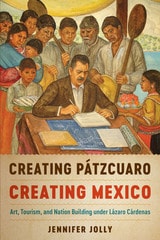
Creating Pátzcuaro, Creating Mexico
Art, Tourism, and Nation Building under Lázaro CárdenasBy Jennifer Jolly
University of Texas Press, 2018
LASA Visual Culture Studies Section Book Prize, Latin American Studies Association (LASA)
Winner, Arthur P. Whitaker Prize, Middle Atlantic Council of Latin American Studies, 2019In the 1930s, the artistic and cultural patronage of celebrated Mexican president Lázaro Cárdenas transformed a small Michoacán city, Pátzcuaro, into a popular center for national tourism. Cárdenas commissioned public monuments and archeological excavations; supported new schools, libraries, and a public theater; developed tourism sites and infrastructure, including the Museo de Artes e Industrias Populares; and hired artists to paint murals celebrating regional history, traditions, and culture. The creation of Pátzcuaro was formative for Mexico; not only did it provide an early model for regional economic and cultural development, but it also helped establish some of Mexico’s most enduring national myths, rituals, and institutions.
In Creating Pátzcuaro, Creating Mexico, Jennifer Jolly argues that Pátzcuaro became a microcosm of cultural power during the 1930s and that we find the foundations of modern Mexico in its creation. Her extensive historical and archival research reveals how Cárdenas and the artists and intellectuals who worked with him used cultural patronage as a guise for radical modernization in the region. Jolly demonstrates that the Pátzcuaro project helped define a new modern body politic for Mexico, in which the population was asked to emulate Cárdenas by touring the country and seeing and embracing its land, history, and people. Ultimately, by offering Mexicans a means to identify and engage with power and privilege, the creation of Pátzcuaro placed art and tourism at the center of Mexico’s postrevolutionary nation building project.
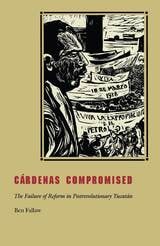
Cárdenas Compromised
The Failure of Reform in Postrevolutionary YucatánBen Fallaw
Duke University Press, 2001
For historical, geographical, and ethnic reasons, Yucatán was the center of large-scale land reform after the Mexican Revolution. A long-standing revolutionary tradition, combined with a harsh division between a powerful white minority and a poor, Maya-speaking majority, made the region the perfect site for Cárdenas to experiment by launching an ambitious top-down project to mobilize the rural poor along ethnic and class lines. The regime encouraged rural peasants to form collectives, hacienda workers to unionize, and urban laborers to strike. It also attempted to mobilize young people and women, to challenge Yucatán’s traditional, patriarchal social structure, to reach out to Mayan communities, and to democratize the political process. Although the project ultimately failed, political dialogue over Cárdenas’s efforts continues. Rejecting both revisionist (anti-Cárdenas) and neopopulist (pro-Cárdenas) interpretations, Fallaw overturns the notion that the state allowed no room for the agency of local actors. By focusing on historical connections across class, political, and regional lines, Fallaw transforms ideas on Cardenismo that have long been accepted not only in Yucatán but throughout Mexico.
This book will appeal to scholars of Mexican history and of Latin American state formation, as well as to sociologists and political scientists interested in modern Mexico.
Populism in Twentieth Century Mexico
The Presidencies of Lázaro Cárdenas and Luis EcheverríaEdited by Amelia M. Kiddle and María L. Muñoz; Foreword by Cuauhtémoc Cárdenas
University of Arizona Press, 2010
This volume brings together twelve original essays that explore the concept of populism in twentieth century Mexico. Contributors analyze the presidencies of two of the century’s most clearly populist figures, evaluating them against each other and in light of other Latin American and Mexican populist leaders. In order to examine both positive and negative effects of populist political styles, contributors also show how groups as diverse as wild yam pickers in 1970s Oaxaca and intellectuals in 1930s Mexico City had access to and affected government projects.
The chapters on the Echeverría presidency are written by contributors at the forefront of emerging scholarship on this topic and demonstrate new approaches to this critical period in Mexican history. Through comparisons to Echeverría, contributors also shed new light on the Cárdenas presidency, suggesting fresh areas of investigation into the work of Mexico’s quintessentially populist leader. Ranging in approach from environmental history to labor history, the essays in this volume present a complex picture of twentieth century populism in Mexico.