Results by title

3 books match the query 'Cabrita, Joel'
cover of Global Visions of Violence: Agency and Persecution in World Christianity

Global Visions of Violence

Agency and Persecution in World Christianity

Jason Bruner

Rutgers University Press, 2023
In Global Visions of Violence, the editors and contributors argue that violence creates a lens, bridge, and method for interdisciplinary collaboration that examines Christianity worldwide in the twentieth and twenty-first centuries. By analyzing the myriad ways violence, persecution, and suffering impact Christians and the imagination of Christian identity globally, this interdisciplinary volume integrates the perspectives of ethicists, historians, anthropologists, and ethnographers to generate new conversations. Taken together, the chapters in this book challenge scholarship on Christian growth that has not accounted for violence while analyzing persecution narratives that can wield data toward partisan ends.  This allows Global Visions of Violence to push urgent conversations forward, giving voice to projects that illuminate wide and often hidden landscapes that have been shaped by global visions of violence, and seeking solutions that end violence and turn toward the pursuit of justice, peace, and human rights among suffering Christians. 
[more]
cover of Religion, Media, and Marginality in Modern Africa

Religion, Media, and Marginality in Modern Africa

Felicitas Becker

Ohio University Press, 2018

In recent years, anthropologists, historians, and others have been drawn to study the profuse and creative usages of digital media by religious movements. At the same time, scholars of Christian Africa have long been concerned with the history of textual culture, the politics of Bible translation, and the status of the vernacular in Christianity. Students of Islam in Africa have similarly examined politics of knowledge, the transmission of learning in written form, and the influence of new media. Until now, however, these arenas—Christianity and Islam, digital media and “old” media—have been studied separately.

Religion, Media, and Marginality in Modern Africa is one of the first volumes to put new media and old media into significant conversation with one another, and also offers a rare comparison between Christianity and Islam in Africa. The contributors find many previously unacknowledged correspondences among different media and between the two faiths. In the process they challenge the technological determinism—the notion that certain types of media generate particular forms of religious expression—that haunts many studies. In evaluating how media usage and religious commitment intersect in the social, cultural, and political landscapes of modern Africa, this collection will contribute to the development of new paradigms for media and religious studies.

Contributors: Heike Behrend, Andre Chappatte, Maria Frahm-Arp, David Gordon, Liz Gunner, Bruce S. Hall, Sean Hanretta, Jorg Haustein, Katrien Pype, and Asonzeh Ukah.
[more]
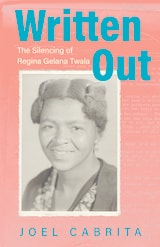
cover of Written Out: The Silencing of Regina Gelana Twala

Written Out

The Silencing of Regina Gelana Twala

Joel Cabrita

Ohio University Press, 2023

Systemic racism and sexism caused one of South Africa’s most important writers to disappear from public consciousness. Is it possible to justly restore her historical presence? Regina Gelana Twala, a Black South African woman who died in 1968 in Swaziland (now Eswatini), was an extraordinarily prolific writer of books, columns, articles, and letters. Yet today Twala’s name is largely unknown. Her literary achievements are forgotten. Her books are unpublished. Her letters languish in the dusty study of a deceased South African academic. Her articles are buried in discontinued publications. Joel Cabrita argues that Twala’s posthumous obscurity has not developed accidentally as she exposes the ways prejudices around race and gender blocked Black African women like Twala from establishing themselves as successful writers. Drawing upon Twala’s family papers, interviews, newspapers, and archival records from Pretoria, Uppsala, and Los Angeles, Cabrita argues that an entire cast of characters—censorious editors, territorial White academics, apartheid officials, and male African politicians whose politics were at odds with her own—conspired to erase Twala’s legacy. Through her unique documentary output, Twala marked herself as a radical voice on issues of gender, race, and class. The literary gatekeepers of the racist and sexist society of twentieth-century southern Africa clamped down by literally writing her out of the region’s history. Written Out also scrutinizes the troubled racial politics of African history as a discipline that has been historically dominated by White academics, a situation that many people within the field are now examining critically. Inspired by this recent movement, Cabrita interrogates what it means for her—a White historian based in the Northern Hemisphere—to tell the story of a Black African woman. Far from a laudable “recovery” of an important lost figure, Cabrita acknowledges that her biography inevitably reproduces old dynamics of White scholarly privilege and dominance. Cabrita’s narration of Twala’s career resurrects it but also reminds us that Twala, tragically, is still not the author of her own life story.
[more]