Results by title
10 books match the query 'Cactus'
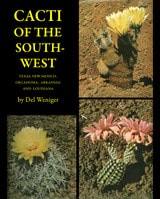
Cacti of the Southwest
Texas, New Mexico, Oklahoma, Arkansas, and LouisianaDel Weniger
University of Texas Press, 0
Del Weniger presents a beautifully illustrated account of all the cacti found in Texas, New Mexico, Oklahoma, Arkansas, and Louisiana. Cactus blossoms often rival the most exotic hothouse plants for delicate beauty. Depending upon the species, they range in color from white through almost the entire spectrum of the rainbow. Nearly every plant in the five-state area is here pictured in color, usually in full bloom.
The cactus was one of the most completely new and different plants encountered by Europeans in the Americas, and the larger species, at least, easily made their presence known to even the most unobservant passerby. To the observant the cactus in its surprising variety of forms has from the beginning exercised a strong fascination. The casual student may easily identify most specimens from these illustrations, and the more serious student will find detailed keys to all of the cacti of the area.
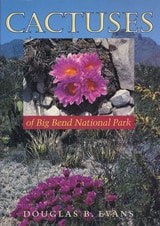
Cactuses of Big Bend National Park
By Douglas B. Evans
University of Texas Press, 1998
When the cactuses bloom in Big Bend National Park, their vivid pinks and purples, reds and yellows bring an unforgettable beauty to the rugged Chihuahuan Desert landscape. In fact, many people visit the park just see the cactus blossoms and the wildflowers. If you're one of them, this book will increase your enjoyment by helping you identify the wonders at your feet. And if you've never been to Big Bend when the cactuses are blooming, you'll discover here what you've been missing.
Douglas B. Evans describes twelve kinds of cactus—living rock, topflower, stout-spined, hedgehog, pineapple, button, barrel, fishhook, nipple, chollas and pricklypears, and Texas nipple—and their individual species known to occur in the park. Color photographs taken by Doris Evans and Ro Wauer accompany the species descriptions. As you hike or drive through the park, you can identify most of the cactuses you see simply by leafing through these splendid pictures and then checking the descriptions, which indicate the cactuses' characteristic features and habitat.
To make the book even more useful, Evans also briefly defines the parts of a cactus, explains how scientific names work, and offers a quick introduction to the geography and ecology of Big Bend National Park and the Chihuahuan Desert. With this information, you'll enjoy not only seeing the cactuses of the Big Bend but also being able to tell one from another and knowing just what makes each one special.
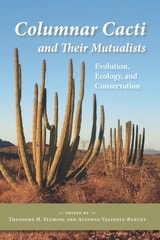
Columnar Cacti and Their Mutualists
Evolution, Ecology, and ConservationEdited by Theodore H. Fleming and Alfonso Valiente-Banuet
University of Arizona Press, 2002
This book summarizes our current knowledge about the ecology, evolution, and conservation of columnar cacti and their vertebrate mutualists to show that the very survival of these cacti depends on animals who pollinate them and disperse their seeds. Contributors from the United States, Mexico, Venezuela, and Colombia explore aspects of geology and evolution that have forged this relationship, review findings in anatomy and physiology, and discuss recent research in population and community ecology as well as conservation issues. Ranging from the Sonoran Desert to the northern Andes, these studies reflect recent progress in understanding how abiotic and biotic factors interact to influence the evolution, distribution, and abundance of cacti and mutualists alike.
In addition, this book examines the ways in which humans, through the process of domestication, have modified these plants for economic benefit. The contributors also review phylogenetic relationships between cacti and nectar-feeding bats in an effort to understand how bat-plant interactions have influenced the evolution of diversity and ecological specialization of both. Because of the number of migratory pollinators feeding on columnar cacti, the authors make conservation recommendations aimed at preserving fully functional ecosystems in arid portions of the New World tropics and subtropics.
No other book treats the pollination ecology of cacti in such depth or offers such a wealth of up-to-date material on the nectar-feeding bats of the New World. As scientists become increasingly concerned with the need to protect biotic interactions, Columnar Cacti and Their Mutualists provides a benchmark for both conservation efforts and future research.
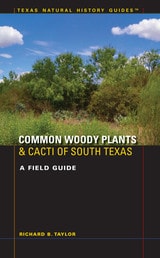
Common Woody Plants and Cacti of South Texas
A Field GuideBy Richard B. Taylor with Texas Parks & Wildlife Department
University of Texas Press, 2014
Woody plants and cacti are vital staple foods for cattle, deer, and other wildlife in drought-prone South Texas. Ranchers, hunters, and land managers who need to identify these plants relied on A Field Guide to Common South Texas Shrubs (published by Texas Parks & Wildlife Press and distributed by UT Press), which is no longer in print. Responding to ongoing demand for the book, Richard B. Taylor has completely updated and expanded it with seven new species, new photographs, and a quick plant identification key.
Common Woody Plants and Cacti of South Texas is an easy-to-use plant identification field guide to fifty species that comprise an estimated 90 percent of the region’s woody canopy cover north of the Rio Grande Valley. The species accounts include photographs, descriptions, values to livestock and wildlife, and nutritional information. The book also provides historical perspectives and information on brush management techniques and strategies, as well as habitat appraisal. All of these resources will enable readers to analyze stocking rates for deer and cattle, evaluate a prospective hunting lease, or buy property.
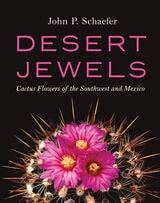
Desert Jewels
Cactus Flowers of the Southwest and MexicoJohn P. Schaefer
University of Arizona Press, 2023
Stunning up-close images by a renowned desert photographer
Cactus flowers are jewels of the desert—they add brilliant pops of color to our arid surroundings. In this book, renowned Tucson photographer John P. Schaefer brings the exquisite and unexpected beauty of the cactus flower to the page. Hundreds of close-up photographs of cactus flowers native to the U.S. Southwest and Mexico offer a visual feast of color and texture, nuance and light.
These stunning photographs allow us to appreciate the spectacular range of color and form cactus flowers have to offer. For the cactus enthusiast, the book offers a comprehensive collection of high-quality flower photographs unlike any other. The photographs cover more than 250 cactus species organized by genus. The book starts with an introduction by the photographer that is both autobiographical and informative. It offers a glimpse into his process for capturing these elusive desert gems, resulting in photographs so beautiful they were featured as a book of stamps issued by the U.S. Postal Service.
This collection of cactus flowers in bloom is a one-of-a-kind work by a master photographer.
No Species Is an Island
Bats, Cacti, and Secrets of the Sonoran DesertTheodore H. Fleming; Illustrations by Kim Kanoa Duffek
University of Arizona Press, 2017
The Sonoran Desert is the most biologically diverse desert in the world. Four species of columnar cacti, including the iconic saguaro and organ pipe, are among its most conspicuous plants. No Species Is an Island describes Theodore H. Fleming’s eleven-year study of the pollination biology of these species at a site he named Tortilla Flats in Sonora, Mexico, near Kino Bay.
Now Fleming shares the surprising results of his intriguing work. Among the novel findings are one of the world’s rarest plant-breeding systems in a giant cactus; the ability of the organ pipe cactus to produce fruit with another species’ pollen; the highly specialized moth-cactus pollination system of the senita cactus; and the amazing lifestyle of the lesser long-nosed bat, the major nocturnal pollinator of three of these species.
These discoveries serve as a primer on how to conduct ecological research, and they offer important conservation lessons for us all. Fleming highlights the preciousness of the ecological web of our planet—Tortilla Flats is a place where cacti and migratory bats and birds connect such far-flung habitats as Mexico’s tropical dry forest, the Sonoran Desert, and the temperate rain forests of southeastern Alaska. Fleming offers an insightful look at how field ecologists work and at the often big surprises that come from looking carefully at a natural world where no species stands alone.
Quicksand and Cactus
Juanita Brooks
Utah State University Press, 1992
The Cactus Hunters
Desire and Extinction in the Illicit Succulent TradeJared D. Margulies
University of Minnesota Press, 2023
An exploration of the explosive illegal trade in succulents and the passion that drives it
Cacti and succulents are phenomenally popular worldwide among plant enthusiasts, despite being among the world’s most threatened species. The fervor driving the illegal trade in succulents might also be driving some species to extinction. Delving into the strange world of succulent collecting, The Cactus Hunters takes us to the heart of this conundrum: the mystery of how and why ardent lovers of these plants engage in their illicit trade. This is a world of alluring desires, where collectors and conservationists alike are animated by passions that at times exceed the limits of law.
What inspires the desire for a plant? What kind of satisfaction does it promise? The answer, Jared D. Margulies suspects, might be traced through the roots and workings of the illegal succulent trade—an exploration that traverses the fields of botany and criminology, political ecology and human geography, and psychoanalysis. His globe-spanning inquiry leads Margulies from a spectacular series of succulent heists on a small island off the coast of Mexico to California law enforcement agents infiltrating a smuggling ring in South Korea, from scientists racing to discover new and rare species before poachers find them to a notorious Czech “cacto-explorer” who helped turn a landlocked European country into the epicenter of the illegal succulent trade.
A heady blend of international intrigue, social theory, botanical lore, and ecological study, The Cactus Hunters offers complex insight into species extinction, conservation, and more-than-human care.
Retail e-book files for this title are screen-reader friendly with images accompanied by short alt text and/or extended descriptions.
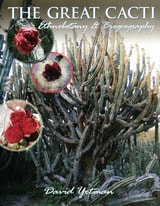
The Great Cacti
Ethnobotany and BiogeographyDavid Yetman
University of Arizona Press, 2007
Yetman has been fascinated by columnar cacti for most of his life and now brings years of study and reflection to a wide-ranging and handsomely illustrated book. Drawing on his close association with the Guarijíos, Mayos, and Seris of Mexico—peoples for whom such cacti have been indispensable to survival—he offers surprising evidence of the importance of these plants in human cultures. The Great Cacti reviews the more than one hundred species of columnar cacti, with detailed discussions of some 75 that have been the most beneficial to humans or are most spectacular. Focusing particularly on northwestern Mexico and the southwestern United States, Yetman examines the role of each species in human society, describing how cacti have provided food, shelter, medicine, even religiously significant hallucinogens.
Taking readers to the exotic sites where these cacti are found—from sea-level deserts to frigid Andean heights—Yetman shows that the great cacti have facilitated the development of native culture in hostile environments, yielding their products with no tending necessary. Enhanced by over 300 superb color photos, The Great Cacti is both a personal and scientific overview of sahuesos, soberbios, and other towering flora that flourish where few other plants grow—and that foster human life in otherwise impossible places.
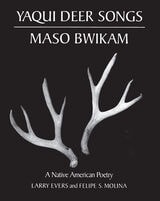
Yaqui Deer Songs/Maso Bwikam
A Native American PoetryLarry Evers and Felipe S. Molina
University of Arizona Press, 1987
Yaqui regard song as a kind of lingua franca of the intelligent universe. It is through song that experience with other living things is made intelligible and accessible to the human community. Deer songs often take the form of dialogues in which the deer and others in the wilderness world speak with one another or with the deer singers themselves. It is in this way, according to one deer singer, that “the wilderness world listens to itself even today.”
In this book authentic ceremonial songs, transcribed in both Yaqui and English, are the center of a fascinating discussion of the Deer Song tradition in Yaqui culture. Yaqui Deer Songs/Maso Bwikam thus enables non-Yaquis to hear these dialogues with the wilderness world for the first time.