Results by title
6 books match the query 'Caesar'
Baetica Felix
People and Prosperity in Southern Spain from Caesar to Septimius SeverusBy Evan W. Haley
University of Texas Press, 2003
Baetica, the present-day region of Andalusia in southern Spain, was the wealthiest province of the Roman Empire. Its society was dynamic and marked by upward social and economic mobility, as the imperial peace allowed the emergence of a substantial middle social and economic stratum. Indeed, so mutually beneficial was the imposition of Roman rule on the local population of Baetica that it demands a new understanding of the relationship between Imperial Rome and its provinces.
Baetica Felix builds a new model of Roman-provincial relations through a socio-economic history of the province from Julius Caesar to the end of the second century A.D. Describing and analyzing the impact of Roman rule on a core province, Evan Haley addresses two broad questions: what effect did Roman rule have on patterns of settlement and production in Baetica, and how did it contribute to wealth generation and social mobility? His findings conclusively demonstrate that meeting the multiple demands of the Roman state created a substantial freeborn and ex-slave "middle stratum" of the population that outnumbered both the super-rich elite and the destitute poor.
Caesar in Gaul and Rome
War in WordsBy Andrew M. Riggsby
University of Texas Press, 2006
Winner, AAP/PSP Award for Excellence, Classics and Ancient History, 2006
Anyone who has even a passing acquaintance with Latin knows "Gallia est omnis divisa in partes tres" ("All Gaul is divided into three parts"), the opening line of De Bello Gallico, Julius Caesar's famous commentary on his campaigns against the Gauls in the 50s BC. But what did Caesar intend to accomplish by writing and publishing his commentaries, how did he go about it, and what potentially unforeseen consequences did his writing have? These are the questions that Andrew Riggsby pursues in this fresh interpretation of one of the masterworks of Latin prose.
Riggsby uses contemporary literary methods to examine the historical impact that the commentaries had on the Roman reading public. In the first part of his study, Riggsby considers how Caesar defined Roman identity and its relationship to non-Roman others. He shows how Caesar opens up a possible vision of the political future in which the distinction between Roman and non-Roman becomes less important because of their joint submission to a Caesar-like leader. In the second part, Riggsby analyzes Caesar's political self-fashioning and the potential effects of his writing and publishing the Gallic War. He reveals how Caesar presents himself as a subtly new kind of Roman general who deserves credit not only for his own virtues, but for those of his soldiers as well. Riggsby uses case studies of key topics (spatial representation, ethnography, virtus and technology, genre, and the just war), augmented by more synthetic discussions that bring in evidence from other Roman and Greek texts, to offer a broad picture of the themes of national identity and Caesar's self-presentation.
Caesar
A Life in Western CultureMaria Wyke
University of Chicago Press, 2008
God and Caesar
Selected Essays on Religion, Politics, & SocietyGeorge Pell
Catholic University of America Press, 2007
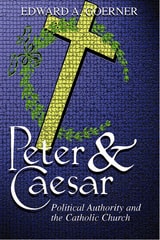
Peter and Caesar
Political Authority and the Catholic ChurchEdward A. Goerner
St. Augustine's Press, 2020
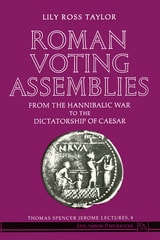
Roman Voting Assemblies
From the Hannibalic War to the Dictatorship of CaesarLily Ross Taylor
University of Michigan Press, 1991