Results by title
7 books match the query 'Cairo (Egypt)'
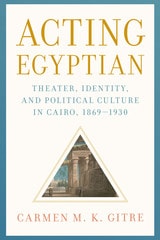
Acting Egyptian
Theater, Identity, and Political Culture in Cairo, 1869–1930By Carmen M. K. Gitre
University of Texas Press, 2019
In the late nineteenth and early twentieth centuries, during the “protectorate” period of British occupation in Egypt—theaters and other performance sites were vital for imagining, mirroring, debating, and shaping competing conceptions of modern Egyptian identity. Central figures in this diverse spectrum were the effendis, an emerging class of urban, male, anticolonial professionals whose role would ultimately become dominant. Acting Egyptian argues that performance themes, spaces, actors, and audiences allowed pluralism to take center stage while simultaneously consolidating effendi voices.
From the world premiere of Verdi’s Aida at Cairo’s Khedivial Opera House in 1871 to the theatrical rhetoric surrounding the revolution of 1919, which gave women an opportunity to link their visibility to the well-being of the nation, Acting Egyptian examines the ways in which elites and effendis, men and women, used newly built performance spaces to debate morality, politics, and the implications of modernity. Drawing on scripts, playbills, ads, and numerous other sources, the book brings to life provocative debates that fostered a new image of national culture and performances that echoed the events of urban life in the struggle for independence.
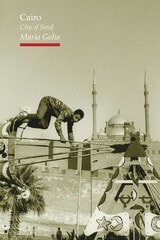
Cairo
City of SandMaria Golia
Reaktion Books, 2004
Cairo steps inside the interactions between Cairenes, examining the roles of family, tradition and bureaucracy in everyday life. The book explores Cairo's relationship with its "others", from the French and British occupations to modern influences like tourism and consumerism. Cairo also discusses characteristic styles of communication, and linguistic mêmes, including slang, grandiloquence, curses and jokes.
Cairo exists by virtue of these interactions, synergies of necessity, creativity and the presence or absence of power. Cairo: City of Sand reveals a peerless balancing act, and transmits the city's overriding message: the breadth of the human capacity for loss, astonishment and delight.
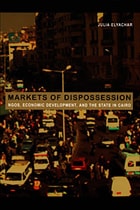
Markets of Dispossession
NGOs, Economic Development, and the State in CairoJulia Elyachar
Duke University Press, 2005
Julia Elyachar studied the efforts of bankers, social scientists, ngo members, development workers, and state officials to turn the craftsmen and unemployed youth of Cairo into the vanguard of a new market society based on microenterprise. She considers these efforts in relation to the alternative notions of economic success held by craftsmen in Cairo, in which short-term financial profit is not always highly valued. Through her careful ethnography of workshop life, Elyachar explains how the traditional market practices of craftsmen are among the most vibrant modes of market life in Egypt. Long condemned as backward, these existing market practices have been seized on by social scientists and development institutions as the raw materials for experiments in “free market” expansion. Elyachar argues that the new economic value accorded to the cultural resources and social networks of the poor has fueled a broader process leading to their economic, social, and cultural dispossession.
On the Semicivilized
Coloniality, Finance, and Embodied Sovereignty in CairoJulia Elyachar
Duke University Press, 2025
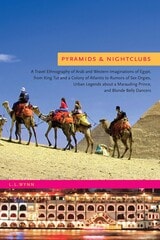
Pyramids and Nightclubs
A Travel Ethnography of Arab and Western Imaginations of Egypt, from King Tut and a Colony of Atlantis to Rumors of Sex Orgies, Urban Legends about a Marauding Prince, and Blonde Belly DancersBy L. L. Wynn
University of Texas Press, 2007
2008 — Leeds Honor Book in Urban Anthropology – Society for Urban, National, and Transnational/Global Anthropology
Living in Egypt at the turn of the millennium, cultural anthropologist L. L. Wynn was struck by the juxtapositions of Western, Gulf Arab, and Egyptian viewpoints she encountered. For some, Egypt is the land of mummies and pharaohs. For others, it is a vortex of decadence, where nightlife promises a chance to salivate over belly dancers and maybe even glimpse a movie star. Offering a new approach to ethnography, Pyramids and Nightclubs examines cross-cultural encounters to bring to light the counterintuitive ways in which Egypt is defined.
Guiding readers on an armchair journey that introduces us to Russian and Australian belly dancers on Nile cruise ships, Egyptian rumors about an Arab prince and his royal entourage, Saudi girls looking for a less restrictive dating scene, and other visitors to this "antique" land, Wynn uses the lens of travel and tourism to depict a fascinating and often surprising version of Egypt, while exploring the concept of stereotype itself. Tracing the history of Western and Arab fascination with Egypt through spurious hunts for lost civilizations and the new economic disparities brought about by the oil industry, Pyramids and Nightclubs ultimately describes the ways in which moments of cultural contact, driven by tourism and labor migration, become eye-opening opportunities for defining self and other.
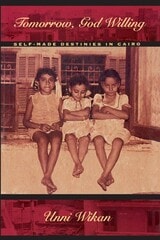
Tomorrow, God Willing
Self-made Destinies in CairoUnni Wikan
University of Chicago Press, 1996
Umm Ali's story is amazing not only for what it reveals about her resourcefulness but for the light it sheds on the resilience of Cairo's poor in the face of disastrous poverty. Like countless other poor people in Cairo, she has developed a personal buoyancy to cope with relentless economic need. It stems from a belief in the ability of people to shape their own destiny and helps explain why Cairo remains virtually free of the social ills—violent street crime and homelessness—that have eroded the lives of poor people in other major cities.
Unni Wikan first met Umm Ali and her family twenty-five years ago and has returned almost every year. She draws on her firsthand experience of their lives to create an intimate portrait of Cairo's back streets and the people who live there. Wikan's innovative approach to ethnographic writing reads like a novel that presents the experiences of Umm Ali's family and neighbors in their own words.
As Umm Ali recounts triumphs and defeats—from forming a savings club with neighbors to the gradual drifting away and eventual return of her husband—she unveils a deeply reflective attitude and her unwavering belief that she can improve her situation. Showing how Egyptian culture interprets poverty and family, this book attests to the capacity of an individual's self-worth to withstand incredible adversity.
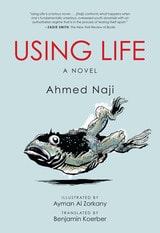
Using Life
By Ahmed Naji, Illustrations by Ayman Al Zorkany, Translated by Benjamin Koerber
University of Texas Press, 2017
Upon its initial release in Arabic in the fall of 2014, Using Life received acclaim in Egypt and the wider Arab world. But in 2016, Ahmed Naji was sentenced to two years in prison after a reader complained that an excerpt published in a literary journal harmed public morality. His imprisonment marks the first time in modern Egypt that an author has been jailed for a work of literature. Writers and literary organizations around the world rallied to support Naji, and he was released in December 2016. His original conviction was overturned in May 2017 but, at the time of printing, he is awaiting retrial and banned from leaving Egypt.
Set in modern-day Cairo, Using Life follows a young filmmaker, Bassam Bahgat, after a secret society hires him to create a series of documentary films about the urban planning and architecture of Cairo. The plot in which Bassam finds himself ensnared unfolds in the novel’s unique mix of text and black-and-white illustrations.
The Society of Urbanists, Bassam discovers, is responsible for centuries of world-wide conspiracies that have shaped political regimes, geographical boundaries, reigning ideologies, and religions. It is responsible for today’s Cairo, and for everywhere else, too. Yet its methods are subtle and indirect: it operates primarily through manipulating urban architecture, rather than brute force. As Bassam immerses himself in the Society and its shadowy figures, he finds Cairo on the brink of a planned apocalypse, designed to wipe out the whole city and rebuild anew.