Results by title
7 books match the query 'Calculus'
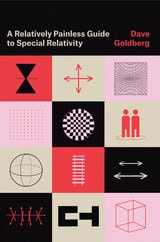
A Relatively Painless Guide to Special Relativity
Dave Goldberg
University of Chicago Press, 2023
Special relativity challenges one’s physical intuition of space, time, matter, and energy in a way that few other topics in physics do. Yet the subject is often treated as an extra in undergraduate courses—something to be picked up in a few random lectures and presented as a combination of geometric and logical puzzles (seemingly with the premise of getting the novice student to concede that Einstein was a genius and that the universe is weird). But special relativity is absolutely fundamental to modern physics. It is the canvas on which electromagnetism, particle physics, field theory, and ultimately general relativity are based. For physics students, developing a relativistic intuition isn’t just a luxury: it’s a requirement.
Physicist and popular author Dave Goldberg provides a rigorous but conversational introduction to fill this void in spacetime education. Employing the standard calculus a sophomore or junior university student in science, engineering, or computer science will have encountered, Goldberg connects relativity to a student’s work ahead, acquainting them with topics like tensors, the development of new physical theories, and how relativity directly relates to other disciplines. But more than this, Goldberg welcomes lifelong learners who may have encountered special relativity in popular accounts, but are seeking a mathematical challenge to understand an elegant physical theory.
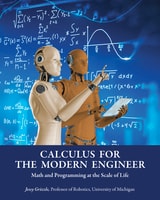
Calculus for the Modern Engineer
Math and Programming at the Scale of LifeJessy Grizzle
Michigan Publishing Services, 2026
In the ever-evolving landscape of engineering education, calculus stands as a foundational pillar, yet its teaching methods have remained largely unchanged for decades. This textbook is born out of a deep-seated need for reform. Traditional calculus courses struggle to incorporate relevant, real-world examples. The disconnect between mathematical theory and its real-world uses hinders the learning process and fails to fully engage students in the practical applications of calculus. A second core issue lies not in the examples used but in the selection of material and the overemphasis on lengthy, manual calculations that lack meaningful context. This book represents a radical departure from conventional approaches, inspired by Prof. Grizzle’s experience developing and teaching the first-semester course ROB 101 Computational Linear Algebra. Its goal is to breathe life into mathematics through programming and realistic examples. It begins by placing integration at the beginning of the learning process, starting with sums and progressing to integration, which is not only more intuitive but also lends itself well to programming applications, such as calculating the change in position of mobile robots from velocity curves. Following integration, the book delves into differentiation (both single-variable and multivariable) and its myriad applications. Traditional methods of computing integrals, such as antiderivatives and substitution methods, are then introduced and framed within the context of both manual calculations and modern symbolic tools. The journey continues through improper integrals, ordinary differential equations (ODEs), Laplace Transforms, and Feedback Control, encompassing a breadth of topics rarely seen in a single calculus course.
Economics and Politics
The Calculus of SupportHelmut Norpoth, Michael S. Lewis-Beck, and Jean-Dominique Lafay, Editors
University of Michigan Press, 1991
Fuchsian Groups
Svetlana Katok
University of Chicago Press, 1992
Several Complex Variables
Raghavan Narasimhan
University of Chicago Press, 1974

Systems of Linear Inequalities
A. S. Solodovnikov
University of Chicago Press, 1980
The Calculus
A Genetic ApproachOtto Toeplitz
University of Chicago Press, 2007
When first published posthumously in 1963, this bookpresented a radically different approach to the teaching of calculus. In sharp contrast to the methods of his time, Otto Toeplitz did not teach calculus as a static system of techniques and facts to be memorized. Instead, he drew on his knowledge of the history of mathematics and presented calculus as an organic evolution of ideas beginning with the discoveries of Greek scholars, such as Archimedes, Pythagoras, and Euclid, and developing through the centuries in the work of Kepler, Galileo, Fermat, Newton, and Leibniz. Through this unique approach, Toeplitz summarized and elucidated the major mathematical advances that contributed to modern calculus.
Reissued for the first time since 1981 and updated with a new foreword, this classic text in the field of mathematics is experiencing a resurgence of interest among students and educators of calculus today.