Results by title
5 books match the query 'Calendar'
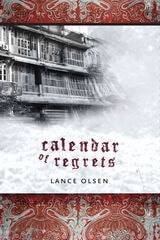
Calendar of Regrets
Lance Olsen
University of Alabama Press, 2010
The poisoning of the painter Hieronymus Bosch; anchorman Dan Rather’s mysterious mugging on Park Avenue as he strolls home alone one October evening; a series of postcard meditations on the idea of travel from a young American journalist visiting Burma; a husband-and-wife team of fundamentalist Christian suicide bombers; the myth of Iphigenia from Agamemnon’s daughter’s point of view—these and other stories form a mosaic, connected through a pattern of musical motifs, transposed scenes, and recurring characters. It is a narrative about narrativity itself, the human obsession with telling ourselves and our worlds over and over again in an attempt to stabilize a truth that, as Nabokov once said, should only exist within quotation marks.
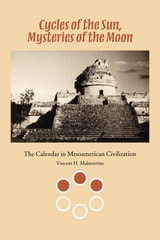
Cycles of the Sun, Mysteries of the Moon
The Calendar in Mesoamerican CivilizationBy Vincent H. Malmström
University of Texas Press, 1996
The simple question "How did the Maya come up with a calendar that had only 260 days?" led Vincent Malmström to discover an unexpected "hearth" of Mesoamerican culture. In this boldly revisionist book, he sets forth his challenging, new view of the origin and diffusion of Mesoamerican calendrical systems—the intellectual achievement that gave rise to Mesoamerican civilization and culture.
Malmström posits that the 260-day calendar marked the interval between passages of the sun at its zenith over Izapa, an ancient ceremonial center in the Soconusco region of Mexico's Pacific coastal plain. He goes on to show how the calendar developed by the Zoque people of the region in the fourteenth century B.C. gradually diffused through Mesoamerica into the so-called "Olmec metropolitan area" of the Gulf coast and beyond to the Maya in the east and to the plateau of Mexico in the west.
These findings challenge our previous understanding of the origin and diffusion of Mesoamerican civilization. Sure to provoke lively debate in many quarters, this book will be important reading for all students of ancient Mesoamerica—anthropologists, archaeologists, archaeoastronomers, geographers, and the growing public fascinated by all things Maya.
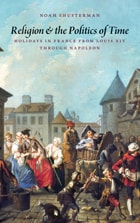
Religion and the Politics of Time
Noah Shusterman
Catholic University of America Press, 2010

The London Stage, 1660-1800 Part 5, 1776-1800
A Calendar of Plays, Entertainment & Afterpieces Together with Casts, Box-Reciepts and ContemporaryEdited by Charles Beecher Hogan, William Van Lennep, Emmett L. Avery, Arthur H.Scouten, George Winchester Stone
Southern Illinois University Press, 1970

The Ordering of Time
From the Ancient Computus to the Modern ComputerArno Borst
University of Chicago Press, 1993
Arno Borst examines the various ways that time has been calculated by numbers and measured by instruments over several centuries, from the computus—an ancient method of determining times and dates—to the present-day computer. In a wide-ranging discussion, he analyzes the classical Greek concepts of divine, natural, and human time; the universal time of ancient Rome; the Easter cycle of the Middle Ages; the development of the mechanical clock in the fourteenth and fifteenth centuries; early modern chronology; and twentieth-century data processing.
Borst argues that although many centuries and countless different instruments—sundials, horologia, abaci, astrolabes, calendars, and calculating machines—separate the medieval computus from the modern computer, each generation has had to answer the same question: how can we make the best use of our available time to improve our lives? The computer, he suggests, is merely a new instrument employed for an ancient purpose.
Lively and accessible, The Ordering of Time will be welcomed by students and researchers in social and cultural history, the history of science and mathematics, as well as anyone interested in the history of time and numbers.