Results by title
7 books match the query 'Calhoun, Craig'
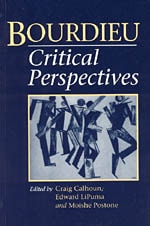
Bourdieu
Critical PerspectivesEdited by Craig Calhoun, Edward LiPuma, and Moishe Postone
University of Chicago Press, 1993
American reception of his works, however, has lacked a full understanding of their place within the broad context of French human science. His individual works separated by distinct boundaries between social science fields in American academia, Bourdieu's cohesive thought has come to this country in fragments.
Bourdieu: Critical Perspectives provides a unified and balanced appraisal of Bourdieu's varied works by both proponents and skeptics. The essays are written from the varied viewpoints of cultural anthropology, ethnomethodology and other varieties of sociology, existential and Wittgensteinian philosophies, linguistics, media studies, and feminism. They work around three main themes: Bourdieu's effort to transcend gaps between practical knowledge and universal structures, his central concept of "reflexivity," and the relations between social structure, systems of classification, and language.
Ultimately, the contributors raise a variety of crucial theoretical questions and address problems that are important not only to understanding Bourdieu but to advancing empirical work of the kind he has pioneered. In an essay written especially for this volume, Bourdieu describes his own "mode of intellectual production" and the reasons he sees for its common misunderstanding.
The contributors are Hubert Dreyfus, Paul Rabinow, Charles Taylor, Aaron Cicourel, James Collins, William Hanks, Beate Krais, Nicholas Garnham, Scott Lash, Roger Brubaker, and Loic Wacquant, and the editors.
Hannah Arendt and the Meaning of Politics
Craig Calhoun
University of Minnesota Press, 1997
Eminent contributors consider what Hannah Arendt means in today’s public debates.
Is politics really nothing more than power relations, competing interests and claims for recognition, conflicting assertions of “simple” truths? No thinker has argued more passionately against this narrow view than Hannah Arendt, and no one has more to say to those who bring questions of meaning, identity, value, and transcendence to our impoverished public life. This volume brings leading figures in philosophy, political theory, intellectual history, and literary theory into a dialogue about Arendt’s work and its significance for today’s fractious identity politics, public ethics, and civic life.
For each essay—on the fate of politics in a postmodern, post-Marxist era; on the connection of nonfoundationalist ethics and epistemology to democracy; on the conditions conducive to a vital public sphere; on the recalcitrant problems of violence and evil—the volume includes extended responses, and a concluding essay by Martin Jay responding to all the others. Ranging from feminism to aesthetics to the discourse of democracy, the essays explore how an encounter with Arendt reconfigures, disrupts, and revitalizes what passes for public debate in our day. Together they forcefully demonstrate the power of Arendt’s work as a splendid provocation and a living resource.Contributors: Richard Bernstein, New School; Anthony Cascardi, U of California, Berkeley; Susan Bickford, U of North Carolina; Kim Curtis, Duke U; Lisa Disch, U of Minnesota; Nancy Fraser, New School; Martin Jay; U of California, Berkeley, Steven Leonard, U of North Carolina; Kirstie McClure, Johns Hopkins U; Dana Villa, Amherst College; and Eli Zaretsky, U of Missouri.
Internationalism and Its Betrayal
Micheline R. IshayForeword by Craig Calhoun
University of Minnesota Press, 1995
Internationalism and Its Betrayal was first published in 1995. Minnesota Archive Editions uses digital technology to make long-unavailable books once again accessible, and are published unaltered from the original University of Minnesota Press editions.
A new world order, proclaimed Western leaders after the cold war, could extend liberal democracy and human rights around the globe. Yet the specter of nationalism once again haunts the world, threatening to extinguish the spirit of internationalism.
Although internationalism is typically understood to be diametrically opposed to nationalism, Micheline Ishay argues to the contrary, maintaining that internationalism often incorporates an individualist element that manifests itself as nationalism during critical periods such as war. For example, the new liberal internationalism invoked after the cold war is now revealing its limits-as reflected by the UN's inability to interfere promptly to stop ethnic and nationalist conflicts in Bosnia, Rwanda, and elsewhere.
Internationalism and Its Betrayal explores the tensions and contradictions between ideas of nationalism and internationalism, focusing on the major political thinkers from the early modern period into the nineteenth century. Ishay examines the writings of Vico, Grotius, Rousseau, Kant, Paine, Robespierre, Burke, Fichte, de Maistre, and Hegel. She speaks to an audience of individuals interested in the spread of democracy, students of human rights and international relations, historians of the French Revolution, and political theorists.
Multicultural Politics
Racism, Ethnicity, and Muslims in BritainTariq Modood
University of Minnesota Press, 2005
Nationalism
Craig Calhoun
University of Minnesota Press, 1998
Sociology in America
A HistoryEdited by Craig Calhoun
University of Chicago Press, 2007
Though the word “sociology” was coined in Europe, the field of sociology grew most dramatically in America. Despite that disproportionate influence, American sociology has never been the subject of an extended historical examination. To remedy that situation—and to celebrate the centennial of the American Sociological Association—Craig Calhoun assembled a team of leading sociologists to produce Sociology in America.
Rather than a story of great sociologists or departments, Sociology in America is a true history of an often disparate field—and a deeply considered look at the ways sociology developed intellectually and institutionally. It explores the growth of American sociology as it addressed changes and challenges throughout the twentieth century, covering topics ranging from the discipline’s intellectual roots to understandings (and misunderstandings) of race and gender to the impact of the Depression and the 1960s.
Sociology in America will stand as the definitive treatment of the contribution of twentieth-century American sociology and will be required reading for all sociologists.
Contributors:
Andrew Abbott, Daniel Breslau, Craig Calhoun, Charles Camic, Miguel A. Centeno, Patricia Hill Collins, Marjorie L. DeVault, Myra Marx Ferree, Neil Gross, Lorine A. Hughes, Michael D. Kennedy, Shamus Khan, Barbara Laslett, Patricia Lengermann, Doug McAdam, Shauna A. Morimoto, Aldon Morris, Gillian Niebrugge, Alton Phillips, James F. Short Jr., Alan Sica, James T. Sparrow, George Steinmetz, Stephen Turner, Jonathan VanAntwerpen, Immanuel Wallerstein, Pamela Barnhouse Walters, Howard Winant
The Roots of Radicalism
Tradition, the Public Sphere, and Early Nineteenth-Century Social MovementsCraig Calhoun
University of Chicago Press, 2012