Results by title
5 books match the query 'California, Northern'
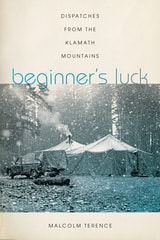
Beginner's Luck
Dispatches from the Klamath MountainsMalcolm Terence
Oregon State University Press, 2018
In the late 1960s, Malcolm Terence left his job as a reporter for the Los Angeles Times to look for adventure and may have found more than he bargained for. The era had triggered unprecedented social and political changes in America, tectonic shifts that challenged war and the social order that oppressed people along lines of class, gender, and race. One branch was a back-to-the-land movement, and Terence, who had just traveled for a year managing a rock band, strayed into Black Bear Ranch, a commune just starting in a remote corner of the Klamath Mountains near the California-Oregon border.
Black Bear Ranch still exists, but many of its early residents eventually returned to urban civilization. A few, Terence among them, stayed on in neighboring river towns. Some tried logging, others gold mining, and some tried growing marijuana, all with mixed success. The local mining and timber communities had a checkered opinion of their new hippie neighbors, as did the Native tribes, but it was the kind of place where people helped each other out, even if they didn’t always agree.
When wildfires grew large, Terence and other veterans of the commune joined the fire crews run by the US Forest Service. In between, the Black Bear expats built homesteads, planted gardens, delivered babies, and raised their children. They gradually overcame the skepticism of the locals and joined them in political battles against the use of herbicides in the forest and the Forest Service’s campaign to close all the mining claims. As in the best of organizing efforts, the organizers learned as much as they led.
Beginner’s Luck will appeal to anyone who experienced life on a commune in the 1960s–1970s or who wants to learn about this chapter in modern American history. Terence offers insight into environmental activism and the long history of conflict between resource exploitation and Native American rights without lecturing or pontificating. With wit, humor, and humility, his anecdotal essays chronicle a time and place where disparate people came together to form an unlikely community.
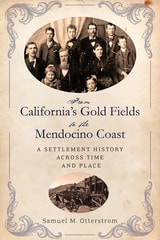
From California's Gold Fields to the Mendocino Coast
A Settlement History Across Time and PlaceSamuel M. Otterstrom
University of Nevada Press, 2017
The development of San Francisco’s outlying region from a wilderness into a prosperous village and farming mecca shows how quickly in-migration coupled with economic diversification can establish a stable settlement structure upon the landscape. Otterstrom describes an intricately woven tapestry of interrelated people who were contributing creators of a wide variety of prosperous northern California environs. He uncovers the processes that converted this sleepy post-Mexican outpost into a focal point of nearly hyperactive youthful growth. The narrative follows this crucial story of settlement development until the dawn of the twentieth century, through the interconnected framework of individual and family ingenuity, migration trajectories, and diverse geographical scales.
Multiplying individualistic experiences from across far-flung appendages of the Northern California system into larger and larger scales, Otterstrom has achieved a matchless historical and sociological study that will form the basis for any future studies of the area.
From Counterculture to Cyberculture
Stewart Brand, the Whole Earth Network, and the Rise of Digital UtopianismFred Turner
University of Chicago Press, 2006
In the early 1960s, computers haunted the American popular imagination. Bleak tools of the cold war, they embodied the rigid organization and mechanical conformity that made the military-industrial complex possible. But by the 1990s—and the dawn of the Internet—computers started to represent a very different kind of world: a collaborative and digital utopia modeled on the communal ideals of the hippies who so vehemently rebelled against the cold war establishment in the first place.
From Counterculture to Cyberculture is the first book to explore this extraordinary and ironic transformation. Fred Turner here traces the previously untold story of a highly influential group of San Francisco Bay–area entrepreneurs: Stewart Brand and the Whole Earth network. Between 1968 and 1998, via such familiar venues as the National Book Award–winning Whole Earth Catalog, the computer conferencing system known as WELL, and, ultimately, the launch of the wildly successful Wired magazine, Brand and his colleagues brokered a long-running collaboration between San Francisco flower power and the emerging technological hub of Silicon Valley. Thanks to their vision, counterculturalists and technologists alike joined together to reimagine computers as tools for personal liberation, the building of virtual and decidedly alternative communities, and the exploration of bold new social frontiers.
Shedding new light on how our networked culture came to be, this fascinating book reminds us that the distance between the Grateful Dead and Google, between Ken Kesey and the computer itself, is not as great as we might think.

One Shot for Gold
Developing a Modern Mine in Northern CaliforniaEleanor Herz Swent
University of Nevada Press, 2021
An account of the creation of a modern, environmentally sensitive mine as told by the people who developed and worked it.
In 1978, a geologist working for the Homestake Mining Company discovered gold in a remote corner of California’s Napa County. This discovery led to the establishment of California’s most productive gold mine in the twentieth century. Named the McLaughlin Mine, it produced about 3.4 million ounces of gold between 1985 and 2002. The mine was also one of the first attempts at creating a new full-scale mine in California after the advent of environmental regulations and the first to use autoclaves to extract gold from ore.
One Shot for Gold traces the history of the McLaughlin Mine and how it transformed a community and an industry. This lively and detailed account is based largely on oral history interviews with a wide range of people associated with the mine, including Homestake executives, geologists, and engineers as well as local neighbors of the mine, officials from county governments, townspeople, and environmental activists. Their narratives— supported by thorough research into mining company documents, public records, newspaper accounts, and other materials—chronicle the mine from its very beginning to its eventual end and transformation into a designated nature reserve as part of the University of California Natural Reserve System.
A mine created at the end of the twentieth century was vastly different from the mines of the Gold Rush. New regulations and concerns about the environmental, economic, and social impacts of a large mine in this remote and largely rural region of the state-required decisions at many levels. One Shot for Gold offers an engaging and accessible account of a modern gold mine and how it managed to exist in balance with the environment and the human community around it.

The Fight to Save the Redwoods
A History of the Environmental Reform, 1917–1978Susan R. Schrepfer
University of Wisconsin Press, 1983
"This is not a simple or ordinary history of a conservation crusade. Schrepfer very ably traces the changes in scientific wisdom from nineteenth-century romanticism and teleological evolutionism to more current ecological dynamism—and the influence of those intellectual developments on political history. . . . The subject is important—much broader than the title suggests—and so is the book."—American Historical Review