Results by title

3 books match the query 'Call centers'
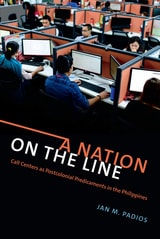
cover of A Nation on the Line: Call Centers as Postcolonial Predicaments in the Philippines

A Nation on the Line

Call Centers as Postcolonial Predicaments in the Philippines

Jan M. Padios

Duke University Press, 2018

In 2011 the Philippines surpassed India to become what the New York Times referred to as "the world's capital of call centers." By the end of 2015 the Philippine call center industry employed over one million people and generated twenty-two billion dollars in revenue. In A Nation on the Line Jan M. Padios examines this massive industry in the context of globalization, race, gender, transnationalism, and postcolonialism, outlining how it has become a significant site of efforts to redefine Filipino identity and culture, the Philippine nation-state, and the value of Filipino labor. She also chronicles the many contradictory effects of call center work on Filipino identity, family, consumer culture, and sexual politics. As Padios demonstrates, the critical question of call centers does not merely expose the logic of transnational capitalism and the legacies of colonialism; it also problematizes the process of nation-building and peoplehood in the early twenty-first century. 
[more]
cover of Answer the Call: Virtual Migration in Indian Call Centers

Answer the Call

Virtual Migration in Indian Call Centers

Aimee Carrillo Rowe

University of Minnesota Press, 2013

What happens over time to Indians who spend their working hours answering phone calls from Americans—and acting like Americans themselves? To find out, the authors of Answer the Call conducted long-term interviews with forty-five agents, trainers, managers, and CEOs at call centers in Bangalore and Mumbai from 2003 to 2012. For nine or ten hours every day, workers in call centers are not quite in India or America but rather in a state of “virtual migration.” Encouraged to steep themselves in American culture from afar, over time the agents come to internalize and indeed perform Americanness for Americans—and for each other.

Call center agents “migrate” through time and through the virtual spaces generated by voice and information sharing. Drawing from their rich interviews, the authors show that the virtual migration agents undergo has no geographically distant point of arrival, yet their perception of moving is not merely abstract. Over the duration of the job, agents’ sense of place and time changes: agents migrate but still remain, leaving them somewhere in between—between India and America, experience and imagination, class mobility and consumption, tradition and modernity, here and there, then and now, past and future.

However tangible and elastic their virtual mobility might seem in these relatively lucrative jobs, it is also suspended within the confines of the very boundaries they migrate across. Having engaged with these vivid and often poignant interviews, readers will never again be indifferent to an Indian agent’s greeting at the other end of a toll-free call: “Hello, my name is Roxanne. How may I help you?”

[more]
cover of Neutral Accent: How Language, Labor, and Life Become Global

Neutral Accent

How Language, Labor, and Life Become Global

A. Aneesh

Duke University Press, 2015

In Neutral Accent, A. Aneesh employs India's call centers as useful sites for studying global change. The horizon of global economic shift, the consequences of global integration, and the ways in which call center work "neutralizes" racial, ethnic, and national identities become visible from the confines of their cubicles. In his interviews with call service workers and in his own work in a call center in the high tech metropolis of Gurgoan, India, Aneesh observed the difficulties these workers face in bridging cultures, laws, and economies: having to speak in an accent that does not betray their ethnicity, location, or social background; learning foreign social norms; and working graveyard shifts to accommodate international customers. Call center work is cast as independent of place, space, and time, and its neutrality—which Aneesh defines as indifference to difference—has become normal business practice in a global economy. The work of call center employees in the globally integrated marketplace comes at a cost, however, as they become disconnected from the local interactions and personal relationships that make their lives anything but neutral.
[more]