Results by title
3 books match the query 'Campaign Finance Reform'
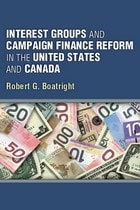
Interest Groups and Campaign Finance Reform in the United States and Canada
Robert G. Boatright
University of Michigan Press, 2011
In the early 2000s, the United States and Canada implemented new campaign finance laws restricting the ability of interest groups to make political contributions and to engage in political advertising. Whereas both nations' legislative reforms sought to reduce the role of interest groups in campaigns, these laws have had opposite results in the two nations. In the United States, interest groups remained influential by developing broad coalitions aimed at mobilizing individual voters and contributors. In Canada, interest groups largely withdrew from election campaigns, and, thus, important voices in elections have gone silent. Robert G. Boatright explains such disparate results by placing campaign finance reforms in the context of ongoing political and technological changes.
Robert G. Boatright is Associate Professor of Political Science at Clark University.
Cover photo: © iStockphoto.com / alfabravoalpharomeo
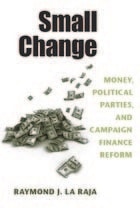
Small Change
Money, Political Parties, and Campaign Finance ReformRaymond J. La Raja
University of Michigan Press, 2010
Reformers lament that, with every effort to regulate the sources of campaign funding, candidates creatively circumvent the new legislation. But in fact, political fundraisers don't need to look for loopholes because, as Raymond J. La Raja proves, legislators intentionally design regulations to gain advantage over their partisan rivals.
La Raja traces the history of the U.S. campaign finance system from the late nineteenth century through the passage of the Bipartisan Campaign Reform Act (BCRA) of 2002. Then, using the 2004 presidential election as a case study, he compares the ways in which Democrats and Republicans adapted their national fund-raising and campaigning strategies to satisfy BCRA regulations. Drawing upon this wealth of historical and recent evidence, he concludes with recommendations for reforming campaign finance in ways that promote fair competition among candidates and guarantee their accountability to voters.
Small Change offers an engaging account of campaign finance reforms' contradictory history; it is a must-read for anyone concerned about influence of money on democratic elections.
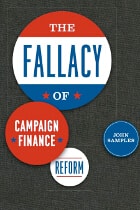
The Fallacy of Campaign Finance Reform
John Samples
University of Chicago Press, 2006
At first glance, campaign finance reform looks like a good idea. McCain-Feingold, for instance, regulates campaigns by prohibiting national political parties from accepting soft money contributions from corporations, labor unions, and wealthy individuals. But are such measures, or any of the numerous and similarly restrictive proposals that have circulated through Washington in recent years, really good for our democracy?
John Samples says no, and here he takes a penetrating look into the premises and consequences of the long crusade against big money in politics. How many Americans, he asks, know that there is little to no evidence that campaign contributions really influence members of Congress? Or that so-called negative political advertising actually improves the democratic process by increasing voter turnout and knowledge? Or that limits on campaign contributions make it harder to run for office, thereby protecting incumbent representatives from losing their seats of power?
Posing tough questions such as these, Samples uncovers numerous fallacies beneath proposals for campaign finance reform. He argues that our most common concerns about money in politics are misplaced because the ideals implicit in our notion of corruption are incoherent or indefensible. The chance to regulate money in politics allows representatives to serve their own interests at a cost to their constituents. And, ironically, this long crusade against the corruption caused by campaign contributions allows public officials to reduce their vulnerability by suppressing electoral competition.
Defying long-held ssumptions and conventional political wisdom, The Fallacy of Campaign Finance Reform is a provocative and decidedly nonpartisan work that will be essential for anyone concerned about the future of American government.