Results by title
6 books match the query 'Can'

Can I Finish, Please?
Catherine Bowman
Four Way Books, 2016

Can I Get a Witness!
Faith, Family, and Chicago Gospel MusicSteven B. Dolins with Gregory Donald Gay
University of Chicago Press, 2026
The remarkable story of pastor Donald Gay and his family’s lasting contributions to gospel music and Chicago culture.
When the preacher Gregory Donald Gay joined his sisters onstage at Carnegie Hall in 1950, on a sold-out bill they shared with Mahalia Jackson and the Clara Ward Singers, he became a participant in a landmark moment: the first concert in the venue to feature entirely gospel music. He was just five years old.
The Gay Sisters—Evelyn, Geraldine, and Mildred—were key figures in gospel’s Golden Age, and their youngest brother had a front-row seat. Evelyn and Geraldine each innovated singular approaches to gospel piano, while Mildred sang. Together, they toured and performed on a series of influential gospel recordings from 1948 to 1973, playing the Apollo Theatre and crossing paths with musical luminaries like Sister Rosetta Tharpe, Sam Cooke, Pops Staples, and Dizzy Gillespie. But despite a hit record and prodigious talent, the Gay Sisters faded from the limelight. In the ensuing years, they weathered personal trials while their mother, Fannie, devoted her attention to another family undertaking: starting a church.
Can I Get a Witness! is a call-and-response between Steven B. Dolins, founder of The Sirens Records, and Donald Gay, who vividly describes his boyhood in Chicago’s Woodlawn neighborhood, his family’s remarkable place in gospel history, his mother’s work as a faith leader, and his own calling as a pastor. The book spotlights the rich contributions of a family remembered not only for the songs they recorded but also for their unwavering kindness to others, a legacy that the legendary Sonny Rollins recounts in a moving foreword.
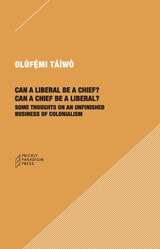
Can a Liberal be a Chief? Can a Chief be a Liberal?
Some Thoughts on an Unfinished Business of ColonialismOlúfémi Táíwò
Prickly Paradigm Press, 2021
Across Africa, it is not unusual for proponents of liberal democracy and modernization to make room for some aspects of indigenous culture, such as the use of a chief as a political figure. Yet for Olúfẹ́mi Táíwò, no such accommodation should be made. Chiefs, he argues, in this thought-provoking and wide-ranging pamphlet, cannot be liberals—and liberals cannot be chiefs. If we fail to recognize this, we fail to acknowledge the metaphysical underpinnings of modern understandings of freedom and equality, as well as the ways in which African intellectuals can offer a distinctive take on the unfinished business of colonialism.

Can the Subaltern See?
Photographs as History, Volume 84Fernando Coronil , ed.
Duke University Press, 0
Each essay looks at the role of a particular photographic genre in the making of modern Latin American identities. Articles cover the adaptation in late-nineteenth-century Oaxaca of European type photography as a tool of imperialist enterprise and science, state consolidation, and consumer culture; the use of portrait photography by the K’iche Mayans of Quetzaltenango; and the family album—made up of snapshots, postcards, and other memorabilia—as a historical document.
Contributors. Greg Grandin, Daniel James, Mirta Zaida Lobato, Deborah Poole

To Can the Kaiser
Arkansas and the Great WarMichael D. Polston
Butler Center for Arkansas Studies, 2015

Undertale
Can a Game Give Hope?Anastasia Salter
University of Chicago Press, 2025
A powerful exploration of the importance and social complexity of the indie gaming sensation
On the surface, the 2015 game Undertale didn’t seem like much, supported by fan funding and with minimalist retro graphics. But despite its pixelated monsters and dated role-playing mechanics, Undertale invited fans and players to rethink their very relationship with gaming and game characters. Players encountered an extraordinary range of possible play experiences, with paths through the game’s unassuming world leading to both empathy and extreme violence, offering room for reflection and growth. Players could befriend (sometimes queer) monsters or kill them, for instance, appealing to each monster’s unique personality to negotiate survival and find community.
Contextualizing this game’s success in the wake of the Gamergate online harassment campaign and meditating on questions of violence and authenticity, writer and game scholar Anastasia Salter offers a profound exploration of this game sensation and a personal story of hope at a time when Salter was otherwise “done” with games. Undertale’s unique structure helped make it synonymous with “indie” games, built outside of the studio as a passion project and inspiring similar passion among its many fans even a decade later. But Undertale’s story also speaks to an auteur dream: What game developer Toby Fox and his collaborators accomplished on a small budget, with relatively simple tools, has left people replaying, arguing, and creating in its wake.
As we enter a cultural moment where intense interest is shifting towards flashy creativity, powered by generative artificial intelligence, Undertale reminds fans and newcomers of the power of thoughtful and intentional human design.