Results by title
9 books match the query 'Canada, Eastern'

Amulets, Effigies, Fetishes, and Charms
Native American Artifacts and Spirit Stones from the NortheastEdward J. Lenik
University of Alabama Press, 2016
Interpreting Sacred Objects: Indigenous Material Culture and Spiritual Meaning in the Northeast.
Decorated stone artifacts are a significant part of archaeological studies of Native Americans in the Northeast. The artifacts illuminated in Amulets, Effigies, Fetishes, and Charms: Native American Artifacts and Spirit Stones from the Northeast include pecked, sculpted, or incised figures, images, or symbols. These are rendered on pebbles, plaques, pendants, axes, pestles, and atlatl weights, and are of varying sizes, shapes, and designs. Lenik draws from Indian myths and legends and incorporates data from ethnohistoric and archaeological sources together with local environmental settings in an attempt to interpret the iconography of these fascinating relics. For the Algonquian and Iroquois peoples, they reflect identity, status, and social relationships with other Indians as well as beings in the spirit world.
Lenik begins with background on the Indian cultures of the Northeast and includes a discussion of the dating system developed by anthropologists to describe prehistory. The heart of the content comprises more than eighty examples of portable rock art, grouped by recurring design motifs. This organization allows for in-depth analysis of each motif. The motifs examined range from people, animals, fish, and insects to geometric and abstract designs. Information for each object is presented in succinct prose, with a description, illustration, possible interpretation, the story of its discovery, and the location where it is now housed. Lenik also offers insight into the culture and lifestyle of the Native American groups represented. An appendix listing places to see and learn more about the artifacts and a glossary are included.
The material in this book, used in conjunction with Lenik’s previous research, offers a reference for virtually every known example of northeastern rock art. Archaeologists, students, and connoisseurs of Indian artistic expression will find this an invaluable work.

Eastern Alpine Guide
Natural History and Conservation of Mountain Tundra East of the RockiesEdited by Mike Jones and Liz Willey
University Press of New England, 2018
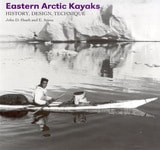
Eastern Arctic Kayaks
History, Design, TechniqueJohn Heath
University of Alaska Press, 2004
Eastern Arctic Kayaks is the product of years of kayak study by two of the world's experts. Combining analyses of form and function with historical background and illustrations of kayaking techniques, this volume is a storehouse of information for recreational kayakers and scholarly readers alike.
Drawing from his vast practical experience and extensive study of museum specimens, John D. Heath offers a comprehensive overview of the evolution and construction of Greenland kayaks supplemented with an illustrated series of rolling and sculling techniques. E. Arima examines kayaks of the eastern Canadian Arctic, covering woodworking tools, construction techniques, and the treatment of skins for the kayak cover.
Core chapters on Greenland and eastern Canada are accompanied by essential articles by Greg Stamer on the use of the Greenland paddle and two studies of kayaks in European museums by Harvey Golden and Hugh Collings. A valuable excerpt from John Brand's Little Kayak Book series makes this British publication available to American readers for the first time.
Lavishly illustrated with drawings and historic photographs, Eastern Arctic Kayaks is a landmark study in the history of watercraft--an essential resource for recreational kayakers and maritime historians and for anyone interested in northern Native material culture.
Hawks and Owls of Eastern North America
Heintzelman, Donald S.
Rutgers University Press, 2004
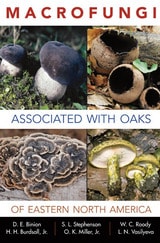
Macrofungi Associated with Oaks of Eastern North America
DENISE E. BINION
West Virginia University Press, 2008
Macrofungi Associated with Oaks of Eastern North America, which was written as a companion to Field Guide to Oak Species of Eastern North America, represents the first major publication devoted exclusively to the macrofungi that occur in association with oak trees in the forests of eastern North America. The macrofungi covered in this volume include many of the more common examples of the three groups—mycorrhizal fungi, decomposers, and pathogens—that are ecologically important to the forest ecosystems in which oaks occur. More than 200 species of macrofungi are described and illustrated via vibrantly colored photographs. Information is given on edibility, medicinal properties, and other novel uses as well. This publication reflects the combined expertise of six mycologists on the macrofungi anyone would be likely to encounter in an oak forest.
Process and Meaning in Spatial Archaeology
Investigations into Pre-Columbian Iroquoian Space and PlaceEric Jones
University Press of Colorado, 2017
The research in this volume represents a new wave of spatial research—exploring beyond settlement patterning to the process and the meaning behind spatial arrangement of past communities and people—and describes new approaches being used for better understanding of past Northern Iroquoian societies. Addressing topics ranging from household task-scapes and gender relations to bioarchaeology and social network analysis, Process and Meaning in Spatial Archaeology demonstrates the vitality of current archaeological research into ancestral Northern Iroquoian societies and its growing contribution to wider debates in North American archaeology.
This cutting-edge research will be of interest to archaeologists globally, as well as academics and graduate students studying Northern Iroquoian societies and cultures, geography, and spatial analysis.
Contributors: Kathleen M. S. Allen, Jennifer A. Birch, William Engelbrecht, Crystal Forrest, John P. Hart, Sandra Katz, Robert H. Pihl, Aleksandra Pradzynski, Erin C. Rodriguez, Dean R. Snow, Ronald F. Williamson, Rob Wojtowicz
Rock Art in an Indigenous Landscape
From Atlantic Canada to Chesapeake BayEdward J. Lenik with Nancy L. Gibbs
University of Alabama Press, 2021
A landmark study of Native American rock art from Atlantic Canada to Chesapeake Bay.
Rock art, petroglyphs, and pictographs have been made by indigenous peoples for thousands of years. Images have been found on bedrock, cliff faces, ridge tops, and boulders and in rock shelters. Some rock surfaces are covered with abstract and geometric designs such as concentric circles, zigzag lines, grids, and cross-hatched and ladder-like patterns. Others depict humans, footprints and handprints, mammals, serpents, and mythic creatures. All were meticulously pecked, incised or painted. This ancient art form connects us to Native Americans’ past, traditions, world views, and sacred places.
Rock Art in an Indigenous Landscape: From Atlantic Canada to Chesapeake Bay is the culmination of the research of preeminent rock art scholar Edward J. Lenik. Here, he profiles more than 64 examples of rock art in varied locations from Nova Scotia to Maryland. Chapters are organized geographically and lead the reader through coastal sites, rivers and streams, lakes and ponds, and upland sites.
Lenik discusses the rock art examples in the context of the indigenous landscape, noting the significance of the place of discovery. Coverage includes a meticulous description of the design or motif and suggestions of time frame, artist-makers, and interpretations. Where possible, indigenous views on the artifacts enrich the narrative. Other invaluable elements are a discussion of how to identify indigenous rock art; a glossary of rock art terms and features and archaeological culture periods; an up-to-date bibliography; and an appendix of a number of reported but unconfirmed petroglyph sites in the regions.
Visions of Sound
Musical Instruments of First Nation Communities in Northeastern AmericaBeverley Diamond, M. Sam Cronk, and Franziska von Rosen
University of Chicago Press, 1995
Featuring over two hundred photographs of instruments, dialogues among the coauthors, numerous interviews with individual music makers, and an appended catalogue of over seven hundred instrument descriptions, this is an important book for all ethnomusicologists and students of Native American culture as well as general readers interested in Native American mythology and religious life.

Woody Plants in Winter
by Earl L. Core and Nelle P. Ammons
West Virginia University Press, 1958
A manual to identify trees and shrubs in winter when the lack of leaves, fruits, and flowers makes them least identifiable, Woody Plants in Winter has become a classic for naturalists, botanists, gardeners, and hobbyists. Earl L. Core and Nell P. Ammons, both West Virginia University Professors of distinction, originally published this book with The Boxwood Press in 1958. Now in its fifteenth printing, the title has come home to West Virginia University Press.