Results by title
5 books match the query 'Cannibals'
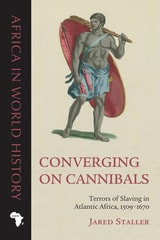
Converging on Cannibals
Terrors of Slaving in Atlantic Africa, 1509–1670Jared Staller
Ohio University Press, 2019
In Converging on Cannibals, Jared Staller demonstrates that one of the most terrifying discourses used during the era of transatlantic slaving—cannibalism—was coproduced by Europeans and Africans. When these people from vastly different cultures first came into contact, they shared a fear of potential cannibals. Some Africans and European slavers allowed these rumors of themselves as man-eaters to stand unchallenged. Using the visual and verbal idioms of cannibalism, people like the Imbangala of Angola rose to power in a brutal world by embodying terror itself.
Beginning in the Kongo in the 1500s, Staller weaves a nuanced narrative of people who chose to live and behave as “jaga,” alleged cannibals and terrorists who lived by raiding and enslaving others, culminating in the violent political machinations of Queen Njinga as she took on the mantle of “Jaga” to establish her power. Ultimately, Staller tells the story of Africans who confronted worlds unknown as cannibals, how they used the concept to order the world around them, and how they were themselves brought to order by a world of commercial slaving that was equally cannibalistic in the human lives it consumed.
Empire Islands
Castaways, Cannibals, and Fantasies of ConquestRebecca Weaver-Hightower
University of Minnesota Press, 2007
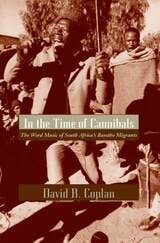
In the Time of Cannibals
The Word Music of South Africa's Basotho MigrantsDavid B. Coplan
University of Chicago Press, 1994
Coplan discusses every aspect of the Basotho musical literature, taking into account historical conditions, political dynamics, and social forces as well as the styles, artistry, and occasions of performance. He engages the postmodern challenge to decolonize our representation of the ethnographic subject and demonstrates how performance formulates local knowledge and communicates its shared understandings.
Complete with transcriptions of full male and female performances, this book develops a theoretical and methodological framework crucial to anyone seeking to understand the relationship between orality and literacy in the context of performance. This work is an important contribution to South African studies, to ethnomusicology and anthropology, and to performance studies in general.
Screaming with the Cannibals
LEE MAYNARD
West Virginia University Press, 2012
The Inconstancy of the Indian Soul
The Encounter of Catholics and Cannibals in 16-century BrazilEduardo Viveiros de Castro
Prickly Paradigm Press, 2011
In the mid-sixteenth century, Jesuit missionaries working in what is now Brazil were struck by what they called the inconstancy of the people they met, the indigenous Tupi-speaking tribes of the Atlantic coast. Though the Indians appeared eager to receive the Gospel, they also had a tendency to forget the missionaries’ lessons and “revert” to their natural state of war, cannibalism, and polygamy. This peculiar mixture of acceptance and rejection, compulsion and forgetfulness was incorrectly understood by the priests as a sign of the natives’ incapacity to believe in anything durably.
In this pamphlet, world-renowned Brazilian anthropologist Eduardo Viveiros de Castro situates the Jesuit missionaries’ accounts of the Tupi people in historical perspective, and in the process draws out some startling and insightful implications of their perceived inconstancy in relation to anthropological debates on culture and religion.