Results by title
8 books match the query 'Canon'
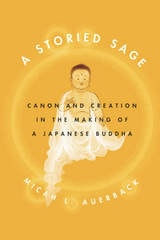
A Storied Sage
Canon and Creation in the Making of a Japanese BuddhaMicah L. Auerback
University of Chicago Press, 2016
Micah L. Auerback follows the changing fortune of the Buddha through the novel uses for the Buddha’s story in high and low culture alike, often outside of the confines of the Buddhist establishment. Auerback argues for the Buddha’s continuing relevance during Japan’s early modern period and links the later Buddhist tradition in Japan to its roots on the Asian continent. Additionally, he examines the afterlife of the Buddha in hagiographic literature, demonstrating that the late Japanese Buddha, far from fading into a ghost of his former self, instead underwent an important reincarnation. Challenging many established assumptions about Buddhism and its evolution in Japan, A Storied Sage is a vital contribution to the larger discussion of religion and secularization in modernity.
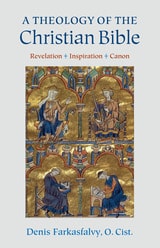
A Theology of the Christian Bible
Revelation - Inspiration - CanonDenis Farkasfalvy
Catholic University of America Press, 2018
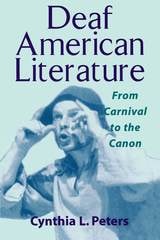
Deaf American Literature
From Carnival to the CanonCynthia Peters
Gallaudet University Press, 2000
“The moment when a society must contend with a powerful language other than its own is a decisive point in its evolution. This moment is occurring now in American society.” Cynthia Peters explains precisely how American Sign Language (ASL) literature achieved this moment by tracing its past and predicting its future in Deaf American Literature: From Carnival to the Canon.
Peters connects ASL literature to the literary canon with the archetypal notion of carnival as “the counterculture of the dominated.” Throughout history, carnivals have been opportunities for the “low,” disenfranchised elements of society to displace their “high” counterparts. Citing the Deaf community’s long tradition of “literary nights” and festivals like the Deaf Way, Peters recognizes similar forces at work in the propagation of ASL literature. The agents of this movement, Deaf artists and ASL performers—“Tricksters,” as Peters calls them—jump between the two cultures and languages. Through this process, they create a synthesis of English literary content reinterpreted in sign language, which raises the profile of ASL as a distinct art form in itself.
In this trailblazing study, Peters applies her analysis to the craft’s landmark works, including Douglas Bullard’s novel Islay and Ben Bahan’s video-recorded narrative Bird of a Different Feather. Deaf American Literature, the only work of its kind, is its own seminal moment in the emerging discipline of ASL literary criticism.
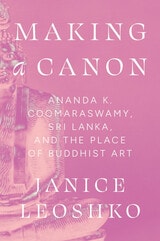
Making a Canon
Ananda K. Coomaraswamy, Sri Lanka, and the Place of Buddhist ArtJanice Leoshko
University of Chicago Press, 2024
An early interpreter of Buddhist art to the West, Ananda Kentish Coomaraswamy laid the foundation of what would become the South Asian visual canon, particularly through his efforts to understand how Buddhist art emerged and developed. In Making a Canon, Janice Leoshko examines how Coomaraswamy’s experience as the director of a mineralogical survey in Sri Lanka shaped his understanding of South Asian art and religion. Along the way, she reveals how Coomaraswamy’s distinctive repetition of Sri Lankan visual images in his work influenced the direction of South Asia’s canon formation and left a lasting impression on our understanding of Buddhist art.
Reading the Bible in Ancient Traditions and Modern Editions
Studies in Memory of Peter W. FlintAndrew B. Perrin
SBL Press, 2017
A collection of essays commemorating the career contributions of Peter W. Flint
An international group of scholars specializing in various disciplines of biblical studies—Dead Sea Scrolls, Septuagint, Hebrew Bible/Old Testament, Second Temple Judaism, and Christian origins—present twenty-seven new contributions that commemorate the career of Peter W. Flint (1951–2016). Each essay interacts with and gives fresh insight into a field shaped by Professor Flint’s life work. Part 1 explores the interplay between text-critical methods, the growth and formation of the Hebrew Scriptures, and the making of modern critical editions. Part 2 maps dynamics of scriptural interpretation and reception in ancient Jewish and Christian literatures of the Second Temple period.
Features
- Essays that assess the state of the field and reflect on the methods, aims, and best practices for textual criticism and the making of modern critical text editions
- Demonstrations of how the processes of scriptural composition, transmission, and reception converge and may be studied together for mutual benefit
- Clarification of the state/forms of scripture in antiquity and how scripture was extended, rewritten, and recontextualized by ancient Jewish and Christian scribes and communities
The Bible as Christian Scripture
The Work of Brevard S. ChildsChristopher R. Seitz
SBL Press, 2013
The Errant Art of Moby-Dick
The Canon, the Cold War, and the Struggle for American StudiesWilliam V. Spanos
Duke University Press, 1995
Combining Heideggerian ontology with a sociopolitical perspective derived primarily from Foucault, the reading of Moby-Dick that forms the center of this book demonstrates that the traditional identification of Melville’s novel as a "romance" renders it complicitous in the discourse of the Cold War. At the same time, Spanos shows how New Americanist criticism overlooks the degree to which Moby-Dick anticipates not only America’s self-representation as the savior of the world against communism, but also the emergent postmodern and anti-imperial discourse deployed against such an image. Spanos’s critique reveals the extraordinary relevance of Melville’s novel as a post-Cold War text, foreshadowing not only the self-destructive end of the historical formation of the American cultural identity in the genocidal assault on Vietnam, but also the reactionary labeling of the current era as "the end of history."
This provocative and challenging study presents not only a new view of the development of literary history in the United States, but a devastating critique of the genealogy of ideology in the American cultural establishment.
When Texts Are Canonized
Timothy H. Lim
SBL Press, 2017
How did canonization take place, and what difference does it make?
Essays in this collection probe the canonical process: Why were certain books, but not others, included in the canon? What criteria were used to select the books of the canon? Was canonization a divine fiat or human act? What was the nature of the authority of the laws and narratives of the Torah? How did prophecy come to be included in the canon? Others reflect on the consequences of canonization: What are the effects in elevating certain writings to the status of “Holy Scriptures”? What happens when a text is included in an official list? What theological and hermeneutical questions are at stake in the fact of the canon? Should the canon be unsealed or reopened to include other writings?
Features:
- Essays that contribute to our understanding of the complex processes of canonization
- Exploration of early concepts of canonicity
- Discussion of reopening the New Testament canon