Results by title
4 books match the query 'Capitals (Cities)'
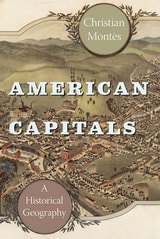
American Capitals
A Historical GeographyChristian Montès
University of Chicago Press, 2014
State capitals are an indelible part of the American psyche, spatial representations of state power and national identity. Learning them by heart is a rite of passage in grade school, a pedagogical exercise that emphasizes the importance of committing place-names to memory. But geographers have yet to analyze state capitals in any depth. In American Capitals, Christian Montès takes us on a well-researched journey across America—from Augusta to Sacramento, Albany to Baton Rouge—shedding light along the way on the historical circumstances that led to their appointment, their success or failure, and their evolution over time.
[more]
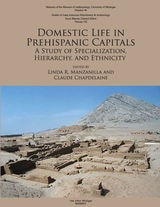
Domestic Life in Prehispanic Capitals
A Study of Specialization, Hierarchy, and EthnicityEdited by Linda R. Manzanilla and Claude Chapdelaine
University of Michigan Press, 2009
With major differences in size, urban plans, and population density, the capitals of New World states had large heterogeneous societies, sometimes multiethnic and highly specialized, making these cities amazing backdrops for complex interactions.
[more]
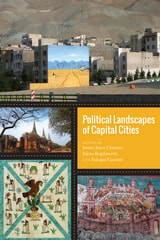
Political Landscapes of Capital Cities
Jessica Joyce Christie
University Press of Colorado, 2016
Political Landscapes of Capital Cities investigates the processes of transformation of the natural landscape into the culturally constructed and ideologically defined political environments of capital cities. In this spatially inclusive, socially dynamic interpretation, an interdisciplinary group of authors including archaeologists, anthropologists, and art historians uses the methodology put forth in Adam T. Smith’s The Political Landscape: Constellations of Authority in Early Complex Polities to expose the intimate associations between human-made environments and the natural landscape that accommodate the sociopolitical needs of governmental authority.
Political Landscapes of Capital Cities blends the historical, political, and cultural narratives of capital cities such as Bangkok, Cusco, Rome, and Tehran with a careful visual analysis, hinging on the methodological tools of not only architectural and urban design but also cultural, historiographical, and anthropological studies. The collection provides further ways to conceive of how processes of urbanization, monumentalization, ritualization, naturalization, and unification affected capitals differently without losing grasp of local distinctive architectural and spatial features. The essays also articulate the many complex political and ideological agendas of a diverse set of sovereign entities that planned, constructed, displayed, and performed their societal ideals in the spaces of their capitals, ultimately confirming that political authority is profoundly spatial.
Contributors: Jelena Bogdanović, Jessica Joyce Christie, Talinn Grigor, Eulogio Guzmán, Gregor Kalas, Stephanie Pilat, Melody Rod-ari, Anne Toxey, Alexei Vranich
[more]
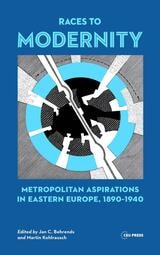
Races to Modernity
Metropolitan Aspirations in Eastern Europe, 1890–1940Martin Kohlrausch
Central European University Press, 2014
The comparative presentation of the birth of metropolises like St. Petersburg, Helsinki, Kiev, Belgrade, or Athens confirms the importance of the Western model as well as the influence of international experts on city planning at the periphery of Europe. In addition, this volume presents an alternative perspective that aims to understand the genesis of Eastern European cities with a metropolitan character or metropolitan aspirations as a process sui generis. The rapid expansion of metropolitan cities such as London and Paris began in the 17th and 18th centuries. Large parts of Central and Eastern Europe underwent urbanization and industrialization with considerable delay. Nevertheless beginning in the second half of the 19th century, the towns in the Romanov and Habsburg empires, as well as in the Balkans grew into cities and metropolitan areas. They changed at an astonishing pace. This transformation has long been interpreted as an attempt to overcome the economic and cultural backwardness of the region and to catch up to Western Europe.
[more]