Results by title
3 books match the query 'Captivity narratives'
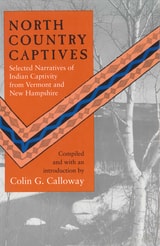
North Country Captives
Selected Narratives of Indian Captivity from Vermont and New HampshireEdited by Colin G. Calloway
University Press of New England, 1992
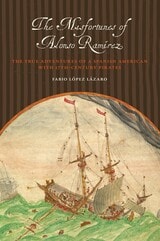
The Misfortunes of Alonso Ramírez
The True Adventures of a Spanish American with 17th-Century PiratesBy Fabio López Lázaro
University of Texas Press, 2011
In 1690, a dramatic account of piracy was published in Mexico City. The Misfortunes of Alonso Ramírez described the incredible adventures of a poor Spanish American carpenter who was taken captive by British pirates near the Philippines and forced to work for them for two years. After circumnavigating the world, he was freed and managed to return to Mexico, where the Spanish viceroy commissioned the well-known Mexican scholar Carlos de Sigüenza y Góngora to write down Ramírez's account as part of an imperial propaganda campaign against pirates.
The Misfortunes of Alonso Ramírez has long been regarded as a work of fiction—in fact, as Latin America's first novel—but Fabio López Lázaro makes a convincing case that the book is a historical account of real events, albeit full of distortions and lies. Using contemporary published accounts, as well as newly discovered documents from Spanish, English, French, Portuguese, and Dutch archives, he proves that Ramírez voyaged with one of the most famous pirates of all time, William Dampier. López Lázaro's critical translation of The Misfortunes provides the only extensive Spanish eyewitness account of pirates during the period in world history (1650–1750) when they became key agents of the European powers jockeying for international political and economic dominance. An extensive introduction places The Misfortunes within the worldwide struggle that Spain, England, and Holland waged against the ambitious Louis XIV of France, which some historians consider to be the first world war.

White Slaves, African Masters
An Anthology of American Barbary Captivity NarrativesEdited by Paul Baepler
University of Chicago Press, 1999
Though Barbary privateers began to seize North American colonists as early as 1625, Barbary captivity narratives did not begin to flourish until after the American Revolution. During these years, stories of Barbary captivity forced the U.S. government to pay humiliating tributes to African rulers, stimulated the drive to create the U.S. Navy, and brought on America's first post-revolutionary war. These tales also were used both to justify and to vilify slavery.
The accounts collected here range from the 1798 tale of John Foss, who was ransomed by Thomas Jefferson's administration for tribute totaling a sixth of the annual federal budget, to the story of Ion Perdicaris, whose (probably staged) abduction in Tangier in 1904 prompted Theodore Roosevelt to send warships to Morocco and inspired the 1975 film The Wind and the Lion. Also included is the unusual story of Robert Adams, a light-skinned African American who was abducted by Arabs and used by them to hunt negro slaves; captured by black villagers who presumed he was white; then was sold back to a group of Arabs, from whom he was ransomed by a British diplomat.
Long out of print and never before anthologized, these fascinating tales open an entirely new chapter of early American literary history, and shed new light on the more familiar genres of Indian captivity narrative and American slave narrative.