Results by title
7 books match the query 'Carceral State'

Archiving Medical Violence
Consent and the Carceral StateChristopher Perreira
University of Minnesota Press, 2023
A major new reading of a U.S. public health system shaped by fraught perceptions of culture, race, and criminality
At the heart of Archiving Medical Violence is an interrogation of the notions of national and scientific progress, marking an advance in scholarship that shows how such violence is both an engine of medical progress and, more broadly, the production of empire. It reads the medical archive through a lens that centers how it is produced, remembered, and contested within cultural production and critical memory.
In this innovative and interdisciplinary book, Christopher Perreira argues that it is in the contradictions of settler colonialism and racial capitalism that we find how medical violence is narrated as a public good. He presents case studies from across a range of locations—Hawai‘i, California, Louisiana, Guatemala—and historical periods from the nineteenth century on. Examining national and scientific conceptions of progress through the lens of medicine and public health, he places official archives in dialogue with visual and literary works, patient writing, and more.
Archiving Medical Violence explores the contested public terrains for narrating value and vulnerabilities, bodies and geographical locations. Ultimately, Perreira reveals for us a medical imaginary built on racialized criminality driving contemporary politics of citizenship, memory, and identity.
Retail e-book files for this title are screen-reader friendly with images accompanied by short alt text and/or extended descriptions.

For the Children?
Protecting Innocence in a Carceral StateErica R. Meiners
University of Minnesota Press, 2016
“Childhood has never been available to all.” In her opening chapter of For the Children?, Erica R. Meiners stakes the claim that childhood is a racial category often unavailable to communities of color. According to Meiners, this is glaringly evident in the U.S. criminal justice system, where the differentiation between child and adult often equates to access to stark disparities. And what is constructed as child protection often does not benefit many young people or their communities. Placing the child at the heart of the targeted criminalization debate, For the Children? considers how perceptions of innocence, the safe child, and the future operate in service of the prison industrial complex.
The United States has the largest prison population in the world, with incarceration and policing being key economic tools to maintain white supremacist ideologies. Meiners examines the school-to-prison pipeline and the broader prison industrial complex in the United States, arguing that unpacking child protection is vital to reducing the nation’s reliance on its criminal justice system as well as building authentic modes of public safety. Rethinking the meanings and beliefs attached to the child represent a significant and intimate thread of the work to dismantle facets of the U.S. carceral state.
Taking an interdisciplinary approach and building from a scholarly and activist platform, For the Children? engages fresh questions in the struggle to build sustainable and flourishing worlds without prisons.
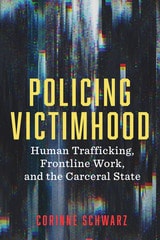
Policing Victimhood
Human Trafficking, Frontline Work, and the Carceral StateCorinne Schwarz
Rutgers University Press, 2023
In Policing Victimhood, Corinne Schwarz interviewed with service providers in the Midwestern US, a region that, though colloquially understood as “flyover country,” regularly positions itself as a leader in state-level anti-trafficking policies and collaborative networks. These frontline workers’ perceptions and narratives are informed by their interpersonal, day-to-day encounters with exploited or trafficked persons. Their insights underscore how anti-trafficking policies are put into practice and influenced by specific ideologies and stereotypes. Extending the reach of street-level bureaucracy theory to anti-trafficking initiatives, Schwarz demonstrates how frontline workers are uniquely positioned to perpetuate or radically counter punitive anti-trafficking efforts.
Taking a cue from anti-carceral feminist critiques and critical trafficking studies, Schwarz argues that ongoing anti-trafficking efforts in the US expand the punitive arm of the state without addressing the role of systemic oppression in perpetuating violence. The violence inherent to the carceral state—and required for its continued expansion—is the same violence that perpetuates the exploitation of human trafficking. In order to solve the “problem” of human trafficking, advocates, activists, and scholars must divest from systems that center punishment and radically reinvest their efforts in dismantling the structural violence that perpetuates social exclusion and vulnerability, what she calls the “-isms” and “-phobias” that harm some at the expense of others’ empowerment. Policing Victimhood encourages readers to imagine a world without carceral violence in any of its forms.
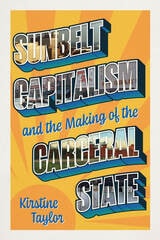
Sunbelt Capitalism and the Making of the Carceral State
Kirstine Taylor
University of Chicago Press, 2025
The story of how the American South became the most incarcerated region in the world’s most incarcerated nation.
Sunbelt Capitalism and the Making of the Carceral State examines the evolution of southern criminal punishment from Jim Crow to the dawn of mass incarceration, charting this definitive era of carceral transformation and expansion in the southern United States. The demise of the county chain gang, the professionalization of police, and the construction of large-scale prisons were among the sweeping changes that forever altered the southern landscape and bolstered the region’s capacity to punish. What prompted this southern revolution in criminal punishment?
Kirstine Taylor argues that the crisis in the cotton fields and the arrival of Sunbelt capitalism in the south’s rising metropolises prompted lawmakers to build expansive, modern criminal punishment systems in response to Brown v. Board of Education and the Black freedom movements of the 1960s and ‘70s. Taking us inside industry-hunting expeditions, school desegregation battles, the sit-in movement, prisoners’ labor unions, and policy commissions, Taylor tells the story of how a modernizing south became the most incarcerated region in the globe’s most incarcerated nation.
Sunbelt Capitalism and the Making of the Carceral State
Kirstine Taylor
University of Chicago Press, 2025
This is an auto-narrated audiobook version of this book.
The story of how the American South became the most incarcerated region in the world’s most incarcerated nation.
Sunbelt Capitalism and the Making of the Carceral State examines the evolution of southern criminal punishment from Jim Crow to the dawn of mass incarceration, charting this definitive era of carceral transformation and expansion in the southern United States. The demise of the county chain gang, the professionalization of police, and the construction of large-scale prisons were among the sweeping changes that forever altered the southern landscape and bolstered the region’s capacity to punish. What prompted this southern revolution in criminal punishment?
Kirstine Taylor argues that the crisis in the cotton fields and the arrival of Sunbelt capitalism in the south’s rising metropolises prompted lawmakers to build expansive, modern criminal punishment systems in response to Brown v. Board of Education and the Black freedom movements of the 1960s and ‘70s. Taking us inside industry-hunting expeditions, school desegregation battles, the sit-in movement, prisoners’ labor unions, and policy commissions, Taylor tells the story of how a modernizing south became the most incarcerated region in the globe’s most incarcerated nation.
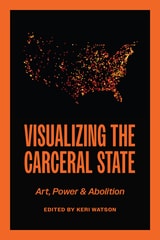
Visualizing the Carceral State
Art, Power, and AbolitionKeri Watson
University of Arkansas Press, 2027
Visualizing the Carceral State: Art, Power, and Abolition explores how visual culture has shaped, justified, and contested systems of incarceration. Bringing together leading scholars in art history and related fields, this interdisciplinary volume examines the images, objects, and spaces that have made the carceral state visible—in everything from prison architecture and colonial exhibitions to photography, print culture, and contemporary art. Across thirteen essays, contributors investigate how visual forms have helped construct public understandings of punishment, race, empire, and state authority. Thoughtfully edited by Keri Watson, Visualizing the Carceral State highlights cultural producers who have challenged these systems, offering alternative ways of seeing incarceration and imagining its abolition. Moving from the nineteenth century to the present and across multiple geopolitical contexts, this volume traces the visual languages through which carceral power operates and the creative practices that resist it. By situating art and visual culture at the center of debates about mass incarceration, Visualizing the Carceral State opens new avenues for thinking about the relationship between aesthetics, politics, and justice.
Work and the Carceral State
Jon Burnett
Pluto Press, 2022
During 2019-20 in England and Wales, over 17 million hours of labor were carried out by more than 12,500 people incarcerated in prisons, while many people in immigration detention centers were also put to work. These people constitute a sub-waged, captive workforce who are frequently discarded by the state when done with.
Work and the Carceral State examines these forms of work as part of a broader exploration of the relationship between criminalization, criminal justice, immigration policy and labor, tracing their lineage through the histories of transportation and banishment, of houses of correction and prisons, to the contemporary production of work.
Criminalization has been used to enforce work and to discipline labor throughout the history of England and Wales. This book demands that we recognise the carceral state as operating at the frontier of labor control in the 21st century.