Results by title
6 books match the query 'Cardinals'
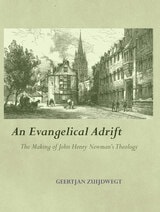
An Evangelical Adrift
The Making of John Henry Newman's TheologyGeertjan Zuijdwegt
Catholic University of America Press, 2022
An Evangelical Adrift is a theological biography of John Henry Newman (1801-1890) that reconstructs the most formative period in his development: the years between his teenage conversion to evangelicalism in 1816 and the beginning of the Tractarian Movement in 1833. By the early 1830s, Newman had explicitly rejected much of the theology he espoused in the late 1810s and early 1820s, and developed a highly original, deeply personal, and quite radical alternative, whose fundamental notions continued to shape his thought in later life. To date, there is neither a historically accurate nor a theologically sophisticated account of this change: the period in which it occurred is neglected, its significance is overlooked, its nature and content are misrepresented, and its scope is narrowed.
Besides being modelled on Newman’s own brief treatment of the period in his autobiographical Apologia pro vita sua (1864), later scholarly accounts are burdened by a persistent assumption that Newman’s catholic sensibility and anti-liberal convictions were constants throughout his life. This assumption was problematized by Frank Turner’s revisionist biography of the Anglican Newman (2002) and the ensuing debate about its reception. Zuijdwegt argues that Turner rightly identified evangelicalism as a key polemical target of the Anglican Newman, but stretched his argument too far by reducing Newman’s self-proclaimed lifelong battle against liberalism as a much later gloss on this earlier history.
The present study offers a compelling alternative to both mainline and revisionist interpretations. Based on detailed historical and theological analysis of the whole range of primary sources (including much neglected published and unpublished material), it meticulously reconstructs Newman’s youthful adoption of, gradual departure from, and theological alternative to evangelicalism. Against most mainline studies, it argues that this was a fundamental transformation, affecting nearly every aspect of Newman’s theology. Against Turner and other revisionists, it argues that this change was the product of careful and consistent theological reasoning and reflection, and that anti-liberalism was just as integral to it as anti-evangelicalism.
[more]
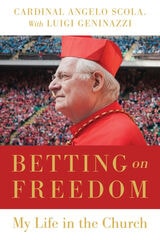
Betting on Freedom
My Life in the ChurchCarinal Angelo Scola
Catholic University of America Press, 2021
In this wide-ranging conversation with the Italian journalist Luigi Geninazzi, Cardinal Angelo Scola discusses both the salient moments of his own life and the path and situation of the Church and society in Europe over the last half-century. The Cardinal recounts his life, speaking of the extraordinary gift of particular friendships he has had, starting with Luigi Giussani, founder of the ecclesial movement Communion and Liberation (CL), and moving on to discuss Hans Urs von Balthasar, Henri De Lubac, and Joseph Ratzinger.
A figure who bridges the past three pontificates, Scola discusses his relationships with St. John Paul II, by whom he was nominated a bishop at the relatively young age of forty nine; Benedict XVI, with whom he has had an intense intellectual friendship for decades; and Pope Francis, of whom he speaks with affection and hope.
At the center of this rich fresco of anecdotes and reflections stands a crucial question: what is the true path of the Church today? Between those who reduce Christianity to a mere civil religion and those who propose a purist return to the Gospel, the cardinal indicates a "third way" by betting on the freedom of the human person to recognize the supreme value of Christ. This is at the same time a bet on the active commitment of believers to contribute, starting from faith, to the birth of a new Europe, inevitably more diverse but no loss of its identity.
[more]
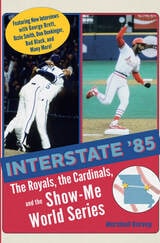
Interstate '85
The Royals, The Cardinals, and the Show-Me World SeriesMarshall Garvey
University of Missouri Press, 2025
For 40 years now, the 1985 World Series between the Kansas City Royals and St. Louis Cardinals has been largely overlooked, save for the enduring notoriety of umpire Don Denkinger’s infamous missed call in Game 6 that helped galvanize a walk-off Royals victory that forced a Game 7, in which the Royals won in a blowout. Seizing upon the imagery of the famed Interstate Highway 70 that connects Kansas City and St. Louis, Interstate ’85 goes beyond “The Call” and recasts the 1985 Series as a unique and deeply compelling chapter in baseball history.
In this blend of baseball and cultural history, Garvey defines the “I-70 Showdown Series” not only by the literal highway that links the two teams’ home cities but the individual and collective roads travelled by the players and others who took part in the event, both before the Series began and well after the last cheers faded.
In addition to gripping human stories and vivid descriptions of on-field action long overshadowed by Denkinger’s monumental blunder, Garvey’s work captures the provincial spectacle of the “Show-Me Series” throughout the state of Missouri. Featuring 27 new interviews conducted by the author, including with George Brett, Ozzie Smith, Don Denkinger, Bud Black, Andy Van Slyke, Ricky Horton, and Mark Gubicza, Interstate ’85 is baseball history writing at its deepest and most captivating.
[more]
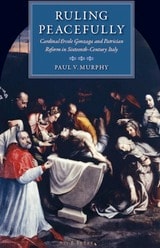
Ruling Peacefully
Cardinal Ercole Gonzaga and Patrician Reform in Sixteenth-Century ItalyPaul V. Murphy
Catholic University of America Press, 2007
Ruling Peacefully provides the first in-depth study of this influential and paradoxical figure. Gonzaga emerges as a complex personality whose interests as the representative of a northern Italian ruling family could just as easily lead him to support reform in the Catholic Church as to hinder it.
[more]
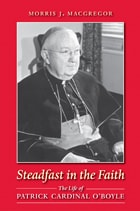
Steadfast in the Faith
The Life of Patrick Cardinal O'BoyleMorris J. MacGregor
Catholic University of America Press, 2006
Cardinal Patrick O'Boyle (1896-1987) is largely remembered as the controversial leader of the Archdiocese of Washington during its first, formative quarter century. Combining considerable foresight about the Church's social concerns with a stubborn resistance to innovation, he countered opposition from those who reviled his progressive stand, especially his steadfast demand for racial equality and support of organized labor.
[more]
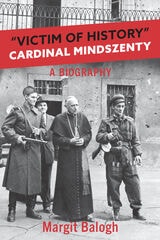
Victim of History
Cardinal Mindszenty, a biographyMargit Balogh
Catholic University of America Press, 2022
“Victim of history,” “a martyr from behind the Iron Curtain,” “the Hungarian Gandhi” – these are just some of the epithets which people used to describe Cardinal Mindszenty, archbishop of Esztergom, who was the last Hungarian prelate to use the title of prince primate. Today, Mindszenty has been forgotten in most countries except for Hungary, but when he died in 1975, he was known all over the world as a symbol of the struggle of the Catholic Church against communism.
Cardinal Mindszenty held the post of archbishop of Esztergom from 1945 until 1974, but during this period of almost three decades he served barely four years in office. The political police arrested him on December 26, 1948, and the Budapest People’s Court subsequently sentenced him to life imprisonment. Based on the Stalinist practice of show trials, one of the accusations against Mindszenty, referring to his legitimist leanings, was his alleged attempt to re-establish Habsburg rule in Hungary. He regained freedom during the 1956 revolution but only for a few days. He was granted refuge by the US Embassy in Budapest between November 4, 1956 –September 28, 1971. In the fifteen years he spent at the American embassy enormous changes took place in the world while his personality remained frozen into the past. When in 1971 Pope Paul VI received the Hungarian foreign minister, he called Mindszenty “the victim of history”. His last years were spent free at last, but far away from his homeland. In Hungary, the Catholic believers eagerly await his beatification.
[more]