Results by title
2 books match the query 'Caribbean Art'

A Dream to Conjure
Emergent Forms in Caribbean Art and CinemaYasmine Espert
Duke University Press, 2027
In A Dream to Conjure, Yasmine Espert considers the hopes and imaginings of Caribbean film from its beginnings. Focusing on narratives of migration from the late 1980s to the late 2010s, Espert attends to the restorative and life-affirming practices that diasporic Caribbean filmmakers conjure to assert their wellbeing, sovereignty, and sense of relation to the Caribbean. She examines how their embodied, aesthetic, and political practices set precedents for organizing efforts and continue a tradition of resistance to colonial extraction. Drawing from her own conversations and collaborations with these artists, she elevates the study with a deeper reflection on what it is like to create in, and about, lands that many said had no place in the film industry. Through an anticolonial, queer-of-color framework, Espert engages the films, dreams, and acts of Caribbean creators as multisensory, time-bending forms of collective engagement that defy colonial logic and prioritize those most vulnerable under regimes of oppression.
[more]
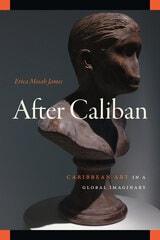
After Caliban
Caribbean Art in a Global ImaginaryErica Moiah James
Duke University Press, 2025
In After Caliban, Erica Moiah James examines the rise of global Caribbean artists in the 1990s and their production of a decolonized art history for the Caribbean. She draws on Aimé Césaire’s rewriting of Shakespeare’s The Tempest, in which Caliban becomes the sole author of his own story, dissolving his fixed position as colonized in relation to Prospero as colonizer. James shows how visual artists such as Marc Latamie, Janine Antoni, Belkis Ayón, Edouard Duval-Carrié, and Christopher Cozier followed Césaire’s model by employing a range of practices and methodologies that refused marginalization. Just as Césaire decolonized The Tempest, so too did these artists, who crafted a decolonial aesthetic that redefined their own cultural and historical narratives and positioned art as a key pathway toward a postcolonial future. By providing the foundation for a postcolonial, post-Caliban art world, these artists redefined the critical and popular notion of contemporary Caribbean art. At the same time, James argues, they fulfilled Césaire’s dream for a postcolonial Caribbean while creating a nonhegemonic art historical practice that exists beyond modern binaries and borders.
[more]