Results by title
3 books match the query 'Carnegie libraries'
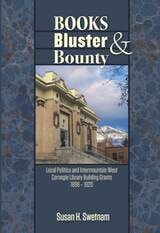
Books, Bluster, and Bounty
Local Politics and Carnegie Library Building Grants in the Intermountain West, 1890-1920Susan H. Swetnam
Utah State University Press, 2012
Books, Bluster, and Bounty examines a cross-section of Carnegie library applications to determine how local support was mustered for cultural institutions in the late nineteenth and early twentieth century West. This comparative study considers the entire region between the Rockies and the Cascades/Sierras, including all of Idaho, Utah, Nevada, and Arizona; western Montana, Wyoming, and Colorado; eastern Oregon and Washington; and small parts of California and New Mexico. The author's purpose is to address not only the how of the process but also the variable why. Although virtually all citizens and communities in the West who sought Carnegie libraries expected tangible benefits for themselves that were only tangentially related to books, what they specifically wanted varied in correlation with the diverse nature of western communities. By looking at the detailed records of the Carnegie library campaigns, the author is able to provide an alternative lens through which to perceive and map the social-cultural makeup and town building of western communities at the turn of the century.
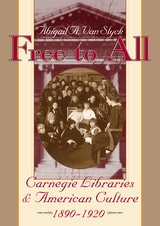
Free to All
Carnegie Libraries & American Culture, 1890-1920Abigail A. Van Slyck
University of Chicago Press, 1996
"The whole story is told here in this book. Carnegie's wishes, the conflicts among local groups, the architecture, development of female librarians. It's a rich and marvelous story, lovingly told."—Alicia Browne, Journal of American Culture
"This well-written and extensively researched work is a welcome addition to the history of architecture, librarianship, and philanthropy."—Joanne Passet, Journal of American History
"Van Slyck's book is a tremendous contribution for its keenness of scholarship and good writing and also for its perceptive look at a familiar but misunderstood icon of the American townscape."—Howard Wight Marshall, Journal of the Society of Architectural Historians
"[Van Slyck's] reading of the cultural coding implicit in the architectural design of the library makes a significant contribution to our understanding of the limitations of the doctrine 'free to all.'"—Virginia Quarterly Review
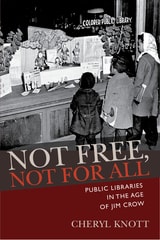
Not Free, Not for All
Public Libraries in the Age of Jim CrowCheryl Knott
University of Massachusetts Press, 2015
Winner of the 2016 Eliza Atkins Gleason Book Award and the 2016 Lillian Smith Book Award
Americans tend to imagine their public libraries as time-honored advocates of equitable access to information for all. Through much of the twentieth century, however, many black Americans were denied access to public libraries or allowed admittance only to separate and smaller buildings and collections. While scholars have examined and continue to uncover the history of school segregation, there has been much less research published on the segregation of public libraries in the Jim Crow South. In fact, much of the writing on public library history has failed to note these racial exclusions.
In Not Free, Not for All, Cheryl Knott traces the establishment, growth, and eventual demise of separate public libraries for African Americans in the South, disrupting the popular image of the American public library as historically welcoming readers from all walks of life. Using institutional records, contemporaneous newspaper and magazine articles, and other primary sources together with scholarly work in the fields of print culture and civil rights history, Knott reconstructs a complex story involving both animosity and cooperation among whites and blacks who valued what libraries had to offer. African American library advocates, staff, and users emerge as the creators of their own separate collections and services with both symbolic and material importance, even as they worked toward dismantling those very institutions during the era of desegregation.