Results by title

5 books match the query 'Carr, David'

cover of Blue Guitar Highway

Blue Guitar Highway

Paul Metsa

University of Minnesota Press, 2011

This is a musician’s tale: the story of a boy growing up on the Iron Range, playing his guitar at family gatherings, coming of age in the psychedelic seventies, and honing his craft as a pro in Minneapolis, ground zero of American popular music in the mid-eighties. “There is a drop of blood behind every note I play and every word I write,” Paul Metsa says. And it’s easy to believe, as he conducts us on a musical journey across time and country, navigating switchbacks, detours, dead ends, and providing us the occasional glimpse of the promised land on the blue guitar highway.

His account captures the thrill of the Twin Cities when acts like the Replacements, Husker Dü, and Prince were remaking pop music. It takes us right onto the stages he shared with stars like Billy Bragg, Pete Seeger, and Bruce Springsteen. And it gives us a close-up, dizzying view of the roller-coaster ride that is the professional musician’s life, played out against the polarizing politics and intimate history of the past few decades of American culture. Written with a songwriter’s sense of detail and ear for poetry, Paul Metsa’s book conveys all the sweet absurdity, dry humor, and passion for the language of music that has made his story sing.

[more]
cover of Crisis of European Sciences and Transcendental Phenomenology

Crisis of European Sciences and Transcendental Phenomenology

Edmund Husserl

Northwestern University Press, 1970

The Crisis of European Sciences and Transcendental Phenomenology, Husserl's last great work, is important both for its content and for the influence it has had on other philosophers. In this book, which remained unfinished at his death, Husserl attempts to forge a union between phenomenology and existentialism.

Husserl provides not only a history of philosophy but a philosophy of history. As he says in Part I, "The genuine spiritual struggles of European humanity as such take the form of struggles between the philosophies, that is, between the skeptical philosophies--or nonphilosophies, which retain the word but not the task—and the actual and still vital philosophies. But the vitality of the latter consists in the fact that they are struggling for their true and genuine meaning and thus for the meaning of a genuine humanity."
[more]
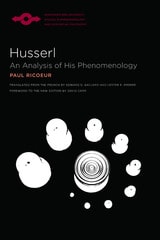
cover of Husserl: An Analysis of His Phenomenology

Husserl

An Analysis of His Phenomenology

Paul Ricoeur, Edward G. Ballard and Lester E. Embree; Foreword by David Carr

Northwestern University Press, 2007

Paul Ricoeur was one of the foremost interpreters and translators of Edmund Husserl's philosophy. These nine essays present Ricoeur's interpretation of the most important of Husserl's writings, with emphasis on his philosophy of consciousness rather than his work in logic. In Ricoeur's philosophy, phenomenology and existentialism came of age and these essays provide an introduction to the Husserlian elements which most heavily influenced his own philosophical position.
[more]
cover of Phenomenology and the Problem of History: A Study of Husserl's Transcendental Philosophy

Phenomenology and the Problem of History

A Study of Husserl's Transcendental Philosophy

David Carr

Northwestern University Press, 2009

In Phenomenology and the Problem of History, David Carr examines the paradox involving Husserl's transcendental philosophy and his later historicist theory. Rejecting the arguments of earlier critics that compromise aspects of Husserl's writing, Carr proposes a model of the transcendental philosopher who balances necessary historical reduction with a strict mind to historical context. 
[more]
cover of The Ethics of History

The Ethics of History

John McCumber

Northwestern University Press, 2004

What is implied by "ethics of history"? The authors of this volume, internationally renowned philosophers and intellectual historians, address this question in all its novelty and ambiguity and develop varied perspectives on the place and nature of ethics in the philosophy, enterprise, and practice of history.
Is the whole historical process--largely consisting of the actions and sufferings of persons and groups--subject to ethical constraint? And what of the ways in which historians present their subject matter; are these methods subject to moral scrutiny? Although they approach these issues from different directions, the contributors agree in their critique of the correspondence theory of history, tin their acceptance of an unbridgeable gap between the past and the historian's present account, and in their call for a revision of the popular appeal to historical objectivity.
[more]