Results by title
5 books match the query 'Carr, Philip J.'
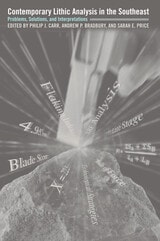
Contemporary Lithic Analysis in the Southeast
Problems, Solutions, and InterpretationsPhilip J. Carr
University of Alabama Press, 2012
William Andrefsky Jr. / Andrew P. Bradbury / Philip J. Carr / CarolynConklin /

Signs of Power
The Rise of Cultural Complexity in the SoutheastEdited by Jon L. Gibson and Philip J. Carr
University of Alabama Press, 2004
Traces the sources of power and large-scale organization of prehistoric peoples among Archaic societies.
By focusing on the first instances of mound building, pottery making, fancy polished stone and bone, as well as specialized chipped stone, artifacts, and their widespread exchange, this book explores the sources of power and organization among Archaic societies. It investigates the origins of these technologies and their effects on long-term (evolutionary) and short-term (historical) change.
The characteristics of first origins in social complexity belong to 5,000- to 6,000-year-old Archaic groups who inhabited the southeastern United States. In Signs of Power, regional specialists identify the conditions, causes, and consequences that define organization and social complexity in societies. Often termed "big mound power," these considerations include the role of demography, kinship, and ecology in sociocultural change; the meaning of geometry and design in sacred groupings; the degree of advancement in stone tool technologies; and differentials in shell ring sizes that reflect social inequality.
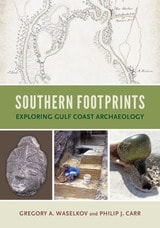
Southern Footprints
Exploring Gulf Coast ArchaeologyGregory A. Waselkov and Philip J. Carr
University of Alabama Press, 2024
Unearthing the Gulf Coast’s past—one footprint at a time.
Southern Footprints celebrates more than fifty years of archaeological research along the Gulf Coast by the University of South Alabama and the Center for Archaeological Studies. Archaeologists Gregory A. Waselkov and Philip J. Carr, the former and current directors of the center, present the “greatest hits” that have transformed knowledge of human history on the Alabama and Mississippi Gulf Coast from the Ice Age until recently. Each archaeological site, from surface collections to premiere archaeological preserves, such as Old Mobile and Holy Ground, offers clues to the past.
The chapters in this collection are arranged chronologically and survey the history and archaeology of a wide range of significant sites, including the Gulf Shores canoe canal, Bottle Creek Mounds, Old Mobile, Fort Mims, Spanish Fort, Spring Hill College, and Mobile River Bridge.
Waselkov and Carr take care to acknowledge in these stories populations who have been historically underdocumented, now recognizing the contributions of Native Americans and African Americans that have been uncovered through archaeology. The authors reveal the dire impacts of climate change, environmental disasters, development, and neglect—and convey their urgency to protect these areas of shared history—as a result of the meticulous excavation, analysis, and preservation of artifacts from these sites. Color photographs showcase the archaeology as it unfolds, often with the help of dedicated volunteers. Southern Footprints will serve as an indispensable reference on the rich Gulf Coast heritage for all to appreciate.
The American Southeast at the End of the Ice Age
Edited by D. Shane Miller, Ashley M. Smallwood, and Jesse W. Tune
University of Alabama Press, 2022
Synthesizes archaeological and environmental evidence to reinterpret how early human populations adapted to dynamic climatic changes during the Late Pleistocene, reshaping our understanding of Paleoindian lifeways and migration in the Southeastern United States.
The 1996 benchmark volume The Paleoindian and Early Archaic Southeast, edited by David G. Anderson and Kenneth E. Sassaman, was the first study to summarize what was known of the peoples who lived in the Southeast when ice sheets covered the northern part of the continent and mammals such as mammoths, saber-toothed cats, and ground sloths roamed the landscape.
The American Southeast at the End of the Ice Age provides an updated, definitive synthesis of current archaeological research gleaned from an array of experts in the region. It is organized in three parts: state records, the regional perspective, and reflections and future directions. Chapters survey a diversity of topics including the distribution of the earliest archaeological sites in the region, chipped-stone tool technology, the expanding role of submerged archaeology, hunter-gatherer lifeways, past climate changes and the extinction of megafauna on the transitional landscape, and evidence of demographic changes at the end of the Ice Age. Discussion of the ethical responsibilities regarding the use of private collections and the relationship of archaeologists and the avocational community, insight from outside the Southeast, and considerations for future research round out the volume.

Time's River
Archaeological Syntheses from the Lower Mississippi ValleyEdited by Janet Rafferty and Evan Peacock
University of Alabama Press, 2008
An archaeologically rich region, in advance of impending disturbance
This volume stands as a key general resource for archaeologists working in the region extending from Louisiana through Mississippi north to Missouri and Kentucky, and it represents an opportunity to influence for decades a large part of the archaeological work to take place in the Southeast.
The book responds to a need for a comprehensive archaeological overview of the Lower Mississippi Valley that forms a portion of an interstate corridor spanning nine states that will run from southern Michigan to the Texas-Mexico border. The culturally sensitive Mississippi Delta is one of the richest archaeological areas in North America, and it is crucial that research designs be comprehensive, coordinated, and meet current preservation and future research needs. The authors are well-respected researchers from both within and outside the region with expertise in the full range of topics that comprise American archaeology. They examine matters of method and theory, the application of materials science, geophysics, and other high-tech tools in archaeology that provide for optimum data-recovery.