Results by title
2 books match the query 'Carrera, Magali M.'
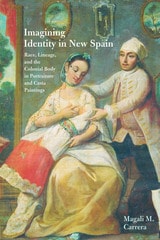
Imagining Identity in New Spain
Race, Lineage, and the Colonial Body in Portraiture and Casta PaintingsBy Magali M. Carrera
University of Texas Press, 2003
Using an interdisciplinary approach that also considers legal, literary, and religious documents of the period, Magali Carrera focuses on eighteenth-century portraiture and casta paintings to understand how the people and spaces of New Spain were conceptualized and visualized.
Winner, Book Award, Association of Latin American Art, 2004
Reacting to the rising numbers of mixed-blood (Spanish-Indian-Black African) people in its New Spain colony, the eighteenth-century Bourbon government of Spain attempted to categorize and control its colonial subjects through increasing social regulation of their bodies and the spaces they inhabited. The discourse of calidad (status) and raza (lineage) on which the regulations were based also found expression in the visual culture of New Spain, particularly in the unique genre of casta paintings, which purported to portray discrete categories of mixed-blood plebeians.
Using an interdisciplinary approach that also considers legal, literary, and religious documents of the period, Magali Carrera focuses on eighteenth-century portraiture and casta paintings to understand how the people and spaces of New Spain were conceptualized and visualized. She explains how these visual practices emphasized a seeming realism that constructed colonial bodies—elite and non-elite—as knowable and visible. At the same time, however, she argues that the chaotic specificity of the lives and lived conditions in eighteenth-century New Spain belied the illusion of social orderliness and totality narrated in its visual art. Ultimately, she concludes, the inherent ambiguity of the colonial body and its spaces brought chaos to all dreams of order.
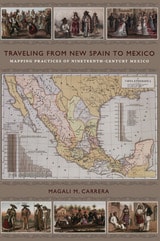
Traveling from New Spain to Mexico
Mapping Practices of Nineteenth-Century MexicoMagali M. Carrera
Duke University Press, 2011
From the sixteenth century until the early nineteenth, Europeans had envisioned New Spain (colonial Mexico) in texts, maps, and other images. In the first decades of the 1800s, ideas about Mexican, rather than Spanish, national character and identity began to cohere in written and illustrated narratives produced by foreign travelers. During the nineteenth century, technologies and processes of visual reproduction expanded to include lithography, daguerreotype, and photography. New methods of display—such as albums, museums, exhibitions, and world fairs—signaled new ideas about spectatorship. García Cubas participated in this emerging visual culture as he reconfigured geographic and cultural imagery culled from previous mapping practices and travel writing. In works such as the Atlas geográfico (1858) and the Atlas pintoresco é historico (1885), he presented independent Mexico to Mexican citizens and the world.