Results by title
3 books match the query 'Carter, Dan T.'
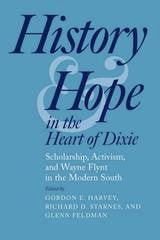
History and Hope in the Heart of Dixie
Scholarship, Activism, and Wayne Flynt in the Modern SouthEdited by Gordon E. Harvey, Richard D. Starnes and Glenn Feldman
University of Alabama Press, 2006
Exploring the history, challenges, and promise of a changing South through the legacy of Wayne Flynt.
This collection of essays on the social and political history of the modern South consider the region’s poor, racial mores and race relations, economic opportunity, Protestant activism, political coalitions and interest groups, social justice, and progressive reform. History and Hope in the Heart of Dixie illuminates the dual role of historian and public advocate in modern America. In a time when the nation’s eyes have been focused by Hurricanes Katrina and Rita onto the vulnerability and dire condition of poor people in the South, the applicability of research, teaching, and activism for this voiceless element seems all the more relevant.
Responding to the example of Wayne Flynt, whose fierce devotion to his state of Alabama and its region has not blinded his recognition of the inequities and despair that define southern life for so many, the scholars assembled in this work present contributions to the themes Flynt so passionately explored in his own work.Two seasoned observers of southern history and culture—John Shelton Reed and Dan T. Carter—offer assessments of Flynt’s influence on the history profession as a whole and on the region of the South in particular.
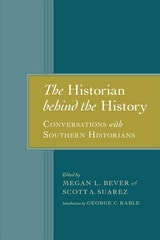
The Historian behind the History
Conversations with Southern HistoriansMegan L. Bever
University of Alabama Press, 2014
The historians and their main topics include:
Richard J. M. Blackett on antebellum and African American history
Dan T. Carter on Reconstruction, Civil Rights, and George Wallace
Pete Daniel on the New Deal and the Cold War South
Laura F. Edwards on the Early Republic, the Civil War, Reconstruction, and women’s history
William W. Freehling on the antebellum South
Gary W. Gallagher on the Civil War
Glenda Elizabeth Gilmore on Jim Crow
James M. McPherson on the Civil War
Theodore Rosengarten on the Depression
J. Mills Thornton III on the antebellum South
In his introduction, award-winning author and historian George C. Rable draws together the multifaceted themes of these interviews, offering a compelling overview of the nature of the field. Edited by Megan L. Bever and Scott A. Suarez, The Historian behind the History offers critical insights about the craft and professional life of the historian.

The Schoolhouse Door
Segregation's Last Stand at the University of AlabamaE. Culpepper Clark
University of Alabama Press, 2007
E. Culpepper Clark's book is a well-researched and crisply written narrative that draws its energy from the drama of the desegregation crisis in the postwar South. The first part of the story, covering the period 1943-57, centers on the admission to and expulsion from the University of Alabama of Autherine Lucy in 1956. In retrospect this appears as an opportunity for peaceful change that was tragically lost by inept university administrators and trustees, who stalled until Alabama's populist-New Deal politics shifted sharply toward segregationist defiance following the bus boycott in Montgomery in 1955-56. The second part centers on the events culminating in Wallace’s spectacular stand at Foster Auditorium in June 1963.
The flagship at Tuscaloosa, threatened by the research pace of the branch campuses at Birmingham and Huntsville, unable to keep or recruit superior faculty during the post-Sputnik boom years, weakly led by strong politicians like John Patterson and Wallace, emerged from the drama as a badly mauled institution, notable chiefly for its football team and Coach Paul 'Bear' Bryant