Results by title
15 books match the query 'Caste'
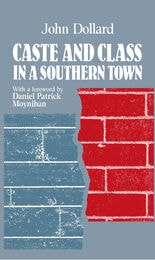
Caste and Class in a Southern Town
John Dollard
University of Wisconsin Press, 1989
An extraordinary powerful exposition of social patterns in a small town, Caste and Class in a Southern Town has become a benchmark in social science methodology and a classic in American studies. Now fifty years after its original publication, John Dollard’s most famous work offers timeless insights and remains essential to those interested in race-related social issues.
In 1937, W. E. B. Du Bois observed, "Dr. Dollard’s study is one of the most interesting and penetrating that has been made concerning the South and is marked by courage and real insight. . . . Dr. Dollard’s book marks a distinct advance in the study of the Southern scene."
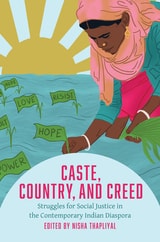
Caste, Country, and Creed
Struggles for Social Justice in the Contemporary Indian DiasporaNisha Thapliyal
Rutgers University Press, 2026
What happens when ancient systems of oppression travel across oceans? How do Indian diaspora communities across five nations challenge centuries-old systems of oppression while building new forms of solidarity? Caste, Country, and Creed: Struggles for Social Justice in the Contemporary Indian Diaspora takes readers inside the dynamic world of contemporary social justice activism spanning Aotearoa New Zealand, Australia, Canada, the United States, and the United Kingdom.
This groundbreaking collection brings together the voices of artists, activists, and scholar-activists who are reshaping conversations about caste discrimination, Islamophobia, and Hindu nationalism beyond India's borders. Through intimate first-person accounts and critical reflections, contributors reveal how diaspora activists are creating powerful counter-narratives and mobilizing collective resistance across local and transnational networks.
The book documents the lived realities of organizing—the values, knowledge traditions, and pivotal moments that spark political protest. Caste, Country, and Creed shows how activists construct alternative knowledge to dissent, build solidarity, and inspire political participation. Contributors offer nuanced insights into the complex relationships and power dynamics that sustain collective action for social justice in the Indian diaspora.
For copyright reasons, this edition is not for sale in India.
Cleansing the Nation
India, the Hindu Modern, and Mediations of GenderRaka Shome
Duke University Press, 2025
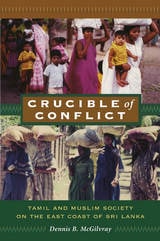
Crucible of Conflict
Tamil and Muslim Society on the East Coast of Sri LankaDennis B. McGilvray
Duke University Press, 2008
McGilvray explores the densely populated farming and fishing settlements in this coastal zone, focusing on the Tamil and Muslim inhabitants of an agricultural town in the Ampara District. Drawing on fieldwork conducted over more than thirty years as well as on Tamil and Dutch historical sources, he describes the regional dominance of a non-Brahmin matrilineal caste of thirteenth-century Kerala origin. The Muslims, who acquired dowry lands and matrilineal family patterns through local intermarriages, have in the twentieth century emerged from Hindu caste domination and are now the Tamil Hindus’ political and economic equals. Crucible of Conflict offers a uniquely detailed account of Muslim kinship and community organization in eastern Sri Lanka, as well as a comparison of Tamil and Muslim practices and institutions. McGilvray concludes with an analysis of the interethnic tensions and communal violence that have intensified in recent years.
Dalit Studies
Ramnarayan S. Rawat and K. Satyanarayana, editors
Duke University Press, 2016
Deep South
A Social Anthropological Study of Caste and ClassAllison Davis, Burleigh B. Gardner, and Mary R. Gardner
University of Chicago Press, 2022
First published in 1941, Deep South is a landmark work of anthropology, documenting in startling and nuanced detail the everyday realities of American racism. Living undercover in Depression-era Mississippi—not revealing their scholarly project or even their association with one another—groundbreaking Black scholar Allison Davis and his White co-authors, Burleigh and Mary Gardner, delivered an unprecedented examination of how race shaped nearly every aspect of twentieth-century life in the United States. Their analysis notably revealed the importance of caste and class to Black and White worldviews, and they anatomized the many ways those views are constructed, solidified, and reinforced.
This reissue of the 1965 abridged edition, with a new foreword from Pulitzer Prize winner Isabel Wilkerson—who acknowledges the book’s profound importance to her own work—proves that Deep South remains as relevant as ever, a crucial work on the concept of caste and how it continues to inform the myriad varieties of American inequality.
Democracy against Development
Lower-Caste Politics and Political Modernity in Postcolonial IndiaJeffrey Witsoe
University of Chicago Press, 2013
Witsoe looks at the history of colonialism in India and its role in both shaping modern caste identities and linking locally powerful caste groups to state institutions, which has effectively created a postcolonial patronage state. He then looks at the rise of lower-caste politics in one of India’s poorest and most populous states, Bihar, showing how this increase in democratic participation has radically threatened the patronage state by systematically weakening its institutions and disrupting its development projects. By depicting democracy and development as they truly are in India—in tension—Witsoe reveals crucial new empirical and theoretical insights about the long-term trajectory of democratization in the larger postcolonial world.
Hall of Mirrors
Power, Witchcraft, and Caste in Colonial MexicoLaura A. Lewis
Duke University Press, 2003
Using judicial records from a variety of colonial courts, Lewis highlights the ethnographic details of legal proceedings as she demonstrates how Indians, in particular, came to be the masters of witchcraft, a domain of power that drew on gendered and hegemonic caste distinctions to complicate the colonial hierarchy. She also reveals the ways in which blacks, mulattoes, and mestizos mediated between Spaniards and Indians, alternatively reinforcing Spanish authority and challenging it through alliances with Indians. Bringing to life colonial subjects as they testified about their experiences, Hall of Mirrors discloses a series of contradictions that complicate easy distinctions between subalterns and elites, resistance and power.
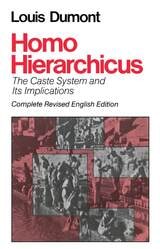
Homo Hierarchicus
The Caste System and Its ImplicationsLouis Dumont
University of Chicago Press, 1981
This edition includes a lengthy new Preface in which Dumont reviews the academic discussion inspired by Homo Hierarchicus and answers his critics. A new Postface, which sketches the theoretical and comparative aspects of the concept of hierarchy, and three significant Appendixes previously omitted from the English translation complete this innovative and influential work.
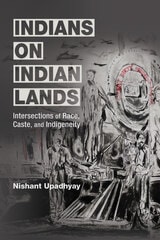
Indians on Indian Lands
Intersections of Race, Caste, and IndigeneityNishant Upadhyay
University of Illinois Press, 2024
Winner of a NWSA/University of Illinois Press First Book Prize
Nishant Upadhyay unravels Indian diasporic complicity in its ongoing colonialist relationship with Indigenous peoples, lands, and nations in Canada. Upadhyay examines the interwoven and simultaneous areas of dominant Indian caste complicity in processes of settler colonialism, antiblackness, capitalism, brahminical supremacy, Hindu nationalism, and heteropatriarchy. Resource extraction in British Columbia in the 1970s–90s and in present-day Alberta offer examples of spaces that illuminate the dispossession of Indigenous peoples and simultaneously reveal racialized, gendered, and casted labor formations. Upadhyay juxtaposes these extraction sites with examples of anticolonial activism and solidarities from Tkaronto. Analyzing silence on settler colonialism and brahminical caste supremacy, Upadhyay upends the idea of dominant caste Indian diasporas as racially victimized and shows that claiming victimhood denies a very real complicity in enforcing other power structures. Exploring stories of quotidian proximity and intimacy between Indigenous and South Asian communities, Upadhyay offers meditations on anticolonial and anti-casteist ways of knowledge production, ethical relationalities, and solidarities.Groundbreaking and ambitious, Indians on Indian Lands presents the case for holding Indian diasporas accountable for acts of violence within a colonial settler nation.
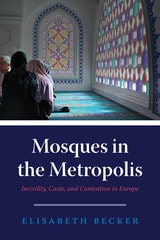
Mosques in the Metropolis
Incivility, Caste, and Contention in EuropeElisabeth Becker
University of Chicago Press, 2021

On the Edge of the Auspicious
GENDER AND CASTE IN NEPALMary M. Cameron
University of Illinois Press, 1998
been noticeably absent from ethnographic accounts of the Himalayan region.
Starting from the perspective of lower-caste Hindu women, Mary M. Cameron
offers a long-overdue study of artisans and farmers in western Nepal.
On the Edge of the Auspicious skillfully shows the connections
between caste hierarchy and gender relations leading to domestic, economic,
and religious power of lower-caste women. Situating her study in the history
of land ownership and contemporary family and work relations, Cameron
explains how and why patriarchal ideology associated with high-caste families
in Nepal does not apply to women of lower caste. Drawing on data from
work, family, and religious domains, this ethnography goes further than
other current studies of caste hierarchy in South Asia to show the everyday
material and ideological dimensions of domination and lower-caste people's
resistance to them..
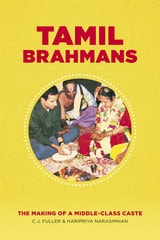
Tamil Brahmans
The Making of a Middle-Class CasteC. J. Fuller and Haripriya Narasimhan
University of Chicago Press, 2014
Fuller and Narasimhan offer one of the most comprehensive looks at Tamil Brahmans around the world to date. They examine Brahman migration from rural to urban areas, more recent transnational migration, and how the Brahman way of life has translated to both Indian cities and American suburbs. They look at modern education and the new employment opportunities afforded by engineering and IT. They examine how Sanskritic Hinduism and traditional music and dance have shaped Tamil Brahmans’ particular middle-class sensibilities and how middle-class status is related to the changing position of women. Above all, they explore the complex relationship between class and caste systems and the ways in which hierarchy has persisted in modernized India.
The Poison in the Gift
Ritual, Prestation, and the Dominant Caste in a North Indian VillageGloria Goodwin Raheja
University of Chicago Press, 1988

Waiting for the Cool Moon
Anti-imperialist Struggles in the Heart of Japan's EmpireWendy Matsumura
Duke University Press, 2024