Results by title
4 books match the query 'Castile, George Pierre'
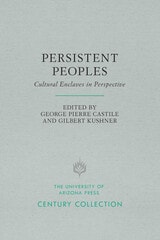
Persistent Peoples
Cultural Enclaves in PerspectiveEdited by George Pierre Castile and Gilbert Kushner
University of Arizona Press, 1981
What constitutes a people? Persistent Peoples draws on enduring groups from around the world to identify and analyze the phenomenon of cultural enclavement. While race, homeland, or language are often considered to be determining factors, the authors of these original articles demonstrate a more basic common denominator: a continuity of common identity in resistance to absorption by a dominant surrounding culture.
Contributors:
William Y. Adams
George Pierre Castile
N. Ross Crumrine
Timothy Dunnigan
Charles J. Erasmus
Frederick J. E. Gorman
Vera M. Green
William B. Griffen
Robert C. Harman
Mark P. Leone
Janet R. Moone
John van Willigen
Willard Walker
Contributors:
William Y. Adams
George Pierre Castile
N. Ross Crumrine
Timothy Dunnigan
Charles J. Erasmus
Frederick J. E. Gorman
Vera M. Green
William B. Griffen
Robert C. Harman
Mark P. Leone
Janet R. Moone
John van Willigen
Willard Walker
[more]
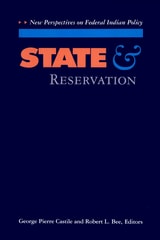
State and Reservation
New Perspectives on Federal Indian PolicyEdited by George Pierre Castile and Robert L. Bee
University of Arizona Press, 1992
Ten original essays focus on the rise, change, and persistence of the Native American reservation system. Contributors drawn from history, anthropology, sociology, and political science offer divergent points of view buttressed by historical and ethnographic case studies. Together, these articles suggest that the time has come—or is long overdue—to rethink the basic assumptions underlying Federal Indian policy.
CONTENTS
Introduction, George Pierre Castile & Robert L. Bee
Part I—Historical Foundations of the Reservation System
An Elusive Institution: The Meanings of Indian Reservations in Gold Rush California, John M. Findlay
Crow Leadership Amidst Reservation Oppression, Frederick E. Hoxie
Part II—The Nonreservation Experience
Utah Indians and the Homestead Laws, Martha C. Knack
The Enduring Reservations of Oklahoma, John H. Moore
Without Reservation: Federal Indian Policy and the Landless Tribes of Washington, Frank W. Porter, III
Part III—Power and Symbols
Riding the Paper Tiger, Robert L. Bee
Indian Sign: Hegemony and Symbolism in Federal Indian Policy, George P. Castile
Part IV—The Resource Base
Primitive Accumulation, Reservations, and the Alaska Native Claims Settlement Act, Lawrence Weiss & David C.Maas
Shortcomings of the Indian Self-Determination Policy, George S. Esber, Jr.
Getting to Yes in the New West: The Negotiation of Policy, Thomas R. McGuire
[more]
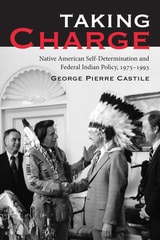
Taking Charge
Native American Self-Determination and Federal Indian Policy, 1975–1993George Pierre Castile
University of Arizona Press, 2006
The Indian Self-Determination Act of 1975 sought to restore self-government to peoples whose community affairs had long been administered by outsiders. This book explores whether that bold ambition was actually realized. Taking Charge is a sequel to the author’s landmark work To Show Heart, which examined Indian policy through 1975. George Castile now explores federal Indian policy in the Carter, Reagan, and first Bush administrations, tracing developments triggered by executive and congressional action—or inaction—and focusing on the dynamics of self-determination as both policy objective and byword in the wake of the landmark 1975 legislation. Drawing on unpublished presidential papers and other archival sources, Castile chronicles the efforts of three presidents to uphold Richard Nixon’s commitment to policy change, weighing such issues as the impact of Reaganomics and the advent of Indian gaming. He examines the marginalizing of Indian policy in both the executive and legislative branches in the face of larger issues, as well as the recurring tendency of policy to be driven by a single determined individual, such as South Dakota senator James Abourezk. Although self-determination is roundly advocated by all concerned with federal Indian policy, until now no book has provided a grasp of both its background and its implications. Taking Charge is an essential contribution to the critical study of that policy that allows a better understanding of contemporary Indian affairs.
[more]
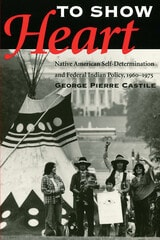
To Show Heart
Native American Self-Determination and Federal Indian Policy, 1960-1975George Pierre Castile
University of Arizona Press, 1998
Federal policy toward Native Americans has fluctuated wildly in the twentieth century. Washington long envisioned that Indians would be assimilated into American culture—until FDR's New Deal introduced tribal self-government. Then, during the Truman and Eisenhower administrations, its goal became the termination of federal wardship status for Indians. This book considers the changes in attitude that began in 1960 and culminated in the Indian Self-Determination Act of 1975. Drawing on personal interviews with key players, George Castile goes behind the scenes in Washington to reveal what motivated policy makers—and who really shaped policy—from the Kennedy to the Ford administrations.
To Show Heart is a detailed and unbiased account of one of the least understood periods in Indian affairs. It tells how "termination" became a political embarrassment during the civil rights movement, how Lyndon Johnson's War on Poverty prompted politicians to rethink Indian policy, and how championing self-determination presented an opportunity for Presidents Nixon and Ford to "show heart" toward Native Americans. Along the way, Castile assesses the impact of the Indian activism of the 1960s and 1970s and offers an objective view of the American Indian Movement and the standoff at Wounded Knee. He also discusses the recent history of individual tribes, which gives greater meaning to decisions made at the national level. Castile's work greatly enhances our understanding of the formulation of current Indian policy and of the changes that have occurred since 1975. To Show Heart is an important book not only for anthropologists and historians but also for Native Americans themselves, who will benefit from this inside look at how bureaucrats have sought to determine their destinies.
To Show Heart is a detailed and unbiased account of one of the least understood periods in Indian affairs. It tells how "termination" became a political embarrassment during the civil rights movement, how Lyndon Johnson's War on Poverty prompted politicians to rethink Indian policy, and how championing self-determination presented an opportunity for Presidents Nixon and Ford to "show heart" toward Native Americans. Along the way, Castile assesses the impact of the Indian activism of the 1960s and 1970s and offers an objective view of the American Indian Movement and the standoff at Wounded Knee. He also discusses the recent history of individual tribes, which gives greater meaning to decisions made at the national level. Castile's work greatly enhances our understanding of the formulation of current Indian policy and of the changes that have occurred since 1975. To Show Heart is an important book not only for anthropologists and historians but also for Native Americans themselves, who will benefit from this inside look at how bureaucrats have sought to determine their destinies.
[more]