Results by title
3 books match the query 'Catechisms'
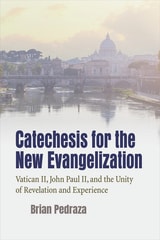
Catechesis for the New Evangelization
Vatican II, John Paul II, and the Unity of Revelation and ExperienceBrian Pedraza
Catholic University of America Press, 2020
Popes Francis, Benedict XVI, and John Paul II have called the present a time of New Evangelization for the Church and have stressed the importance of catechesis for this mission. John Paul II claimed that this renewal of the Church’s mission is grounded in the teachings of the Second Vatican Council. Nevertheless, approaches to catechesis in the conciliar and postconciliar era have varied greatly, as evidenced by the shifts in catechetical practice effected by the modern catechetical movement. Just as the dominant forms of theology changed from neo-scholastic to anthropological approaches so, too, did catechesis move from catechism-based approaches to more anthropological models based upon human experience.
In light of this context, Catechesis for the New Evangelization examines the theological foundations of catechesis in the Church’s understanding of divine revelation and its reception by the human person, especially as found in the conciliar constitutions, Dei Verbum and Gaudium et Spes. After drawing norms on divine revelation from these documents, it traces the history of the modern catechetical movement in order to compare this history with the conciliar norms, highlighting the renewal’s strengths and weaknesses.
These steps prepare the way for the main part of the book: an examination of the anthropology of Karol Wojtyła/Pope John Paul II. Ultimately, his anthropology provides an understanding of the person that can unite divine revelation and human experience in a way that takes what is best from the modern catechetical movement, while developing the ministry in a way that can be fruitful for the New Evangelization.
Pedraza’s book is not only an incisive look at modern catechetical history and theory. It also touches upon some of the most important theological topics of the past century, including the neo-scholastic crisis, the proper interpretation of the Council, the relationship of nature and grace, and the modern understanding of the imago dei, with the research and competency appropriate for scholarly interest and the accessibility needed for educated practitioners in catechesis.
[more]
Doctrinal Sermons on the Catechism of the Catholic Church
Kenneth Baker
St. Augustine's Press, 2012
[more]
Teaching and Mentoring Writers in the Sciences
An Evidence-Based ApproachBethann Garramon Merkle and Stephen B. Heard
University of Chicago Press, 2025
Blending deep experience, humor, and evidence-based advice, this is an invaluable resource for everyone involved in developing good scientific writers.
Every scientist eventually teaches scientific writing or mentors junior scientists as they develop their writing skills—only to discover that the task is both challenging and remarkably time-consuming. If you are in this position, Teaching and Mentoring Writers in the Sciences is the resource you need, offering approaches that will help you help writers develop their skills more effectively and with less time and effort.
Bethann Garramon Merkle and Stephen B. Heard, both experts in scientific communication, offer evidence-based advice that draws on their own extensive experience as well as on proven tactics from writing studies, science studies, and rhetoric and composition. Shorn of the unfamiliar and off-putting jargon that much pedagogy literature adopts, their advice is engaging and accessible to scientists. As you read, you’ll see where developing writers are coming from; how mastering scientific writing matters to the careers of students who do and don’t continue in academia; how writing occurs and is taught in both undergraduate and graduate curricula; how to find and harness teaching resources that help share the workload; how to teach writing to students who speak English as an additional language; and how to navigate the use (by yourself and by developing writers) of tools from pencils and dictionaries to AI writing assistants. If you teach or mentor scientific writers, this book will help you deliver what your students and mentees need most: clear, effective writing guidance.
[more]