Results by title

10 books match the query 'Catholic Church and philosophy'
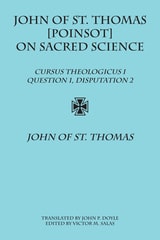
cover of John of St. Thomas [Poinsot] on Sacred Science: Cursus Theologicus I, Question 1, Disputation 2

John of St. Thomas [Poinsot] on Sacred Science

Cursus Theologicus I, Question 1, Disputation 2

John Of St. Thomas

St. Augustine's Press, 2012

This volume offers an English translation of John of St. Thomas’s Cursus theologicus I, question I, disputation 2. In this particular text, the Dominican master raises questions concerning the scientific status and nature of theology. At issue, here, are a number of factors: namely, Christianity’s continual coming to terms with the “Third Entry” of Aristotelian thought into Western Christian intellectual culture – specifically the Aristotelian notion of ‘science’ and sacra doctrina’s satisfaction of those requirements – the Thomistic-commentary tradition, and the larger backdrop of the Iberian Peninsula’s flourishing “Second Scholasticism.” 
    In this latter context, John of St. Thomas applies the theological principles of Thomas Aquinas to the Scholastic disputes preoccupying Thomist, Franciscan, and Jesuit theologians, such as Cajetan, Bañez, Luis de Molina, Vazquez, Suárez – to name only a few – in a tour de force of theological thinking throughout the entire period of Scholasticism. In the process – and not insignificantly – the status quaestionis of theology’s scientific character is clearly framed and answered according to John’s satisfaction. 
    Key to John of St. Thomas’s resolution of the question is his understanding of the continuity of the     power of human reason with the super-intelligibility of divine revelation spelled out in terms of what he calls “virtual revelation.” This text presented in this volume is a quintessential example of the deep and abiding harmony that flourished between faith and reason as well as grace and nature within the golden era of Baroque Scholasticism.
[more]
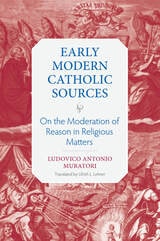
cover of On the Moderation of Reason in Religious Matters

On the Moderation of Reason in Religious Matters

Ludovico Antonio Muratori

Catholic University of America Press, 2024
Lodovico Antonio Muratori (1672 –1750) was an Italian Catholic priest, notable as historian and a leading scholar of his age, and for his discovery of the Muratorian fragment, the earliest known list of New Testament books. No other book inspired Catholics of the 18th century more than Muratori's On the Moderation of Reason in Religious Matters. Ever since its publication in 1714, it had virtually a magisterial status by those who sought to revitalize the intellectual verve of Catholic theology. In essay form, Muratori addressed the fundamental challenges of doubt, authority, blind faith, the Copernican worldview, and the limitations of human reason. This work is a must-read for anyone looking to deepen their understanding of the intersection between religion and reason.
[more]
cover of Person, Being, and History

Person, Being, and History

Michael Baur

Catholic University of America Press, 2011

the various essays in this volume by colleagues and former students of Schmitz examine his thought and the subjects of his teaching. In addition to an overall exposition of his own thought, the collection treats themes such as gift, faith and reason, culture and dialogue, modernity and post-modernity
[more]
cover of Scattering the Seed: A Guide through Balthasar's Early Writings on Philosophy and the Arts

Scattering the Seed

A Guide through Balthasar's Early Writings on Philosophy and the Arts

Aidan Nichols

Catholic University of America Press, 2006
[more]
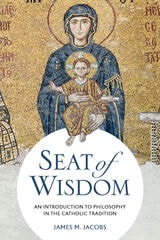
cover of Seat of Wisdom: An Introduction to Philosophy in the Catholic Tradition

Seat of Wisdom

An Introduction to Philosophy in the Catholic Tradition

James M. Jacobs

Catholic University of America Press, 2021
The Catholic Church has always recognized that philosophy is necessary both to understand the faith as well as to defend it. The need for a philosophically informed faith has become more acute with the rise of secularism. Seat of Wisdom demonstrates that the philosophical principles developed in the Catholic tradition, especially as articulated in Thomism, provide the intellectual foundation for belief in God and are also the only reliable basis for a fully coherent vision of man’s place in the world. Seat of Wisdom begins with an exploration of the relationship between faith and reason. Philosophy’s essential role is to discover the rational principles underlying the intelligible order of reality. These principles act as a bridge connecting science and religious faith, enabling the believer to integrate all facets of human experience. Each of those first principles, as expressed in the transcendental properties, are then analyzed as the basis of the major philosophical disciplines. Starting with metaphysics’ study of being, the argument proceeds to consider the true, the good, and the beautiful in terms of epistemology, anthropology, ethics, aesthetics, and political philosophy. Lastly, these principles are shown to point to God as creator. The strength of the Catholic philosophical tradition is evident when contrasted with reductive theories which fail to account for the breadth of human experience. Consequently, each chapter will introduce influential philosophers whose inadequate theories inform contemporary assumptions. Against this, the Thomistic argument is elucidated as being inclusive of the insights of the reductive position. It will be seen that this “both/and” approach is the only way to do justice to the glory of God and the gift of creation. Religion is prey to skepticism when it is isolated from the rest of knowledge. This integrative argument, uniting discussions of nature, politics, and theology according to common principles, enables the reader to grasp the unity of wisdom. Moreover, by engaging alternative positions, it provides the reader with tools to defend the Catholic worldview against those reductive philosophies which only deprive life of its full meaning.
[more]
cover of The Classical Moment: Selected Essays on Knowledge and Its Pleasures

The Classical Moment

Selected Essays on Knowledge and Its Pleasures

James V. Schall

St. Augustine's Press, 2014

The essay is one of the great inventions of the human mind. It can talk about anything and everything. It can be lightsome or solemn. It can be witty or informative. Above all, it is short. It likes the passage in which Socrates told Callicles in the Gorgias to make his answers brief. Yet, we can find in essays things we need and want to know. Aquinas often managed to make the most profound arguments in two paragraphs. Samuel Johnson did the same. 
      The Classical Moment is, indeed, a collection of “selected essays.” Such a collection is a classical and beloved form of English letters, the literary form most preferred by Schall. 
     The essays in this book all touch on knowledge and its pleasures. Schall does not tarry on the effort and determination it often takes to say just what we want to say, then say it and know that we have said it. Somehow, when an essay is written, an author simply knows that it is complete, that it is what he wanted to say. He says to himself, “Yes, that is it.” An essayist may well be conscious that when he begins an essay, he really does not know what he will finally say. The writing is the saying. Our writing is our thinking, our thinking-through, our being pleased to know this is it . . . this is the point Schall, one of America’s greatest essayists, makes here.
      The “classical moment” is that intense experience of seeing or hearing or encountering some vista, or song, or person that takes us out of ourselves. We are most ourselves somehow when we are most outside of ourselves, seeing what is not ourselves. We are intended to be more than ourselves in being ourselves, to know with others what is the truth, to know what is.
      These essays originally appeared in regular columns done in various journals, papers, and on-line sources. One can read them in any order. The order of the author or collector does have a certain “logic,” but each essay is also a whole, something contained within itself. 
     The unity of an essay collection is found more in a kind enthrallment that comes to us when we deal with the things that are both important and delightful. At bottom, these essays belong together. Aristotle warned us that if we did not delight in the things that are, we would seek our highest pleasures where they are not really found. 
        We will always seek something to delight in. What civilization is about lies in finding what is really worthy of the capacity of delight that is given to us in our being. The “classical moment” is the perfect phrase that brings us to the threshold of this experience. We have to enter it ourselves, but once inside, we will find so much more than ourselves. And we will rejoice.
 

[more]
cover of The Reception of Pragmatism in France and the Rise of Roman Catholic Modernism, 1890-1914

The Reception of Pragmatism in France and the Rise of Roman Catholic Modernism, 1890-1914

David G. Schultenover

Catholic University of America Press, 2009
This collection of essays provides a small revolution in the study of Roman Catholic Modernism, a movement that until now has been largely seen as an episode that underscored institutional Catholicism's isolation from the mainstream intellectual currents of the time.
[more]
cover of The Unchanging Truth of God? Crucial Philosophical Issues for Theology

The Unchanging Truth of God? Crucial Philosophical Issues for Theology

Thomas G. Guarino

Catholic University of America Press, 2021
It has long been a cornerstone of Catholic belief that Christians can be intelligent and creative thinkers—inquisitive seekers after truth—as well as men and women of ardent faith. Catholics are entirely committed, then, to the claim that human rationality and religious faith are complementary realities since they are equally gifts of God. But understanding precisely how faith and reason cohere has not always been a smooth path. At times, theology has allowed philosophy to become the leading (and baleful) partner in the faith-reason relationship, thereby lapsing into rationalism or relativism. At other times, theology has been tempted by fideism, with philosophy now regarded as little more than a pernicious intruder corrupting Christian faith, life and thought. The essays in this volume display how Catholicism understands the proper confluence between philosophy and theology, between human rationality and Christian faith, between the natural order and supernatural grace. To illustrate these points, the book draws on a long line of Christian thinkers: Origen, Augustine, Anselm, Aquinas and, in our own day, Fides et Ratio of John Paul II and the Regensburg Address of Benedict XVI. How is theology always a “Jewgreek” enterprise—to borrow a term from Jacques Derrida—always a combination of the biblical (Hebraic) and philosophical (Hellenic) traditions? Why is one particular element of philosophy, metaphysics, essential for the intelligibility and clarity of Catholic theology? Why is this so much the case that John Paul II could state emphatically: “a philosophy which shuns metaphysics would be radically unsuited to the task of mediation in the understanding of Revelation”? But theology cannot simply be about dialogue with philosophers of yesteryear. Theology must constantly incorporate fresh thinking and remain in lively conversation with an extensive variety of contemporary perspectives. This book displays how reciprocity and absorption has been characteristic of theology’s past and must represent its future as well.
[more]
cover of Theology Needs Philosophy

Theology Needs Philosophy

Matthew L. Lamb

Catholic University of America Press, 2016
Theology Needs Philosophy brings together essays by leading theologians and philosophers on the fundamental importance of human reason and philosophy for Catholic theology and human cultures generally. This edited collection studies the contributions of reason, with its acquired wisdom, science, and scholarship, in five sections. Those sections are: (1) the inevitable presence and service of philosophy in theology; (2) the metaphysics of creation, nature, and the natural knowledge of God; (3) the history of Logos as reason in the fathers, in St. Thomas Aquinas, and Medieval Biblical commentaries; (4) the role of reason in Trinitarian theology, Christology, and Mariology; and finally (5) reason in the theology of Aquinas.
[more]
cover of Wisdom in Bonaventure's <i>Hexameron</i>: Philosophical Problems, Theological Solutions

Wisdom in Bonaventure's <i>Hexameron</i>

Philosophical Problems, Theological Solutions

Benjamin Winter

Catholic University of America Press, 2024

This book presents Saint Bonaventure as a cutting-edge thinker who engaged with natural philosophy on its own terms. His final academic project was an unfinished collection of scholastic sermons titled Collationes in Hexaëmeron. At this moment in history, academics were clashing over the limits of cognition and the definition of science (scientia). Much has been written detailing how the incorporation of Aristotle’s philosophy into university curricula eventually prompted the Condemnations of 1270 and 1277. But perhaps it is incorrect to conceive of these events in a frame of escalating tensions leading to collapse. Perhaps a new perspective can be found by venturing back to 1273, to see Aristotle through the eyes of a theologian who was both magister and minister, bishop and brother—one who respected the academy’s rigor but also challenged its tendency toward self-absorption. Guiding readers through vision one of Collationes in Hexaëmeron, Benjamin Winter argues that Bonaventure’s rejection of certain philosophical errors ought to be understood within the context of the virtuous person’s journey to wisdom. Propositions such as the eternity of the world, the unicity of the intellect, and fated necessity are not variables in a zero-sum equation “balanced out” by truths of faith. Instead, Bonaventure sees these propositions as opportunities to reflect charitably on nature and grace, emphasizing that just as knowledge is empty without love, understanding is insufficient without humility. Rather than renounce Aristotle or stifle scientific inquiry, Collationes in Hexaëmeron wholeheartedly acknowledges the affective and communal dimensions of philosophical knowledge. Bonaventure creates a magnificent and enduring text with powerful applications today.
[more]