Results by title
5 books match the query 'Catholic Social Teaching'
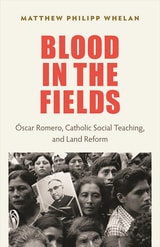
Blood in the Fields
Óscar Romero, Catholic Social Teaching, and Land ReformMatthew Philipp Whelan
Catholic University of America Press, 2020
On March 24, 1980, a sniper shot and killed Archbishop Óscar Romero as he celebrated mass. Today, nearly four decades after his death, the world continues to wrestle with the meaning of his witness.
Blood in the Fields: Óscar Romero, Catholic Social Teaching, and Land Reform treats Romero’s role in one of the central conflicts that seized El Salvador during his time as archbishop and that plunged the country into civil war immediately after his death: the conflict over the concentration of agricultural land and the exclusion of the majority from access to land to farm. Drawing extensively on historical and archival sources, Blood in the Fields examines how and why Romero advocated for justice in the distribution of land, and the cost he faced in doing so.
In contrast to his critics, who understood Romero’s calls for land reform as a communist-inspired assault on private property, Blood in the Fields shows how Romero relied upon what Catholic Social Teaching calls the common destination of created goods, drawing out its implications for what property is and what possessing it entails. For Romero, the pursuit of land reform became part of a more comprehensive politics of common use, prioritizing access of all peoples to God’s gift of creation.
In this way, Blood in the Fields reveals how close consideration of this conflict over land opened up into a much more expansive moral and theological landscape, in which the struggle for justice in the distribution of land also became a struggle over what it meant to be human, to live in society with others, and even to be a follower of Christ. Understanding this conflict and its theological stakes helps clarify the meaning of Romero’s witness and the way God’s work to restore creation in Christ is cruciform.
[more]
Catholic Social Teaching
Mary Hobgood
Temple University Press, 1991
"This excellent book is one of the few scholarly investigations that analyze the official Catholic School Teaching from the perspective of the secular, economic, and political sciences."
--Gregory Baum
Drawing upon a lively debate within the field of social theory, Mary E. Hobgood argues that the paradigm conflict between orthodox neoclassical and radical economic models is reflected in Catholic documents that address economic justice. She maintains that dynamics within Catholic teaching are explicable only in terms of this clash of fundamentally opposing perspectives.
This study shows how normative values of social justice are always tied to a particular social theory or model of society. When assumptions shift from one model to another, the concrete actions mandated by these justice norms change significantly. Consequently, the Catholic social justice tradition contains not only two mutually exclusive analyses of capitalist dynamics, it also has very different interpretations of such norms as economic democracy and a preferential notion for the poor. Hobgood argues that the Church needs to clarify the economic models that inform its social justice mandates and to assess those models for their compatibility with the Church's moral concerns, otherwise, Catholic social teaching's interpretations of justice and how Christians must act for it remain inconsistent.
"[Mary Hobgood] asks what Catholic teaching itself has assumed about the way the economy works, and she brings to the fore hidden assumptions that are fundamental to the policy prescriptions in Catholic teaching.... The result is a clear picture of the divided mind and practice of Catholicism when confronting twentieth-century economic realities. If Catholic teaching did us all the service of finding a strong moral and theological voice for a critique of secular economics, Dr. Hobgood points the way to make that voice a clearer one, more aware of its limitations and of its potential."
--Larry L. Rasmussen, from the Foreword
"This is one of the most enlightening analyses of Catholic social teaching that I have ever read. It goes far beyond the available commentaries because of its sharp focus on the economic--not just as the content of the teaching, but its provision of the theoretical framework in which to situate the economic content. The book is very insightful with regard to Catholic social teaching, but I think her exposition holds great value for the analysis of World Council of Churches' positions and the positions of any denomination. Even beyond that, her models throw light on the daily battles within any church institution that is working for justice and peace while at the same time engaging in the compromises and contradictions required to maintain itself within the current economic system."
--Marie J. Giblin, Maryknoll School of Theology
[more]
Handbook of Catholic Social Teaching
A Guide for Christians in the World TodayMartin Schlag
Catholic University of America Press, 2017
Handbook of Catholic Social Teaching employs a question and answer format, to better accentuate the response of the Church's message to the questions Catholics have about their social role and what the Church intends to teach about it. Written in consultation with the Pontifical Council for Justice and Peace, the Handbook should take its place alongside the Catechism of the Social Doctrine of the Church on the shelf of informed Catholics as works that can inform what we believe and do in the public sphere.
[more]
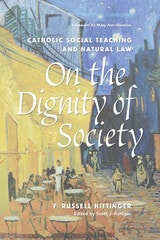
On the Dignity of Society
Catholic Social Teaching and Natural LawF. Russell Hittinger
Catholic University of America Press, 2024
In this collection of essays, Francis Russell Hittinger shows that Catholic social teaching is not only an articulate defense of the dignity of the human person, but perhaps more fundamentally an elucidation of the dignity of society. Indeed, Hittinger enables us to see that one cannot properly defend the dignity of the person without also showing the dignity of societies in which human persons – as naturally familial, political, and ecclesial animals – seek their own perfection in communion with others. Hittinger has been a renowned scholar of Catholic social doctrine for some time now, and the essays presented here are the fruit of his mature thinking on the topic over the course of many years. As each chapter shows, Hittinger’s historically important body of work on Catholic moral and social philosophy and theology is rooted in natural law theory and Thomistic philosophy, but also animated by St. Augustine’s thought and thus consistently sensitive to historical contexts and arenas for moral and theological disputation. These magisterial essays therefore integrate historical studies of the development of Catholic social teaching with systematic exposition of the theological coherence of that tradition, while also articulating the essential role of philosophy and natural law within both.
The volume is divided into three parts. The first part is comprised of six essays on Catholic social teaching, the second part is made up of six essays on natural law and its role in social doctrine, and the third part includes two essays discussing the first principles of the Church’s teaching on social issues. This collection will no doubt become a standard in the field of scholarship on Catholic social teaching.
[more]
The Common Good of Constitutional Democracy
Essays in Political Philosophy and on Catholic Social TeachingMartin Rhonheimer
Catholic University of America Press, 2013
The Common Good of Constitutional Democracy offers a rich collection of essays in political philosophy by Swiss philosopher Martin Rhonheimer. Like his other books in both ethical theory and applied ethics, which have recently been published in English, the essays included are distinguished by the philosophical rigor and meticulous attention to the primary and secondary literature of the various topics discussed
[more]