Results by title
7 books match the query 'Catholic Theology'
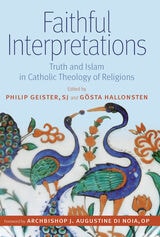
Faithful Interpretations
Truth and Islam in Catholic Theology of ReligionsPhilip Geister
Catholic University of America Press, 2021
”Theology of Religions” is among the most burning issues within Christian theology today. The challenge to study and discuss different ways of handling conflicting truth claims and religious narratives between religions is taken up by a growing number of theologians across denominational boundaries. This is a common and ecumenical effort undertaken by Christian theologians all over the world. And yet, the impact of specific ecclesiastical or theological traditions on different concepts of theology of religions should not be underestimated. As well known, the Second Vatican council with its pivotal decree Nostra Aetate (On the relation to other religions) not only set the agenda for Catholic theology, but even influenced the wider discussion on the topic. The papers of this volume were all given at a conference in Uppsala, Sweden in October 2017. The structure of Faithful Interpretations follows closely the way the conference was conducted.
A general introduction to the development and present status of ”Theology of Religions” by Marianne Moyaert opens the book. Archbishop J Augustine Di Noia of the Vatican Congregation for the Doctrine of Faith then treats the recent developments in the teaching of the Magisterium regarding theology of religions. Anna Bonta Moreland adresses the issue of Muhammad and Christian Prophecy. Diego R Sarrió Cucarella focuses on early Christian theological views of Islam and concludes that Islam has been from the begining a ”disturbing” factor in the Christian view of salvation history. Wilhelmus G B M Valkenberg discusses the impact of Nostra Aetate on the Church’s relation to Muslims, using especially the precedent of Nicolaus of Cues as regards a constructive approach to Islam. Klaus von Stosch adresses a sensitive issue in Muslim-Christian relations and illustrates the advantages of the comparative theology approach for the theology of religions.
Complementing this perspective, Peter Jonkers offers a hermeneutical perspective on truth claims, and reflects on ”the religious Other” with references to Jacques Derrida among others. Reinhold Bernhardt argues in favour of a biblically grounded “relational-existential” theory of truth, which would be most helpful with regard to other religions. To conclude, the prominent Catholic specialist on Theology of Religions, Gavin D’Costa, widened the perspective by addressing the relation to Judaism from the point of view of the covenant and the promises of the land. Altogether, the papers of this volume give a clear impression of the status of Roman Catholic Theology of Religions.
[more]
Principles of Catholic Theology, Book 1
On the Nature of TheologyThomas Joseph White, OP
Catholic University of America Press, 2023
Catholic theology has to face a certain number of fundamental questions: what is the nature and content of Christian revelation, what are the sources of revelation, how are the mysteries of the faith to be understood in relation of one to another, and how do the truths of the Catholic faith relate to the acquisitions of natural reason. In the contemporary context, Catholic theology is marked by a diversity of approaches, many of which are seemingly incompatible or estranged from one another. How might we think about the unity of Catholic theology over and above the diversity of forms? What role, if any, can Aquinas play as a common doctor in facilitating exchanges between theological traditions in the Church?
Principles of Catholic Theology seeks to address directly the nature of Catholic theology and the challenge of its contemporary articulation with an eye towards its articulation in its Thomistic key. This book is also the first of a series of collections of essays by Thomas Joseph White, OP, extending over a range of fundamental topics in Catholic dogmatic theology.
[more]
Principles of Catholic Theology, Book 2
On the Rational Credibility of ChristianityThomas Joseph White, OP
Catholic University of America Press, 2023
Can a philosopher defend the rational warrant for belief in Christianity? Is it reasonable to be religious? Is it philosophically responsible to be a Christian who believes in the mystery of the Trinity? Principles of Catholic Theology explores these questions in a systematic way by considering questions of ultimate explanation. Why not hold that modern atheistic naturalism provides the best explanation of reality? Or, if there is a transcendent first principle that explains all of reality, is it impersonal rather than personal? Contrastingly, if monotheism constitutes the best explanation for created being, how can we reasonably believe in any particular revelation concerning God? What are the criteria for rational belief in revelation?
Thomas Joseph White, OP, considers these questions by exploring a series of topics: the transcendentals (existence, oneness, truth, goodness, beauty); rational argument for the existence of God; the immateriality and subsistence after death of the personal soul of the human being; the historical and conceptual coherence of Trinitarian doctrine; and the reasonableness of the natural desire to see God. The aim of Principles of Catholic Theology, Book 2 is to place contemporary natural reason in profound dialogue with the Catholic faith and to think about ways that we can consent to the profound mystery of the Holy Trinity that are in robust concord with the knowledge obtained from philosophical, scientific, and historical sources.
[more]
Principles of Catholic Theology, Book 3
On God, Trinity, Creation, and ChristThomas Joseph White
Catholic University of America Press, 2024
What if anything can human beings know about God, either by way of philosophical reasoning or by divine revelation? How does the mystery of the Incarnation illuminate our understanding of the nature and mystery of God and the nature and destiny of the human person? The essays in this book explore topics pertaining to the nature of God, apophatic theology, divine simplicity and the holy Trinity, divine beauty, and the beauty of creation. The book also contains a series of speculative considerations of Christology: Why did God become human? How ought we understand the two natures of Christ and the topic of the communication of idioms (attribution of both divine and human properties to one person)? There is also a sustained treatment of Jesus' human knowledge and voluntary freedom. Did Jesus understand his own lordship and his unity with the Father and the Holy Spirit, and if so, how? Did Christ's human will always accord with the divine will, and what significance does this idea have for our understanding of the redemption affected by Christ for the whole human race? Through these explorations, principles drawn from Thomas Aquinas and from Thomistic tradition are taken into account as key resources for the adjudication of contemporary theological challenges.
Principles of Catholic Theology, Book 3 is a continuation of Fr. Thomas Joseph White's collection of essays, extending over a range of fundamental topics in Catholic dogmatic theology.
[more]
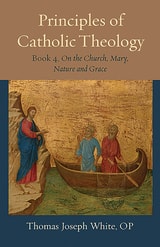
Principles of Catholic Theology, Book 4
On the Church, Mary, Nature and GraceThomas Joseph White
Catholic University of America Press, 2023
In the Nicene Creed Christians profess belief in the Church, "one, holy, catholic, and apostolic." The Church is also called the mystical body of Christ and the bride of Christ. What is the Church and how can we understand her mystery in light of the mystery of Christ? Principles of Catholic Theology, Book 4 explores Catholic ecclesiology and the theology of the Virgin Mary, as an exemplar of the Church's life. It also considers the people of Israel in light of the Church and Christ. The second half of the book considers human nature in light of the grace of Christ, and ecclesial humanity, so as to consider thematic and universal relations of grace to human nature. Major controversies are addressed such as the natural desire to see God and the Thomistic understanding of election and predestination. Effectively this volume seeks to receive and interpret the teaching of the Second Vatican Council Constitution on the Church, Lumen Gentium, within the Thomistic theological tradition and in light of that tradition.
Principles of Catholic Theology, Book 4 is a continuation of Fr. Thomas Joseph White's collection of essays, extending over a range of fundamental topics in Catholic dogmatic theology.
[more]
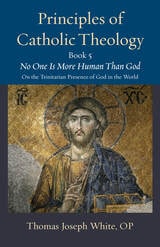
Principles of Catholic Theology, Book 5
No One is More Human Than God: On the Trinitarian Presence of God in the WorldThomas Joseph White
Catholic University of America Press, 2026
This work explores a Christian understanding of God’s presence in the world. As the Creator of all that exists, the Creator-Trinity is mysteriously present to all things, and truly but imperfectly knowable as such. In addition to this creative presence, however, there is also the manifestation of God’s presence as a gift of grace. By supernatural faith, the trinitarian life of God is made known to us as an object of the Christian mystical life. This life is centered especially upon God’s unique presence by way of Incarnation, human life, death, and resurrection, in the person of Jesus of Nazareth. This work explores these notions in comparison with other religious traditions, in a Catholic as well as ecumenical perspective. Original considerations are offered regarding the nature of scriptural inspiration, the Church as the mystical body of Christ, and the sacraments as instrumental expressions of the Incarnation, all with a view to the notion of mystical experience, and union with God.
Principles of Catholic Theology, Book 5 is a continuation of Fr. Thomas Joseph White’s collection of essays, extending over a range of fundamental topics in Catholic dogmatic theology.
[more]
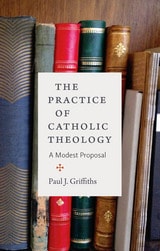
The Practice of Catholic Theology
Paul J. Griffiths
Catholic University of America Press, 2016
In The Practice of Catholic Theology: A Modest Proposal, Paul J. Griffiths has written a how-to book for Catholic theologians that will both instruct beginners and challenge long-time practitioners to sharpen their understanding of their craft. He defines Catholic theology as the practice of thinking, speaking, and writing about the God of Christian confession; so understood, it's something that anyone can learn to do. Personal sanctity is not required, but as with any other practice, practitioners of this beautiful and elevated thought-performance need to know some things and to develop some skills in order to be able to perform it.
[more]