Results by title

4 books match the query 'Catholic Tradition'
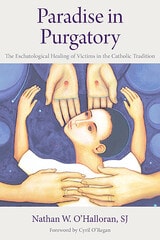
cover of Paradise in Purgatory: The Eschatological Healing of Victims in the Catholic Tradition

Paradise in Purgatory

The Eschatological Healing of Victims in the Catholic Tradition

Nathan W. O'Halloran

Catholic University of America Press, 2024
The claim of this book is that it is a precondition for Heaven that victims experience an eschatological healing of their other-inflicted wounds. Nathan O’Halloran, SJ, argues that the best theological space in which to locate this eschatological healing is in what he terms Paradise-in-Purgatory. The doctrine of Purgatory developed as a postmortem theological category for addressing sins committed after baptism and for which adequate penance has not been completed before death. In its full doctrinal articulations at Lyons II, Florence, and Trent, Purgatory is a doctrine concerned with personal, self-inflicted sin. Victims, on the other hand, require healing from other-inflicted sin rather than self-inflicted sin. For this reason, a certain expansion of this Catholic doctrine is required to make theological space for victims. O’Halloran argues that he has found that theological space within the Church’s ample tradition. The wellspring from which the doctrine of Purgatory emerged contains a richer content than has been represented thus far by conciliar definitions. Paradise in Purgatory maintains that the soteriological logic out of which Purgatory developed can be extended also to the postmortem healing of victims, and the soteriological logic of the New Testament supports this conclusion. Using as fundamental touchstones the wiping away of victims’ tears in the Book of Revelation, and the healing of Dinocrates through the prayers of his sister Perpetua in the Passion of Perpetua and Felicity, O’Halloran argues that victims must have an opportunity to experience full postmortem salvation from other-inflicted sin. The volume concludes that Purgatory can be theologically expanded to include a Paradise-in-Purgatory, i.e., a process that heals the other-inflicted wounds of sin which victims carry with them through death. The wounds of victims cannot be eschatologically discarded but must be subjected to the healing salvation which Christ came to offer.
[more]
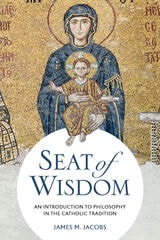
cover of Seat of Wisdom: An Introduction to Philosophy in the Catholic Tradition

Seat of Wisdom

An Introduction to Philosophy in the Catholic Tradition

James M. Jacobs

Catholic University of America Press, 2021
The Catholic Church has always recognized that philosophy is necessary both to understand the faith as well as to defend it. The need for a philosophically informed faith has become more acute with the rise of secularism. Seat of Wisdom demonstrates that the philosophical principles developed in the Catholic tradition, especially as articulated in Thomism, provide the intellectual foundation for belief in God and are also the only reliable basis for a fully coherent vision of man’s place in the world. Seat of Wisdom begins with an exploration of the relationship between faith and reason. Philosophy’s essential role is to discover the rational principles underlying the intelligible order of reality. These principles act as a bridge connecting science and religious faith, enabling the believer to integrate all facets of human experience. Each of those first principles, as expressed in the transcendental properties, are then analyzed as the basis of the major philosophical disciplines. Starting with metaphysics’ study of being, the argument proceeds to consider the true, the good, and the beautiful in terms of epistemology, anthropology, ethics, aesthetics, and political philosophy. Lastly, these principles are shown to point to God as creator. The strength of the Catholic philosophical tradition is evident when contrasted with reductive theories which fail to account for the breadth of human experience. Consequently, each chapter will introduce influential philosophers whose inadequate theories inform contemporary assumptions. Against this, the Thomistic argument is elucidated as being inclusive of the insights of the reductive position. It will be seen that this “both/and” approach is the only way to do justice to the glory of God and the gift of creation. Religion is prey to skepticism when it is isolated from the rest of knowledge. This integrative argument, uniting discussions of nature, politics, and theology according to common principles, enables the reader to grasp the unity of wisdom. Moreover, by engaging alternative positions, it provides the reader with tools to defend the Catholic worldview against those reductive philosophies which only deprive life of its full meaning.
[more]
cover of Shared Mission: Religious Education in the Catholic Tradition, Revised Edition

Shared Mission

Religious Education in the Catholic Tradition, Revised Edition

Leonardo Franchi

Catholic University of America Press, 2023
This book is a contribution to scholarship in the field of religious education. Its aim is simple: to offer a critical perspective on the nature of religious education in the light of contemporary developments in Catholic thinking in catechesis and wider thinking in education. The issues raised in the book will provide ample material for fruitful dialogue and constructive debate in the world of Catholic education. Part One revolves around four historical contexts selected specifically to illuminate contemporary developments in the field. While these historical periods have porous boundaries, they offer a working structure in support of the core claims of the book. Part Two explores the complex genealogy of the relationship between catechesis and Religious Education. Key thematic frames of reference within which the relevant Magisterial documents and associated academic literature are set out and explored chronologically thus allowing for some cross-referencing across the themes: unsurprisingly the range of the issues for debate resists a neat packaging within specific time-frames but does provide a helpful working structure. Part Three proposes that a Spirituality of Communion should underpin the Church’s work in catechesis, education and Religious Education. Shared Mission seems to be a satisfactory articulation of the necessary dialogic relationship between both fields and offers a suitable space for both distinction and reciprocity. The revised edition contains an appendix on the Global Compact on Education.
[more]
cover of The Catholic Tradition

The Catholic Tradition

Thomas Langan

University of Missouri Press, 1998

In his Tradition and Authenticity in the Search for Ecumenic Wisdom, Thomas Langan argued that the close interaction of traditions in today's society calls for methodical critical appropriation of the beliefs fostered by the principal traditions. He also promised to demonstrate by example how such appropriation could be accomplished. In The Catholic Tradition, Langan successfully fulfills that vow by showing how a tradition—the Catholic—has shaped his own outlook.

In this comprehensive study, Langan examines the history of the Catholic Church and the origins of its teachings since the Church's conception. Although committed to the Catholic religion, Langan does not obscure the Church's failings as he lays out the fundamentals of the Catholic faith.

He provides insight into the great Christological councils, discusses the differences in the spiritualities of East and West, and portrays the crucial roles that the pope and bishops played during the Middle Ages. He incorporates the thought of Augustine, Aquinas, and medieval Catholicism as he traces the rise and decline of Christian Europe, the great issues raised by the reform: priesthood, the Eucharist, spirituality, and Church structure.

Satan has no greater triumph, Langan asserts, than when Catholics, who are recipients of the Good News of God's universal love, allow selections from their tradition to be turned into sectarianism and ideology. This balanced history of the Church as human reality faces such perversions squarely. But despite betrayals by its own across the centuries, the Catholic tradition, with its origin at Sinai, remains the oldest and largest extant religious institution.

In a last section Langan offers a unique overview of the church's present situation, its strengths and weaknesses, the new movement and the challenge of the "new evangelization."

[more]