Results by title
4 books match the query 'Catholic literature'
Between Human and Divine
The Catholic Vision in Contemporary LiteratureMary Reichardt
Catholic University of America Press, 2010
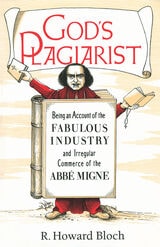
God's Plagiarist
Being an Account of the Fabulous Industry and Irregular Commerce of the Abbe MigneR. Howard Bloch
University of Chicago Press, 1994
How did he do it?
Migne harnessed a deep well of personal energy and a will of iron to the latest innovations in print technology, advertising, and merchandising. His assembly-line production and innovative marketing of the massive editions of the Church Fathers placed him at the forefront of France's new commerce. Characterized by the police as one of the great "schemers" of the century, this priest-entrepreneur put the most questionable of business practices in the service of his devotion to Catholicism.
Part detective novel, part morality tale, Bloch's narrative not only will interest scholars of nineteenth-century French intellectual history but will appeal also to general readers interested in the history of publishing or just a good historical yarn.
"An unforgettable, Daumier-like portrait, sharp and satirical, of this enterprising, austere and somewhat crazed merchandiser of sacred learning. . . . Bloch deserves great credit for the wit and style of his effort to explore the Pedantic Park of nineteenth-century learning, that island of monsters which scholars have found, as yet, no escape."—Anthony Grafton, New Republic
"Bloch is an exhilarating guide to the methods which made Migne the Napoleon of the Prospectus, a publicist of genius, Buffalo Bill and P.T. Barnum rolled into one."—David Coward, Times Literary Supplement
"Mercifully, Bloch's sense of humour has none of that condescending mock-bewilderment commonly applied to the foreign or ancient. . . . It enables Bloch to promote Migne as a forerunner of the department store and to place him on a continuum running from St. Paul to the Tupperware party: the quality of the merchandise is increasingly irrelevant, still more the nature of its contents."—Graham Robb, London Review of Books

Some Catholic Writers
Ralph McInerny
St. Augustine's Press, 2007
Writing Habits
Historicism, Philosophy, and English Benedictine Convents, 1600–1800Jaime Goodrich
University of Alabama Press, 2021
The first in-depth examination of the texts produced in English Benedictine convents between 1600 and 1800.
After Catholicism became illegal in England during the sixteenth century, Englishwomen established more than twenty convents on the Continent that attracted thousands of nuns and served as vital centers of Catholic piety until the French Revolution. Today more than 1,000 manuscripts and books produced by, and for, the Benedictine convents are extant in European archives. Writing Habits: Historicism, Philosophy, and English Benedictine Convents, 1600–1800 provides the first substantive analysis of these works in order to examine how members of one religious order used textual production to address a major dilemma experienced by every English convent on the Continent: How could English nuns cultivate a cloistered identity when the Protestant Reformation had swept away nearly all vestiges of English monasticism?
Drawing on an innovative blend of methodologies, Jaime Goodrich contends that the Benedictines instilled a collective sense of spirituality through writings that created multiple overlapping communities, ranging from the earthly society of the convent to the transhistorical network of the Catholic Church. Because God resides at the heart of these communities, Goodrich draws on the works of Martin Buber, a twentieth-century Jewish philosopher who theorized that human community forms a circle, with each member acting as a radius leading toward the common center of God. Buber’s thought, especially his conception of the I-You framework for personal and spiritual relationships, illuminates a fourfold set of affiliations central to Benedictine textual production: between the nuns themselves, between the individual nun and God, between the convent and God, and between the convent and the Catholic public sphere. By evoking these relationships, the major genres of convent writing—administrative texts, spiritual works, history and life writing, and controversial tracts—functioned as tools for creating community and approaching God.
Through this Buberian reading of the cloister, Writing Habits recovers the works of Benedictine nuns and establishes their broader relevance to literary history and critical theory.