50 books match the query 'Catholics' and 3 start with a
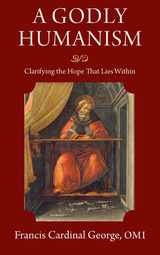
cover of A Godly Humanism: Clarifying the Hope That Lies Within

A Godly Humanism

Clarifying the Hope That Lies Within

Francis E. George

Catholic University of America Press, 2015
For Francis Cardinal George, the Catholic Church is not a movement, built around ideas, but a communion, built around relationships. In A Godly Humanism, he shares his understanding of the Church in lively, compelling prose, presenting a way to understand and appreciate the relationships of God to human beings and of human beings to one another. These loving relationships are continually made present to us in and through the Church, from the time of Jesus' first disciples down to our own day. We are introduced to how the spiritual and intellectual life of Christians, aided in every generation by the Holy Spirit working through the Apostles and their successors, resist the danger of splitting apart from one another. Though they take different outward forms at different times, both wisdom and holiness are made possible for every Christian of every station of life. Sign-posting his conversation by the milestones of his own spiritual and intellectual journey, Cardinal George invites us to view the Church and her history in ways that go beyond the categories of politics - through which we find merely human initiative, contrivance, and adjustment - and rather to see the initiative as God's first and foremost. God is the non-stop giver, we are non-stop recipients of his gifts, and the recent popes, no less than the Father of the Church, have made every effort to make us aware of the graces - that is, of the unearned benefits - that God confers on us as Catholics, as Christians, as believers, and simply as human persons. Pope Francis, he reminds us, contrasts human planning with God's providence, and this book is at once an exposition of that providence and a personal response of gratitude for the way it has operated in one man's life.
[more]
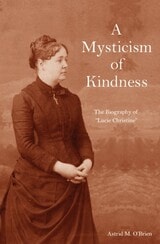
cover of A Mysticism of Kindness: The Lucie Christine Story

A Mysticism of Kindness

The Lucie Christine Story

Astrid M. O’Brien

University of Scranton Press, 2010

On the surface, Lucie Christine—the pseudonym given to a nineteenth-century Frenchwoman named Mathilde Boutle—was a very ordinary upper-middle-class woman, fulfilling her daily responsibilities to her husband and children. But underneath, Lucie Christine was an extraordinary human being. In A Mysticism of Kindness, Astrid M. O’Brien tells the life story of this remarkable woman, revealing how her experiences as a mystic allowed her to persevere as a wife and mother in the midst of constant verbal and physical abuse from her alcoholic husband. Her story will inspire all those who struggle to find a way to live a strong spiritual life in an often difficult and troubling world.
[more]
cover of Autobiography of an Aspiring Saint

Autobiography of an Aspiring Saint

Cecilia Ferrazzi

University of Chicago Press, 1996

Charged by the Venetian Inquisition with the conscious and cynical feigning of holiness, Cecelia Ferrazzi (1609-1684) requested and obtained the unprecedented opportunity to defend herself through a presentation of her life story. Ferrazzi's unique inquisitorial autobiography and the transcripts of her preceding testimony, expertly transcribed and eloquently translated into English, allow us to enter an unfamiliar sector of the past and hear 'another voice'—that of a humble Venetian woman who had extraordinary experiences and exhibited exceptional courage.

Born in 1609 into an artisan family, Cecilia Ferrazzi wanted to become a nun. When her parents' death in the plague of 1630 made it financially impossible for her to enter the convent, she refused to marry and as a single laywoman set out in pursuit of holiness. Eventually she improvised a vocation: running houses of refuge for "girls in danger," young women at risk of being lured into prostitution.

Ferrazzi's frequent visions persuaded her, as well as some clerics and acquaintances among the Venetian elite, that she was on the right track. The socially valuable service she was providing enhanced this impresssion. Not everyone, however, was convinced that she was a genuine favorite of God. In 1664 she was denounced to the Inquisition.

The Inquisition convicted Ferrazzi of the pretense of sanctity. Yet her autobiographical act permits us to see in vivid detail both the opportunities and the obstacles presented to seventeenth-century women.
[more]