Results by title
3 books match the query 'Cato, Marcus Porcius'
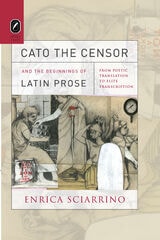
Cato the Censor and the Beginnings of Latin Prose
From Poetic Translation to Elite TranscriptionEnrica Sciarrino
The Ohio State University Press, 2011
In the past decade, classical scholarship has been polarized by questions concerning the establishment of a literary tradition in Latin in the late third century BCE. On one side of the divide, there are those scholars who insist on the primacy of literature as a hermeneutical category and who, consequently, maintain a focus on poetic texts and their relationship with Hellenistic precedents. On the other side are those who prefer to rely on a pool of Latin terms as pointers to larger sociohistorical dynamics, and who see the emergence of Latin literature as one expression of these dynamics. Through a methodologically innovative exploration of the interlacing of genre and form with practice, Enrica Sciarrinobridges the gap between these two scholarly camps and develops new areas of inquiry by rescuing from the margins of scholarship the earliest remnants of Latin prose associated with Cato the Censor—a “new man” and one of the most influential politicians of his day. By systematically analyzing poetic and prose texts in relation to one another and to diverse authorial subjectivities, Cato the Censor and the Beginnings of Latin Prose: From Poetic Translation to Elite Transcription offers an entirely new perspective on the formation of Latin literature, challenges current assumptions about Roman cultural hierarchies, and sheds light on the social value attributed to different types of writing practices in mid-Republican Rome.
[more]
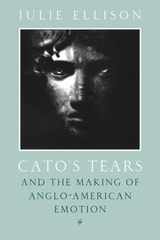
Cato's Tears and the Making of Anglo-American Emotion
Julie Ellison
University of Chicago Press, 1999
How did the public expression of feeling become central to political culture in England and the United States? In this ambitious revisionist account of a much expanded "Age of Sensibility," Julie Ellison traces the evolution of the politics of emotion on both sides of the Atlantic from the late seventeenth to the early nineteenth century.
Early popular dramas of this time, Ellison shows, linked male stoicism with sentimentality through portrayals of stoic figures whose civic sacrifices bring other men to tears. Later works develop a different model of sensibility, drawing their objects of sympathy from other races and classes—Native Americans, African slaves, servants. Only by examining these texts in light of the complex masculine tradition of stoic sentimentality, Ellison argues, can one interpret women's roles in the culture of sensibility.
In her conclusion, Ellison offers "a short history of liberal guilt," exploring the enduring link between male stoicism and male sensibility in political and cultural life from the late seventeenth century to today.
[more]
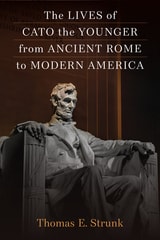
The Lives of Cato the Younger from Ancient Rome to Modern America
Thomas E. Strunk
University of Michigan Press, 2026
The Lives of Cato the Younger from Ancient Rome to Modern America traces the reception and influence of Cato from his suicide at the fall of the Roman Republic to the twenty-first century. In preferring death to Julius Caesar’s dictatorship, Cato became a symbol of resistance to tyrannical rulers during the Roman Empire. In the years that followed, three interpretations of Cato became predominant: Cato lived and died with the resolve of a philosopher; he was a traitor to Caesar’s legitimate rule; or he was a republican statesman defending liberty. Beginning with these interpretations, Thomas E. Strunk explores Cato’s reception in antiquity with chapters on Tacitus and Plutarch; and he later discusses medieval Christian writers such as Augustine, who considered Cato’s suicide sinful, and Dante, who made him the noble guardian of Purgatory. In Europe, playwrights composed dramas on Cato’s death that ignited the revolutionary spirit of the age, later inspiring American general George Washington and his soldiers. Abolitionists such as Frederick Douglass invoked Cato and his revolutionary spirit, yet after the Civil War, Cato’s name was appropriated as a symbol of allegiance for Confederates and their descendants, and lines memorializing Cato were inscribed on the Confederate Memorial at Arlington Cemetery. As the first book to provide an in-depth study of Cato and his lasting influence, Strunk’s study seeks to explore the contemporary nature of his principles and their influence on present-day American politics.
[more]