Results by title
5 books match the query 'Cattle'
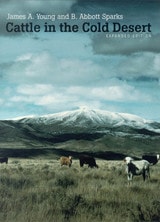
Cattle In The Cold Desert, Expanded Edition
James A. Young
University of Nevada Press, 2002
A sophisticated ecological analysis of ranching in northern Nevada featuring a new chapter and new epilogue by the authors.First published in 1985, Cattle in the Cold Desert has become a classic in the environmental history of the Great Basin, brilliantly combining a lively account of the development of the Great Basin grazing industry with a detailed scientific discussion of the ecology of its sagebrush/grassland plant communities. The volume traces the history of white settlement in the Great Basin from about 1860, along with the arrival of herds of cattle and sheep to exploit the forage resources of a pristine environment and, through the history of John Sparks, a pioneer cattleman, illustrates how the herdsmen interacted with the sagebrush/grasslands of the cold desert West. As the story unfolds on two levels—that of the herdsmen adapting their livelihood to the challenging conditions of the Great Basin's scanty forage, aridity, and fierce winters, and that of the fragile ecology of the desert plant communities responding to the presence of huge herds of livestock—we see the results of a grand experiment initiated by men willing to venture beyond the limits of accepted environmental potential to settle the Great Basin, as well as the often ruinous consequences of the introduction of domestic livestock into the plant communities of the region. The result is a remarkably balanced and insightful discussion of the grazing industry in the Intermountain West. This new paperback edition includes an additional chapter that addresses the impact of wild mustangs on the Great Basin rangelands, and an epilogue that discusses changes in rangeland management and in rangeland conditions, especially the impact of recent wildfires. As concern over the future of the Great Basin's unique rangeland environment and its principal agricultural industry grows, Cattle in the Cold Desert remains essential reading for everyone who cares about this underappreciated region of the American West.
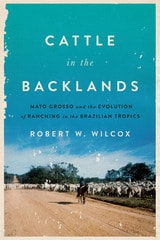
Cattle in the Backlands
Mato Grosso and the Evolution of Ranching in the Brazilian TropicsBy Robert W. Wilcox
University of Texas Press, 2017
Henry A. Wallace Award, The Agricultural History Society, 2018
Brazil has the second-largest cattle herd in the world and is a major exporter of beef. While ranching in the Amazon—and its destructive environmental consequences—receives attention from both the media and scholars, the states of Mato Grosso and Mato Grosso do Sul actually host the most cattle. A significant beef producer in Brazil beginning in the late nineteenth century, the region served as a laboratory for raising cattle in the tropics, where temperate zone ranching practices do not work. Mato Grosso ranchers and cowboys transformed ranching’s relationship with the environment, including the introduction of an exotic cattle breed—the Zebu—that now dominates Latin American tropical ranching.
Cattle in the Backlands presents a comprehensive history of ranching in Mato Grosso. Using extensive primary sources, Robert W. Wilcox explores three key aspects: the economic transformation of a remote frontier region through modern technical inputs; the resulting social changes, especially in labor structures and land tenure; and environmental factors, including the long-term impact of ranching on ecosystems, which, he contends, was not as detrimental as might be assumed. Wilcox demonstrates that ranching practices in Mato Grosso set the parameters for tropical beef production in Brazil and throughout Latin America. As the region was incorporated into national and international economic structures, its ranching industry experienced the entry of foreign investment, the introduction of capitalized processing facilities, and nascent discussions of ecological impacts—developments that later affected many sectors of the Brazilian economy.
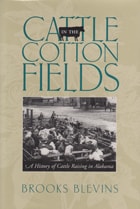
Cattle in the Cotton Fields
A History of Cattle Raising in AlabamaBrooks Blevins
University of Alabama Press, 2013
Cattle raising today is the most widely practiced form of agriculture in Alabama and ranks second only to the poultry industry in terms of revenue. Brooks Blevins not only relates the development and importance of the industry to agricultural practices but also presents it as an integral component of southern history, inextricably linked to issues of sectional politics, progressivism, race and class struggles, and rural depopulation. Most historians believe cattle were first introduced by the Spanish explorers and missionaries during the early decades of the 16th century. Native Americans quickly took up cattle raising, and the practice was reinforced with the arrival of the French and the British. By 1819--after massive immigration of Anglo-American herders, farmers, and planters--cattle played an integral role in the territory's agriculture and economy. Despite the dominance of the cotton industry during the antebellum period, cattle herding continued to grow and to become identified as an important part of the region's agriculture.
In the early decades of the 20th century, the boll weevil drove many planters out of the cotton business. These planters adopted a midwestern model of cattle raising consisting of purebred English breeds, enclosed pastures, scientific breeding and feeding practices, and intimate cooperation among cattlemen, government agents, and business interests. This model of farming gradually replaced the open range herding tradition.

Cattle on a Thousand Hills
A History of the Cattle Industry in ArkansasC.J. Brown
University of Arkansas Press, 1996

Cattle, Priests, and Progress in Medicine
Calvin W. Schwabe
University of Minnesota Press, 1978
Cattle, Priests, and Progress in Medicine was first published in 1978. Minnesota Archive Editions uses digital technology to make long-unavailable books once again accessible, and are published unaltered from the original University of Minnesota Press editions.
The author shows that over the centuries many of the most significant breakthroughs in improving humans health have been closely associated with observations and experiments on animals other than man. Because human medical progress has been so dependent on veterinary studies, he urges that schools of veterinary medicine assume a much greater role in the training of persons for research in human medicine.
To illuminate the historical link between animals and man in medical progress, Professor Schwabe recounts highlights in the history of medicine from ancient times onward. He describes the early history of man in terms of animal cultures, focusing on the prehistoric Nile Valley, and points to similarities in medical knowledge between present-day "cattle" societies in Northeastern Africa and the ancient people of the Nile. He discusses the comparative healers of ancient Egypt, the comparative foundations of Greek medicine, the Arabic contribution, Sicily and the beginnings of modern medicine, and subsequent developments through the Renaissance .Bringing the history down to modern times, Professor Schwabe emphasizes the role of veterinary medicine in medical research. He outlines specific reforms in the curricula of schools and colleges of veterinary medicine which would provide for the education of medical investigators.