Results by title
3 books match the query 'Césaire, Aimé'
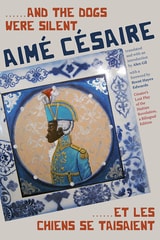
......And the Dogs Were Silent/......Et les chiens se taisaient
Aimé Césaire. Translated and with an introduction by Alex Gil. With a foreword by Brent Hayes Edwards.
Duke University Press, 2024
Available to readers for the first time, Aimé Césaire’s three-act drama . . . . . . And the Dogs Were Silent—written during the Vichy regime in Martinique in 1943 and lost until 2008—dramatizes the Haitian Revolution and the rise and fall of Toussaint Louverture as its heroic leader. This bilingual English and French edition stands apart from Césaire’s more widely known 1946 closet drama. Following the slave revolts that sparked the revolution, Louverture arrives as both prophet and poet, general and visionary. With striking dramatic technique, Césaire retells the revolution in poignant encounters between rebels and colonial forces, guided by a prophetic chorus and Louverture’s steady ethical and political vision. In the last act, we reach the hero’s betrayal, his imprisonment, and his last stand against the lures of compromise. Césaire’s masterwork is a strikingly beautiful and brutal indictment of colonial cruelty and an unabashed celebration of Black rebellion and victory.
[more]
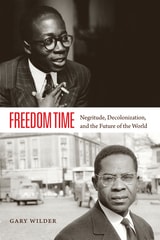
Freedom Time
Negritude, Decolonization, and the Future of the WorldGary Wilder
Duke University Press, 2015
Freedom Time reconsiders decolonization from the perspectives of Aimé Césaire (Martinique) and Léopold Sédar Senghor (Senegal) who, beginning in 1945, promoted self-determination without state sovereignty. As politicians, public intellectuals, and poets they struggled to transform imperial France into a democratic federation, with former colonies as autonomous members of a transcontinental polity. In so doing, they revitalized past but unrealized political projects and anticipated impossible futures by acting as if they had already arrived. Refusing to reduce colonial emancipation to national independence, they regarded decolonization as an opportunity to remake the world, reconcile peoples, and realize humanity’s potential. Emphasizing the link between politics and aesthetics, Gary Wilder reads Césaire and Senghor as pragmatic utopians, situated humanists, and concrete cosmopolitans whose postwar insights can illuminate current debates about self-management, postnational politics, and planetary solidarity. Freedom Time invites scholars to decolonize intellectual history and globalize critical theory, to analyze the temporal dimensions of political life, and to question the territorialist assumptions of contemporary historiography.
[more]
Modern Odysseys
Cavafy, Woolf, Césaire, and a Poetics of IndirectionMichelle Zerba
The Ohio State University Press, 2021
Michelle Zerba’s Modern Odysseys explores three major writers in global modernism from the Mediterranean, Anglo-European Britain, and the Caribbean whose groundbreaking literary works have never been studied together before. Using language as an instrument of revolution and social change, C. P. Cavafy, Virginia Woolf, and Aimé Césaire gave expression to the forms of human experience we now associate with modernity: homoeroticism, transsexuality, and racial consciousness. More specifically, Zerba argues that Odyssean tropes of diffusion, isolation, passage, and return give form to works by these writers but in ways that invite us to reconsider and revise the basic premises of reception studies and intellectual history. Combining close readings of literary texts with the study of interviews, essays, diaries, and letters, Zerba advances a revisionary account of how to approach relationships between antiquity and modernity. Instead of frontal encounters with the Odyssey, Cavafy, Woolf, and Césaire indirectly—but no less significantly—engage with Homer’s epic poem. In demonstrating how such encounters operate, Modern Odysseys explores issues of race and sexuality that connect antiquity with the modern period.
[more]