Results by title
2 books match the query 'Cell phone systems'
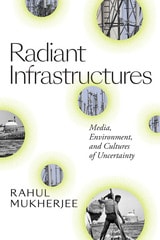
Radiant Infrastructures
Media, Environment, and Cultures of UncertaintyRahul Mukherjee
Duke University Press, 2020
In Radiant Infrastructures Rahul Mukherjee explores how the media coverage of nuclear power plants and cellular phone antennas in India—what he calls radiant infrastructures—creates environmental publics: groups of activists, scientists, and policy makers who use media to influence public opinion. In documentaries, lifestyle television shows, newspapers, and Bollywood films, and through other forms of media (including radiation-sensing technologies), these publics articulate contesting views about the relationships between modernity, wireless signals, and nuclear power. From testimonies of cancer patients who live close to cell towers to power plant operators working to contain information about radiation leaks and health risks, discussions in the media show how radiant infrastructures are at once harbingers of optimism about India's development and emitters of potentially carcinogenic radiation. In tracing these dynamics, Mukherjee expands understandings of the relationship between media and infrastructure and how people make sense of their everyday encounters with technology and the environment.
[more]
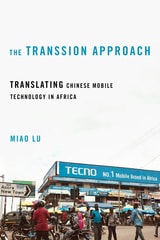
The Transsion Approach
Translating Chinese Mobile Technology in AfricaMiao Lu
University of Illinois Press, 2025
How do we explain China’s tech rise in Africa? As Africa’s top phone seller, the Shenzhen-based company Transsion has profoundly shaped the continent’s digital transformation by providing affordable yet feature-rich mobile phones for the economically disadvantaged. Miao Lu draws on rich fieldwork in China and Ghana to delve into the company’s operations and growing influence. Critiquing technology transfer, Lu focuses on design, marketing, and repair to illustrate the multi-layered technology translations between China and Ghana. Borrowing the metaphor of deep ploughing, Lu examines the rural-centric and lower-class–oriented approach of translating mobile technology. Transsion challenges the cultural imagination of big tech. But the company is also evolving into a regional power that’s adept at marginalizing small players and increasing local dependence. Lu’s analysis explores the complexity that Shenzhen can act as Silicon Valley’s “South” and Africa’s “North” simultaneously. The middle space created by Transsion bridges globalization from above and below, which opens the door to new possibilities and inequalities.
[more]