Results by title
2 books match the query 'Cemetery'
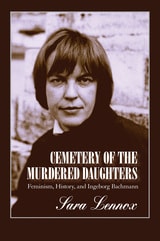
Cemetery of the Murdered Daughters
Feminism, History, and Ingeborg BachmannSara Lennox
University of Massachusetts Press, 2006
Although Austrian writer Ingeborg Bachmann (1926–1973) is widely regarded as one of the most important twentieth-century authors writing in German, her novels and stories have sometimes been viewed narrowly as portraits of women as victims. In this innovative study, Sara Lennox provides a much broader perspective on Bachmann's work, at the same time undertaking an experiment in feminist methodology. Lennox examines Bachmann's poetry and prose in historical context, arguing that the varied feminist interpretations of her writings are the result of shifts in theoretical emphases over a period of more than three decades. Lennox then places her own essays on Bachmann in similar perspective, showing how each piece reflects the historical moment in which it was written. Making use of recent interdisciplinary approaches—Foucauldian theories of sexuality, post-colonial theory, materialist feminism—she explores the extent to which each of her earlier readings was shaped by the methods employed, the questions asked, and the political issues that seemed most germane at the time. Out of this analysis comes a new understanding of the significance of Bachmann's work and new insight into the theory and practice of feminist criticism.

The Cemetery of Chua Village and Other Stories
Doan Le
Northwestern University Press, 2005
This seventh volume in the "Voices from Vietnam" series introduces U. S. readers to another major figure in modern Vietnamese letters: Doan Le. Noted for her versatility of style and her originality, she writes tales that are intensely human and universal, exploring such subjects as greed, marriage, divorce, aging and human rights. For the scholar, these stories give insight into Vietnamese culture after the "renovation". For the general reader, these are stories that explore all the subtle enigmas of the human heart.
As Wayne Karlin notes in his introduction, "[She] is a master of allegory and gently complex satire...her stories can often be fantastical—Sholom Aleichem's village of Helm channeled by Kafka through Our Town—or they can be deeply personal and realistic. In both cases they grow unabashedly from the real vicissitudes of her life."