Results by title
5 books match the query 'Centennial celebrations, etc'
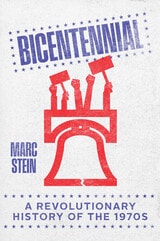
Bicentennial
A Revolutionary History of the 1970sMarc Stein
University of Chicago Press, 2026
“Utterly illuminating. . . . Just a really revelatory book.”—Jill Lepore, The New York Times, The “Book Review” Podcast • “As historian Stein traces in Bicentennial, a national birthday can launch a much broader, more inclusive, and ambitious national project.”—Rebecca Brenner Graham, The New Republic • “A comprehensive and critical look at the Spirit of 1976.”—Library Journal
As the United States marks its semiquincentennial in 2026, renowned historian Marc Stein looks back at the politics of another landmark celebration during a time of striking similarities and surprising differences: the US bicentennial in 1976.
In the aftermath of Vietnam and Watergate, the bicentennial sparked an extraordinary national conversation about the country’s past, present, and future. As patriots, planners, profiteers, and protesters argued about how to commemorate the national birthday, they collectively reimagined the promises and perils of democracy during a transformational decade.
From award-winning historian Marc Stein, Bicentennial: A Revolutionary History of the 1970s is an original, illuminating, and insightful study of that era. While focusing on festivities and fights in Philadelphia, the nation’s birthplace, the book also explores the many proposed and abandoned celebrations that percolated up around the country. It tells a broadly democratic story of both the “official” bicentennial and counter-bicentennial activism, offering revolutionary perspectives on national politics, social movements, and popular culture. From the queer courtship of President Richard Nixon and Philadelphia Mayor Frank Rizzo to parades and protests with millions of participants, and from a deadly outbreak of Legionnaires’ disease at Philadelphia’s most prestigious hotel to the establishment of groundbreaking African American, ethnic, and Jewish museums, the bicentennial reveals a kaleidoscope of American peculiarities, problems, and possibilities.
The lasting influence of 1976 on one of the nation’s great urban centers and the United States as a whole is undeniable. As the nation—once again enmeshed in political and social upheaval—marks its two-hundred-fiftieth birthday in 2026, there is no better time to look back at its two-hundredth and marvel at what has changed, and what has not.
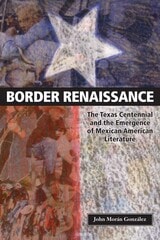
Border Renaissance
The Texas Centennial and the Emergence of Mexican American LiteratureBy John Morán González
University of Texas Press, 2009
The Texas Centennial of 1936, commemorated by statewide celebrations of independence from Mexico, proved to be a powerful catalyst for the formation of a distinctly Mexican American identity. Confronted by a media frenzy that vilified "Meskins" as the antithesis of Texan liberty, Mexican Americans created literary responses that critiqued these racialized representations while forging a new bilingual, bicultural community within the United States. The development of a modern Tejana identity, controversies surrounding bicultural nationalism, and other conflictual aspects of the transformation from mexicano to Mexican American are explored in this study. Capturing this fascinating aesthetic and political rebirth, Border Renaissance presents innovative readings of important novels by María Elena Zamora O'Shea, Américo Paredes, and Jovita González. In addition, the previously overlooked literary texts by members of the League of United Latin American Citizens (LULAC) are given their first detailed consideration in this compelling work of intellectual and literary history.
Drawing on extensive archival research in the English and Spanish languages, John Morán González revisits the 1930s as a crucial decade for the vibrant Mexican American reclamation of Texas history. Border Renaissance pays tribute to this vital turning point in the Mexican American struggle for civil rights.
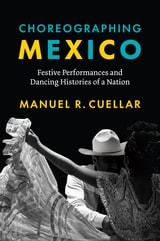
Choreographing Mexico
Festive Performances and Dancing Histories of a NationManuel R. Cuellar
University of Texas Press, 2022
2023 de la Torre Bueno® First Book Award, Dance Studies Association
The impact of folkloric dance and performance on Mexican cultural politics and national identity.
The years between 1910 and 1940 were formative for Mexico, with the ouster of Porfirio Díaz, the subsequent revolution, and the creation of the new state. Amid the upheaval, Mexican dance emerged as a key arena of contestation regarding what it meant to be Mexican. Through an analysis of written, photographic, choreographic, and cinematographic renderings of a festive Mexico, Choreographing Mexico examines how bodies in motion both performed and critiqued the nation.
Manuel Cuellar details the integration of Indigenous and regional dance styles into centennial celebrations, civic festivals, and popular films. Much of the time, this was a top-down affair, with cultural elites seeking to legitimate a hegemonic national character by incorporating traces of indigeneity. Yet dancers also used their moving bodies to challenge the official image of a Mexico full of manly vigor and free from racial and ethnic divisions. At home and abroad, dancers made nuanced articulations of female, Indigenous, Black, and even queer renditions of the nation. Cuellar reminds us of the ongoing political significance of movement and embodied experience, as folklórico maintains an important and still-contested place in Mexican and Mexican American identity today.
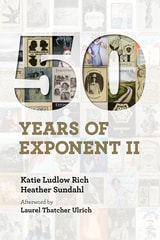
Fifty Years of Exponent II
Katie Ludlow Rich
Signature Books, 2024
On a sweltering day in June 1974, a group of housewives, graduate students, and young professionals gathered in the Boston suburbs. Their mission: to produce the first issue of Exponent II, a “humble yet sincere” newspaper “poised on the dual platforms of Mormonism and Feminism.” They viewed their work as an act of devotion, not rebellion, and were naïve of the cold reception they would soon receive from LDS Church leaders. Nevertheless, the paper became a national platform connecting Mormon feminists. It provided a vital space for them to question and integrate different aspects of their dual—and sometimes dueling—identities. From the Equal Rights Amendment to queer identity, Exponent II has hosted some of the most urgent conversations of its time while also embracing life’s dailiness.
This comprehensive history and anthology celebrate five decades of Exponent II. Through meticulous research and compelling storytelling, the authors chronicle the organization’s evolution from a kitchen-table-style newspaper to a quarterly magazine, blog, and annual retreat. Its transformative impact on the lives of its participants stands as a testament to the power of connection, resilience, and community over ideological purity.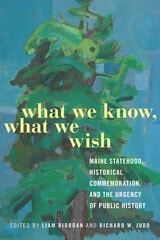
What We Know, What We Wish
Maine Statehood, Historical Commemoration, and the Urgency of Public HistoryEdited by Liam Riordan and Richard W. Judd
University of Massachusetts Press, 2025
Cities, states, and nations are grappling with how best to commemorate historical events and anniversaries in ways that are fair, accurate, and open public dialogue about the often contested past. This volume springs from varied approaches to the historical commemoration of Maine’s state bicentennial in 2020 that involved academics, independent scholars, local and statewide cultural organizations, sovereign Wabanaki nations, and the state itself in the form of the Maine State Bicentennial Commission. While wide-ranging in their goals and values, all sought to take advantage of opportunities for collaboration to contribute to a dynamic and multi-faceted practice of public history. These new essays use Maine’s bicentennial as a focal point to put public history theory into action. Its diverse contributors share stories about the past that move beyond celebration to reflect crucial ways that the past shapes our understanding of the present and our aspirations for the future.
This volume’s core argument is that academics need to collaborate more fully with independent scholars, history-based cultural institutions, and the general public in order for public history to thrive and to improve the quality of civic life. What We Know, What We Wish does this through wide ranging essays that discuss the long statehood era in Maine from the 1770s to 1820s as well as its legacies in the state centennial commemoration of 1920 and museum exhibits from the 2020 bicentennial. The occupational and cultural diversity of the collection’s contributors together with the content of their essays offer a model for how to put public history principles into practice to foreground meaningful historical reflection that is urgently needed in divided communities around the world.
Contributors include the volume editors, as well as Maulian Bryant, Osihkiyol (Zeke) Crofton-Macdonald, Charles H. Lagerbom, Ryan LaRochelle, Stuart Kestenbaum, Michael McVaugh, Kevin D. Murphy, Micah A. Pawling, Jessica Skwire Routhier, Donald Soctomah, Laura Fecych Sprague, Alan Taylor, and Laurel Thatcher Ulrich.