Results by title
5 books match the query 'Central American literature'
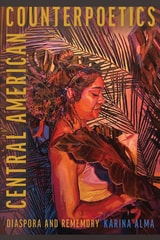
Central American Counterpoetics
Diaspora and RememoryKarina Alma
University of Arizona Press, 2024
Author Karina Alma offers a systemic method and artistic mode for unpacking social and political memory formation that resists dominant histories. Central American Counterpoetics responds to political repression through acts of creativity that prioritize the well-being of anticolonial communities. Building on Toni Morrison’s theory of rememory, the volume examines the concept as an embodied experience of a sensory place and time lived in the here and now. By employing primary sources of image and word, interviews of creatives, and a critical self-reflection as a Salvadoran immigrant woman in academia, Alma’s research breaks ground in subject matter and methods by considering cultural and historical ties across countries, regions, and traditions. The diverse creatives included explore critical perspectives on topics such as immigration, forced assimilation, maternal love, gender violence, community arts, and decolonization.

Claribel Alegría and Central American Literature
Critical EssaysSandra M. Boschetto-Sandoval
Ohio University Press, 1993
These essays examine the multifaceted work of the Central American author whom Latin American literary historians consider precursor of “cultural dialogism” in poetry and fiction. As poet, essayist, journalist, novelist, and writer of “quasi–testimonio,” Alegría’s multiple discourses transgress the boundaries between traditional and postmodern political theories and practices. Her work reveals an allegory of relation and negotiation between “intelligentsia” and subaltern peoples as well as the need for a more socially extensive literature, not exclusive of more elite “magical literatures.”
The essays in the fist section frame Alegría’s discourses within sociohistorical, political, and literary contexts in order to illuminate the author’s singular place in the literary and political history of Central America. The essays in the second section engage in a feminist dialogic in which the reader encounters various critical validations and valorizations of Alegría’s many female voices. The third section involves the reader in the pursuit of extratextual or extraliterary resonances in Alegría’s work.
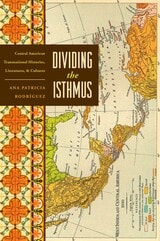
Dividing the Isthmus
Central American Transnational Histories, Literatures, and CulturesBy Ana Patricia Rodríguez
University of Texas Press, 2009
In 1899, the United Fruit Company (UFCO) was officially incorporated in Boston, Massachusetts, beginning an era of economic, diplomatic, and military interventions in Central America. This event marked the inception of the struggle for economic, political, and cultural autonomy in Central America as well as an era of homegrown inequities, injustices, and impunities to which Central Americans have responded in creative and critical ways. This juncture also set the conditions for the creation of the Transisthmus—a material, cultural, and symbolic site of vast intersections of people, products, and narratives.
Taking 1899 as her point of departure, Ana Patricia Rodríguez offers a comprehensive, comparative, and meticulously researched book covering more than one hundred years, between 1899 and 2007, of modern cultural and literary production and modern empire-building in Central America. She examines the grand narratives of (anti)imperialism, revolution, subalternity, globalization, impunity, transnational migration, and diaspora, as well as other discursive, historical, and material configurations of the region beyond its geophysical and political confines.
Focusing in particular on how the material productions and symbolic tropes of cacao, coffee, indigo, bananas, canals, waste, and transmigrant labor have shaped the transisthmian cultural and literary imaginaries, Rodríguez develops new methodological approaches for studying cultural production in Central America and its diasporas.
Monumental in scope and relentlessly impassioned, this work offers new critical readings of Central American narratives and contributes to the growing field of Central American studies.
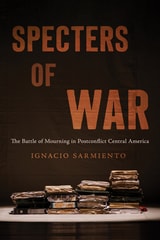
Specters of War
The Battle of Mourning in Postconflict Central AmericaIgnacio Sarmiento
University of Arizona Press, 2025
Specters of War explores mourning practices in postwar Central America, particularly in El Salvador and Guatemala. Ignacio Sarmiento delves into the intricate dynamics of grieving through an interdisciplinary lens, analyzing expressions of mourning in literature, theater, and sites of memory. At the heart of this analysis is the contention over who has the right to mourn, how mourning is performed, and who is included in this process. Sarmiento reveals mourning not as a private affair but as a battleground where different societal factions vie for the possibility of grieving the dead.
Through meticulous research and theoretical nuance, Specters of War sheds light on the politics of mourning in postconflict societies. Sarmiento argues that mourning is not merely a personal experience but a deeply political act intertwined with power struggles and societal divisions. From victims of state terrorism to military elites, various groups engage in a complex dance of grief, revealing the fraught nature of public mourning in postwar Central America. By examining cultural artifacts and memorialization projects, Sarmiento uncovers the multifaceted nature of mourning and its implications for memory, justice, and reconciliation.
This groundbreaking work is essential reading for scholars, students, and professionals interested in Central American history and culture, as well as post-authoritarian societies. Specters of War promises to deepen our understanding of postwar Central America and the legacy of loss in shaping collective identities and narratives of the past.
Taking Their Word
Literature and the Signs of Central AmericaArturo Arias
University of Minnesota Press, 2007
Central Americans are one of the largest Latino population groups in the United States. Yet, Arturo Arias argues, the cultural production of Central Americans remains little known to North Americans.
In Taking Their Word, Arias complicates notions of the cultural production of Central America, from Mexico in the North to Panama in the South. He charts the literature of Central America’s liberation struggles of the 1970s and 1980s, its transformation after peace treaties were signed, the emergence of a new Maya literature that decenters Latin American literature written in Spanish, and the rise and fall of testimonio. Arias demonstrates that Central America and its literature are marked by an indigenousness that has never before been fully theorized or critically grasped. Never one to avoid controversy, Arias proffers his views of how the immigration of Central Americans to North America has changed the cultural topography of both zones.
With this groundbreaking work, Arias establishes the importance of Central American literature and provides a frame for future studies of the region’s culture.
Arturo Arias is director of Latin American studies at the University of Redlands. He is the author of six novels in Spanish and editor of The Rigoberta Menchú Controversy (Minnesota, 2001).