Results by title
3 books match the query 'Central Eastern Europe'
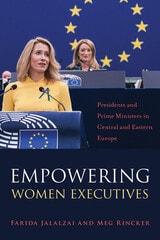
Empowering Women Executives
Presidents and Prime Ministers in Central and Eastern EuropeFarida Jalalzai and Meg Rincker
Temple University Press, 2027
What role does gender play as women pursue government positions, gain office, and govern countries in Central and Eastern Europe? In Empowering Women Executives, Farida Jalalzai and Meg Rincker examine women’s paths to and influence at the executive level, focusing specifically on Croatia, Poland, Slovakia, Estonia, and Romania.
The authors interview President Kersti Kaljulaid of Estonia, Prime Minister Jadranka Kosor of Croatia, Prime Minister Iveta Radičová of Slovakia, and Prime Minister Viorica Dăncilă of Romania as well as dozens of political experts and insiders to provide an in-depth look at female executives’ power in office. The authors also show the impact these leaders had in a region where traditional gender roles expanded only after the fall of Communism.
Each case study describes the historical context in which a woman emerges as a candidate, her ability to shape legislation, and how the media portrays her gender in analyzing her leadership. The authors also consider how gender influences a female executive’s leadership style or policy priorities—from appointing women to government positions and support for policies benefitting women to being a role model.
Empowering Women Executives illuminates women’s political inclusion in an area of the world where women have gained significant political agency.
Quest for a Suitable Past
Myth and Memory in Central and Eastern EuropeLucian Boia
Central European University Press, 2017
Safe Third Countries
Extending the EU Asylum and Immigration Policies to Central and Eastern EuropeSandra Lavenex
Central European University Press, 1999
The refugee issue has always been controversial and Lavenex's analyses add fuel to an already heated debate. She analyses the various bi- and multilateral processes by which the countries of Central and Eastern Europe (CEECs) are being gradually incorporated into a restrictive refugee regime established among the EU member states, in which the CEECs serve as "gate-keepers" for refugees and immigrants heading towards Western Europe.
At a time when many transition countries are trying to enter the EU, Lavenex highlights the CEECs consent to adapt to Western European policies aimed at fighting illegal immigration and reducing the numbers of asylum seekers as a political bargaining tool in exchange for future membership in the EU. She also argues that the regime undermines the values of international refugee protection and diffuses states' responsibilities by establishing a system of negative redistribution for the handling of asylum claims.
Safe Third Countries is the first comprehensive study on the extension of the emergent European refugee regime and highlights, in an innovative manner, the complex entanglement of domestic policies, European integration and international relations.