Results by title
5 books match the query 'Cervantes'

Cervantes and the Material World
Carroll B. Johnson
University of Illinois Press, 2000
Cervantes and the Material World reveals a recurrent preoccupation with the clash of two different economic systems: a reenergized feudalism and an incipient capitalism. Overturning the common assumption that Don Quixote, Sancho Panza, and myriad other colorful characters carry out their adventures in a timeless social milieu, Johnson demonstrates how their perspectives and experiences are shaped by the events and crises of their immediate historical context.
Johnson examines how questions of the distribution of wealth, the ownership of the means of production, and membership in one or another economic order permeate Cervantes's fiction. Thoughtfully contextualizing key excerpts, he suggests how business activities, legal codes, and other materialist practices actively impinge on the lives of the characters, influencing and in some cases determining their motivations and their possibilities for action.
A major study that will change the face of Cervantes scholarship, Cervantes and the Material World is also an important resource for students of the Spanish Golden Age and Renaissance and baroque literature and culture.
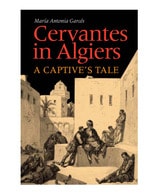
Cervantes in Algiers
A Captive's TaleMaria Antonia Garces
Vanderbilt University Press, 2005
No work has documented in such vivid and illuminating detail the socio-political world of sixteenth-century Algiers, Cervantes's life in the prison-house, his four escape attempts, and the conditions of his final ransom. Garces's portrait of a sophisticated multi-ethnic culture in Algiers, moreover, is likely to open up new discussions about early modern encounters between Christians and Muslims. By bringing together evidence from many different sources, historical and literary, Garces reconstructs the relations between Christians, Muslims, and renegades in a number of Cervantes's writings.
The idea that survivors of captivity need to repeat their story in order to survive (an insight invoked from Coleridge to Primo Levi to Dori Laub) explains not only Cervantes's storytelling but also the book that theorizes it so compellingly. As a former captive herself (a hostage of Colombian guerrillas), the author reads and listens to Cervantes with another ear.

Cervantes in Transit
Studies in Honor of Francisco Layna RanzPaul Michael Johnson
University of Delaware Press, 2027
Cervantes in Transit explores how Cervantes’s texts embody movement, transformation, and boundary-crossing across multiple dimensions. Theorizing Cervantes as a figure at once of transit and in transit, the volume argues that the diverse and often disparate array of Cervantine interpretations is not simply a byproduct of modernity, but an inherent component of the author’s own writing. Cervantes transgressed boundaries of all sorts—mixing genres, blurring fiction and reality, and moving characters into paratextual spaces. The concept of transit encompasses both physical movement between places and fundamental change or metamorphosis, reflecting how Cervantes’s writing has traveled through temporal, geographical, and conceptual spaces while continuously transforming. The volume’s thirteen chapters explore five thematic clusters: “Impressions” examines material book history and paratextual borders; “Identities” analyzes racial, religious, gender, and class transgressions; “Ironies” considers humor as a boundary-crossing mode; “Influences” traces Cervantes’s engagement with literary traditions; and “Itineraries” maps geographical circulation and global networks.
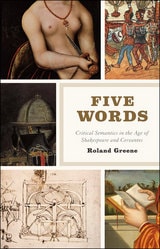
Five Words
Critical Semantics in the Age of Shakespeare and CervantesRoland Greene
University of Chicago Press, 2013
Rather than analyzing works, careers, or histories, Greene discusses a broad swath of Renaissance and transatlantic literature—including Shakespeare, Cervantes, Camões, and Milton—in terms of the development of these five words. Aiming to shift the conversation around Renaissance literature from current approaches to riskier enterprises, Greene also proposes new methods that take advantage of digital resources like full-text databases, but still depend on the interpreter to fashion ideas out of ordinary language. Five Words is an innovative and accessible book that points the field of literary studies in an exciting new direction.
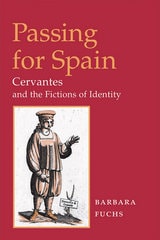
Passing for Spain
CERVANTES AND THE FICTIONS OF IDENTITYBarbara Fuchs
University of Illinois Press, 2003
In five lucid and engaging chapters, Fuchs examines what passes in Cervantes’s fiction: gender and race in Don Quijote and “Las dos doncellas”; religion in “El amante liberal” and La gran sultana; national identity in the Persiles and “La española inglesa.” She argues that Cervantes represents cross-cultural impersonation -- or characters who pass for another gender, nationality, or religion -- as challenges to the state’s attempts to assign identities and categories to proper Spanish subjects.
Fuchs demonstrates the larger implications of this challenge by bringing a wide range of literary and political texts to bear on Cervantes’s representations. Impeccably researched, Passing for Spain examines how the fluidity of individual identity in early modern Spain undermined a national identity based on exclusion and difference.