Results by title

5 books match the query 'Chávez Frías, Hugo'
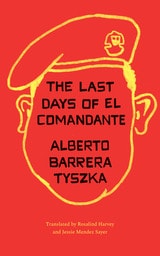
cover of The Last Days of El Comandante

The Last Days of El Comandante

By Alberto Barrera Tyszka; translated by Rosalind Harvey and Jessie Mendez Sayer

University of Texas Press, 2020

2021 — Honorable Mention, Best Fiction Book Translation – International Latino Book Awards, Latino Literacy Now

Winner of the Tusquets Prize in 2015 and previously translated into French, German, Dutch, Polish, and Portuguese, Alberto Barrera Tyszka’s Patria o muerte is now available in English.

​President Hugo Chávez’s cancer looms large over Venezuela in 2012, casting a shadow of uncertainty and creating an atmosphere of secrets, lies, and upheaval across the country. This literary thriller follows the connected lives of several Caracas neighbors consumed by the turmoil surrounding the Venezuelan president’s impending death.

Retired oncologist Miguel Sanabria, seeing the increasingly combustible world around him, feels on constant edge. He finds himself at odds with his wife, an extreme anti-Chavista, and his radical Chavista brother. These feelings grow when his nephew asks him to undertake the perilous task of hiding cell-phone footage of Chávez in Cuba. Fredy Lecuna, an unemployed journalist, takes a job writing a book about Chávez’s condition, which requires him to leave for Cuba while his landlord attempts to kick his wife and son out of their apartment. Nine-year-old María, long confined to an apartment with a neurotic mother intensely fearful of the city’s violence, finds her only contact with the outside world through a boy she messages online.
[more]
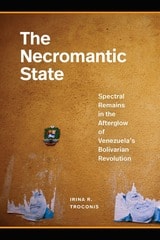
cover of The Necromantic State: Spectral Remains in the Afterglow of Venezuela's Bolivarian Revolution

The Necromantic State

Spectral Remains in the Afterglow of Venezuela's Bolivarian Revolution

Irina R. Troconis

Duke University Press, 2025
In the spring of 2013, televisions across Venezuela announced the death of then-president Hugo Chávez, leader of the Bolivarian Revolution and key political actor in Latin America’s “turn to the left.” Chávez’s death, however, was not the end of Chávez’s life. In The Necromantic State, Irina R. Troconis examines how Chávez, as a “specter,” has lingered in Venezuela’s public, private, and digital spaces. Focusing on contemporary Venezuela and drawing from a diverse corpus that includes tattoos, toys, memes, graffiti, and a hologram haunting the streets of downtown Caracas, Troconis contends that, in moments of failed transitions, political tensions, and crises of legitimacy, the state brings the dead back to life to negotiate the terms of its survival. By showing how this necromantic performance enables the state’s material and visual manifestations in public and private spaces, Troconis untangles a sociopolitical moment in which the ghostly acts as the affective, social, and political force that grounds state authority and ensures the preservation of the status quo, as it circumscribes acts of political imagination and limits popular resistance.
[more]
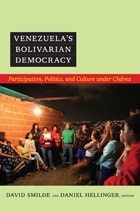
cover of Venezuela's Bolivarian Democracy: Participation, Politics, and Culture under Chávez

Venezuela's Bolivarian Democracy

Participation, Politics, and Culture under Chávez

David Smilde and Daniel Hellinger, eds.

Duke University Press, 2011

Venezuela’s Bolivarian Democracy brings together a variety of perspectives on participation and democracy in Venezuela. An interdisciplinary group of contributors focuses on the everyday lives of Venezuelans, examining the forms of participation that have emerged in communal councils, cultural activities, blogs, community media, and several other forums. The essays validate many of the critiques of democracy under Chávez, as well as much of the praise. They show that while government corporatism and clientelism are constant threats, the forms of political and cultural participation discussed are creating new discourses, networks, and organizational spaces—for better and for worse. With open yet critical minds, the contributors seek to analyze Venezuela’s Bolivarian democratic experience through empirical research. In doing so, they reveal a nuanced process, a richer and more complex one than is conveyed in international journalism and scholarship exclusively focused on the words and actions of Hugo Chávez.

Contributors
Carolina Acosta-Alzuru
Julia Buxton
Luis Duno Gottberg
Sujatha Fernandes
María Pilar García-Guadilla
Kirk A. Hawkins
Daniel Hellinger
Michael E. Johnson
Luis E. Lander
Margarita López-Maya
Elizabeth Gackstetter Nichols
Coraly Pagan
Guillermo Rosas
Naomi Schiller
David Smilde
Alejandro Velasco
[more]
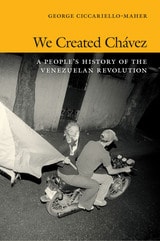
cover of We Created Chávez: A People's History of the Venezuelan Revolution

We Created Chávez

A People's History of the Venezuelan Revolution

Geo Maher

Duke University Press, 2013

Since being elected president in 1998, Hugo Chávez has become the face of contemporary Venezuela and, more broadly, anticapitalist revolution. George Ciccariello-Maher contends that this focus on Chávez has obscured the inner dynamics and historical development of the country’s Bolivarian Revolution. In We Created Chávez, by examining social movements and revolutionary groups active before and during the Chávez era, Ciccariello-Maher provides a broader, more nuanced account of Chávez’s rise to power and the years of activism that preceded it.

Based on interviews with grassroots organizers, former guerrillas, members of neighborhood militias, and government officials, Ciccariello-Maher presents a new history of Venezuelan political activism, one told from below. Led by leftist guerrillas, women, Afro-Venezuelans, indigenous people, and students, the social movements he discusses have been struggling against corruption and repression since 1958. Ciccariello-Maher pays particular attention to the dynamic interplay between the Chávez government, revolutionary social movements, and the Venezuelan people, recasting the Bolivarian Revolution as a long-term and multifaceted process of political transformation.
[more]
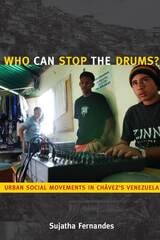
cover of Who Can Stop the Drums?: Urban Social Movements in Chávez's Venezuela

Who Can Stop the Drums?

Urban Social Movements in Chávez's Venezuela

Sujatha Fernandes

Duke University Press, 2010

In this vivid ethnography of social movements in the barrios, or poor shantytowns, of Caracas, Sujatha Fernandes reveals a significant dimension of political life in Venezuela since President Hugo Chávez was elected. Fernandes traces the histories of the barrios, from the guerrilla insurgency, movements against displacement, and cultural resistance of the 1960s and 1970s, through the debt crisis of the early 1980s and the neoliberal reforms that followed, to the Chávez period. She weaves barrio residents’ life stories into her account of movements for social and economic justice. Who Can Stop the Drums? demonstrates that the transformations under way in Venezuela are shaped by negotiations between the Chávez government and social movements with their own forms of historical memory, local organization, and consciousness.

Fernandes portrays everyday life and politics in the shantytowns of Caracas through accounts of community-based radio, barrio assemblies, and popular fiestas, and the many interviews she conducted with activists and government officials. Most of the barrio activists she presents are Chávez supporters. They see the leftist president as someone who understands their precarious lives and has made important changes to the state system to redistribute resources. Yet they must balance receiving state resources, which are necessary to fund their community-based projects, with their desire to retain a sense of agency. Fernandes locates the struggles of the urban poor within Venezuela’s transition from neoliberalism to what she calls “post-neoliberalism.” She contends that in contemporary Venezuela we find a hybrid state; while Chávez is actively challenging neoliberalism, the state remains subject to the constraints and logics of global capital.

[more]