Results by title
7 books match the query 'Chains'

Between the Chains
Turner Cassity
University of Chicago Press, 1991
"Turner Cassity's excellent work is like no one else's. It is funny, at times perverse, and wickedly serious. In this present collection, such poems as 'When in Doubt, Remain in Doubt,' 'Acid Rain on Sherwood Forest,' and 'How Jazz Came up the Elbe' show one of our finest poets at the top of his game."—Timothy Steele
"Cassity thinks on his feet, agile and fierce—funny too."—Thom Gunn
"At a time when most poems seem a commodity, quickly written, quickly read and easily thrown away, Turner Cassity's poems seem even more astonishing examples of good writing and reading, exceptions to be admired and kept."—Edgar Bowers

Breaking the Chains
Gender, Context, and the Politics of Writing in Modern ChinaDong Limin
Seagull Books, 2025
How has literature shaped gender politics in modern China? How has the concept of “woman” evolved within the shifting sociopolitical landscape? Old Chains and New delves into these questions by examining the dynamic interplay between literature, gender, and historical change. Drawing from literary studies, history, and sociology, this book reveals how women’s writing has not only reflected but also actively shaped cultural and national transformations.
From the late Qing era, when the “woman question” emerged as part of China’s response to imperialist pressures, to the ongoing evolution of feminist literary scholarship, this study argues that gender and literature are deeply interwoven. Women’s liberation in modern China was never solely about gender equality—it became a driving force for broader social change and national identity formation. Engaging with the complexities of women’s literature through a cultural-political lens, this book challenges static definitions and calls for a reevaluation of women’s literature not just as a literary category but as a key component in shaping China’s modern intellectual and cultural history.
By adopting the framework of “China as method,” Old Chains and New reimagines the role of literature in ideological and cultural shifts. It highlights women’s writing as a unique form of aesthetic politics—one with the power to intervene in and transform reality.
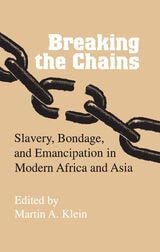
Breaking the Chains
Slavery, Bondage, and Emancipation in Modern Africa and AsiaMartin A. Klein
University of Wisconsin Press, 1993
“Martin Klein has brought together recent work on the abolition of slavery, from Ottoman Turkey to Thailand and from South India to West Africa. This anthology builds on the recent scholarship on both slavery in Asia and Africa and the end of slavery as a world-wide historical phenomenon. Whereas other anthologies have tended to focus on either Africa or Asia, this project brings together in one volume case studies and methodological approaches concerning both regions. Breaking the Chains will be an important part of the relatively sparse literature on emancipation in comparative and global context.”—Richard Roberts, Stanford University
Because the American history of slavery and emancipation tends to be foremost in Western minds, few realize that traditional forms of servitude still exist in a variety of places around the world: children are sold on the streets of Bangkok, bondage persists in India despite official efforts to abolish it, and until 1980 slavery was legal in Mauritania.
Breaking the Chains deals with emancipation in African and Asian societies which were either colonized or came under the domination of European powers in the nineteenth century. In these societies, emancipation involved the imposition on non-European societies of an explicitly European discourse on slavery, and, in most cases, a free labor ideology. Most of the slave masters described in these essays were not European and found European ideas on emancipation difficult to accept.
Against this backdrop, the essayists (many of whom contribute their own non-Western perspective) focus on the transition from slavery (or other forms of bondage) to emancipation. They show that in each case the process involved pressure from European abolition movements, the extension of capitalist relations of production, the concerns and perceptions of the colonial state, and the efforts of non-Western elites to modernize their cultures.
Martin A. Klein argues that the Asian and African experience has much in common with the American experience, particularly in efforts to control labor and family life. The struggle to control the labor of former slaves has often been intense and, he suggests, has had a continuing impact on the social order in former slave societies.
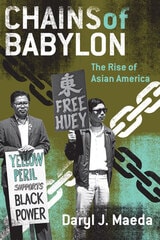
Chains of Babylon
The Rise of Asian AmericaDaryl J. Maeda
University of Minnesota Press, 2009
In Chains of Babylon, Daryl J. Maeda presents a cultural history of Asian American activism in the late 1960s and early 1970s, showing how the movement created the category of "Asian American" to join Asians of many ethnicities in racial solidarity. Drawing on the Black Power and antiwar movements, Asian American radicals argued that all Asians in the United States should resist assimilation and band together to oppose racism within the country and imperialism abroad.
As revealed in Maeda's in-depth work, the Asian American movement contended that people of all Asian ethnicities in the United States shared a common relationship to oppression and exploitation with each other and with other nonwhite peoples. In the early stages of the civil rights era, the possibility of assimilation was held out to Asian Americans under a model minority myth. Maeda insists that it was only in the disruption of that myth for both African Americans and Asian Americans in the 1960s and 1970s that the full Asian American culture and movement he describes could emerge. Maeda challenges accounts of the post-1968 era as hopelessly divisive by examining how racial and cultural identity enabled Asian Americans to see eye-to-eye with and support other groups of color in their campaigns for social justice.
Asian American opposition to the war in Vietnam, unlike that of the broader antiwar movement, was predicated on understanding it as a racial, specifically anti-Asian genocide. Throughout he argues that cultural critiques of racism and imperialism, the twin "chains of Babylon" of the title, informed the construction of a multiethnic Asian American identity committed to interracial and transnational solidarity.
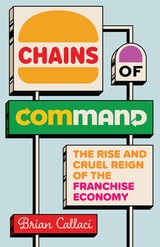
Chains of Command
The Rise and Cruel Reign of the Franchise EconomyBrian Callaci
University of Chicago Press, 2026
A surprising look at the big business of owning small businesses and what America’s franchise economy means for its workers.
Walk into a McDonald’s anywhere in the United States, and it will be identical to every other McDonald’s in the country. Yet, that particular store is almost certainly owned and operated by an “independent” franchisee. While McDonald’s presents an image of centralized uniformity to the consumer, it shows a different face to the small business owners operating its stores under its control and the workers preparing its product to its standards. How then does McDonald’s—and its big business peers—manage to be two things at once?
In this revelatory work, economist Brian Callaci shows how franchisors have altered the legal treatment of corporations in their favor through a decades-long crusade of lobbying and litigation. Their efforts subsequently unleashed a slew of legal and economic sins upon the US economy and labor force, allowing multinational corporations to control continent-spanning empires while outsourcing employment and scapegoating legal responsibilities onto small businesses. The result: the unfettered growth of some of America’s most recognizable businesses, at the aggregate expense of America’s workers.
Remarkable in both its scale and synthesis, Callaci’s story is the first chronicle of this business movement—initially resisted by US courts before experiencing a dramatic reversal of fortune after decades of campaigning by some of America’s most established entrepreneurs. An urgent and erudite history, Chains of Command reveals how the US labor market was tamed one small business at a time.

Chains of Love
Slave Couples in Antebellum South CarolinaEmily West
University of Illinois Press, 2004
Focusing on South Carolina, West deals directly with the most intimate areas of the slave experience including courtship, love and affection between spouses, the abuse of slave women by white men, and the devastating consequences of forced separations. Slaves fought these separations through cross-gender bonding and cross-plantation marriages, illustrating West's thesis about slave marriage as a fierce source of resistance to the oppression of slavery in general.
Making expert use of sources such as the Works Progress Administration narratives, slave autobiographies, slave owner records, and church records, this book-length study is the first to focus on the primacy of spousal support as a means for facing oppression. Chains of Love provides telling insights into the nature of the slave family that emerged from these tensions, celebrates its strength, and reveals new dimensions to the slaves' struggle for freedom.
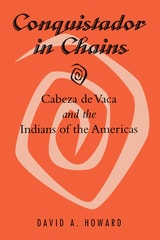
Conquistador in Chains
Cabeza de Vaca and the Indians of the AmericasDavid A. Howard
University of Alabama Press, 1996
Unlike many Spanish conquistadores who brought to the Americas a wave of disease, destruction, and oppression, Cabeza de Vaca’s stated intention was to pursue a different kind of conquest—one that would be just and humane, true to Spanish religion and law, and one that safeguarded liberty and justice for the indigenous peoples of the New World.
Bringing to South America skills and experiences earned with native peoples in North America, however, Cabeza de Vaca both failed to understand the indigenous peoples in the south and alienated many Spanish settlers in the Rio de la Plata Province, whose economic interests he threatened. Eventually the Spanish colonists formed a conspiracy to remove him from power and return him to Spain in chains.
That Cabeza de Vaca was overthrown is not surprising. His ideas and policies opposed the self-interest of most of the first Spaniards who had come to America, although he inspired the support of many even after his humiliating return to Spain. In Conquistador in Spain, historian David Howard provides a fascinating account of the rise and fall of this colonial idealist.