Results by title

11 books match the query 'Chapter'

cover of Anna Livia Plurabelle: The Making of a Chapter

Anna Livia Plurabelle

The Making of a Chapter

Fred Higginson

University of Minnesota Press, 1960

Anna Livia Plurabelle: The Making of a Chapter was first published in 1960. Minnesota Archive Editions uses digital technology to make long-unavailable books once again accessible, and are published unaltered from the original University of Minnesota Press editions.This volume traces the development of “Anna Livia Plurabelle,” the most famous chapter in James Joyce’s book Finnegans Wake. Mr. Higginson has collated all the extant drafts of the chapter, both published and unpublished, notably those in the manuscript collection of the British Museum. He has condensed this extensive material into six texts and has used a system of brackets which will enable scholars to reconstruct all of the known drafts from the texts given here. Readers who are interested principally in the major steps of the revisions or in gaining some insight into the larger developments of the work may do so by simply reading the six texts.This book provides the first substantial publication of material from the British Museum collection. While he was working on Finnegans Wake, Joyce sent his manuscript drafts to Miss Harriet Weaver, whom he regarded as the book’s patron. Miss weaver gave the drafts to the British Museum in 1951.In addition to the texts themselves, Mr. Higginson provides an introduction and editorial, bibliographical, and textual notes. In his introduction, he presents a theory of the techniques Joyce used in revising Finnegans Wake. He stresses the obsessive care with which Joyce revised and argues that the revisions produce a concentration, rather than a diffusion, of implication. He believes that both the tedious and the inspired revisions strengthen the structure of the book.Students of Joyce will find this book indispensable. It is of interest also to students of the creative process in general -- writers, critics, and aestheticians -- and to all readers who admire Joyce’s lyrical invocation of Dublin’s queen of rivers.
[more]
cover of Bloody Williamson: A Chapter in American Lawlessness

Bloody Williamson

A Chapter in American Lawlessness

Paul M. Angle; Introduction by John Y. Simon

University of Illinois Press, 1952

"In Williamson County some men took to violence almost as a way of life. A shocking story, well told."--New Yorker

Williamson County in southern Illinois has been the scene of almost unparalleled violence, from the Bloody Vendetta between two families in the 1870s through the Herrin Massacre of 1922, Ku Klux Klan activities that ended in fatalities, and the gang war of the 1920s between the Charlie Birger and Shelton brothers gangs. Paul Angle was fascinated by this more-than-fifty-year history, and his account of this violence has become a classic.
[more]
cover of Distancing English: A Chapter in the History of the Inexpressible

Distancing English

A Chapter in the History of the Inexpressible

Page Richards

The Ohio State University Press, 2009

How did fears of cultural inadequacy play out in the English language after American independence and the War of 1812? Like many of his nineteenth-century contemporaries, essayist Walter Channing suggests that the country’s perceived deficiency in literature is due to a crucial overlap with England, that is, having “the same language with a nation, totally unlike it in almost every relation.” In Distancing English, Page Richards shows how these concerns of language are historically interwoven with the inexpressible.
 
Often overlooked, the topos of the inexpressible redirects the ventriloquism of the English language. From its beginning, this topos combines the hyperbole of high expectations with the failure of inadequate words. In Charles Brockden Brown or George Tucker, it can register deficiency of “character” on and off the page, establishing important strategies of decenteredness also associated with modernism.
 
In writers such as Nathaniel Hawthorne, Wallace Stevens, and John Berryman, the inexpressible seizes advantage from disadvantage. It runs through literary framing strategies and flexible shaggy dog humor. An opening to the 1855 Leaves of Grass, Walt Whitman’s Preface remaps the topos andemerges as a distinguished moment in the articulation of the inexpressible.  


[more]
cover of Indexes: A Chapter from "The Chicago Manual of Style," Eighteenth Edition

Indexes

A Chapter from "The Chicago Manual of Style," Eighteenth Edition

The University of Chicago Press Editorial Staff

University of Chicago Press, 2024

Indexing A–Z from The Chicago Manual of Style—the undisputed authority for style, usage, and grammar.

In this age of searchable text, the need for an index made with human input is sometimes questioned. But a good index can do what a plain search cannot: It gathers all the substantive terms and subjects of the work, sorts them alphabetically, provides cross-references to and from related terms, and includes specific page numbers or other locators or, for electronic formats, direct links to the text. This painstaking intellectual labor serves readers of any longer work, whether it is searchable or not. For searchable texts, an index provides insurance against fruitless queries and unintended results. In a word, a good index makes the text more accessible.
​
Most book indexes must be assembled swiftly between the time page proofs are issued and the time they are returned to the typesetter—usually about four weeks. An author preparing their own index will have to proofread as well as index the work in that short time span.

This insightful chapter-length booklet will guide both professionals and first-time indexers in assembling an index that will do justice to both the book and the reader.  

[more]
cover of Indexes: A Chapter from The Chicago Manual of Style

Indexes

A Chapter from The Chicago Manual of Style

The University of Chicago Press

University of Chicago Press, 1993

[more]
cover of Indexes: A Chapter from The Chicago Manual of Style, 15th Edition

Indexes

A Chapter from The Chicago Manual of Style, 15th Edition

University of Chicago Press Staff

University of Chicago Press, 2003

For nearly one hundred years, The Chicago Manual of Style has been the authoritative reference for writers, editors, and publishers. Now in its fifteenth edition, the Manual has been thoroughly revised and updated. The chapter on indexing presented here has been reorganized, streamlined, and revised for the electronic age. It provides examples and recommendations on style and method for professionals, authors, and others who prepare indexes for published works.
[more]
cover of Indexes: A Chapter from The Chicago Manual of Style, 16th ed.

Indexes

A Chapter from The Chicago Manual of Style, 16th ed.

University of Chicago Press Staff

University of Chicago Press, 2010

This volume contains all the material from The Chicago Manual of Style, 16th Edition that relates to indexes and the work of indexing. Thoroughly updated to reflect current accepted practices, it is an indispensable guide for anyone preparing an index.
[more]
cover of Indexes: A Chapter from The Chicago Manual of Style, Seventeenth Edition

Indexes

A Chapter from The Chicago Manual of Style, Seventeenth Edition

The University of Chicago Press Editorial Staff

University of Chicago Press, 2017
Preparing an index for a book or other type of publication is a specialized skill. This volume presents the chapter from The Chicago Manual of Style, 17th Edition devoted to best practices for preparing and editing indexes as well as current standards for style and format of indexes. Thoroughly updated, it is an indispensable guide for anyone involved in preparing an index.
[more]
cover of Life and Work of George Sylvester Morris: A Chapter in the History of American Thought in the Nineteenth Century

Life and Work of George Sylvester Morris

A Chapter in the History of American Thought in the Nineteenth Century

R.M. Wenley

University of Michigan Press, 1917
George Sylvester Morris was a man whose “rare personality stamped itself” upon the University of Michigan, according to author R. M. Wenley. This book is a biography of the nineteenth-century philosopher, from his early years in New England, through his professorship at the University of Michigan, to his early death in 1889. Also included in this book is a bibliography of Morris’s writings.
[more]
cover of The Chapter of Kings

The Chapter of Kings

Mr. Collins

Bodleian Library Publishing, 2005

Poor Edward the Fifth was young killed in his bed
By his uncle, Richard, who was knocked on the head
By Henry the Seventh, who in fame grew big
And Henry the Eighth, who was fat as a pig!

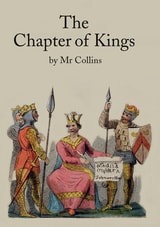
By the time "Mr. Collins" had written this verse, George III, the King of England, had been noticeably missing for seven years—having spent much of the time in his final period of illness at Windsor Castle—and the country had forever lost its American colonies. For many English citizens this dismal period was considered to be the beginning of the end for the British monarchy. The Chapter of Kings, offered here in a facsimile edition, provides a good deal of illustration to that effect.

For the first time since 1818, these charming verses, which were written for children but remain a biting satire ofthe British monarchy, are available for our edification and amusement, each accompanied by hand-drawn "portraits" of England's kings, from Caesar through George, the prince and future king.

Written and illustrated with a keen sense of irony, The Chapter of Kings is a fascinating peek, both for children and parents, into nineteenth-century attitudes toward the royals.

[more]
cover of The Life of Stephen F. Austin, Founder of Texas, 1793-1836: A Chapter in the Westward Movement of the Anglo-American People

The Life of Stephen F. Austin, Founder of Texas, 1793-1836

A Chapter in the Westward Movement of the Anglo-American People

By Eugene C. Barker

University of Texas Press, 1969

Almost a hundred years after the death of Stephen F. Austin this first full-length biography was published. And for almost a quarter of a century—dividing his time between editing, teaching, textbook writing, and serving in various academic capacities—Eugene C. Barker pursued the study which resulted in The Life of Stephen F. Austin. His accomplishment has long been regarded as a fine example of biography in Texas literature.

[more]