Results by title
4 books match the query 'Chapters'
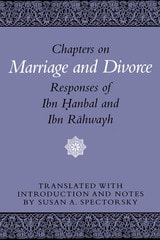
Chapters on Marriage and Divorce
Responses of Ibn Hanbal and Ibn RahwayhTranslated with introduction and notes by Susan A. Spectorsky
University of Texas Press, 1993
While western-derived legal codes have superseded Islamic law in many parts of the Muslim world, Islamic, Koran-based law still retains its force in the area of marriage and family relations, the area that is key to the status of women. This work makes available for the first time in English three compilations of responses to questions about family law given by two prominent Muslim jurists of the ninth century (third century of Islam)—Ahmad b. Hanbal, the eponymous founder of the Hanbali rite of Sunni Islam (the one dominant in Saudi Arabia), and Ishaq b. Rahwayh. These compilations are basic sources for the study of the development of legal thinking in Islam.
The introduction to the translation locates the compilations in a historical context and elucidates how the various issues of family law are treated. An appendix contains a collation of the significant variants among the manuscripts and printed versions of the Arabic texts. The volume concludes with a topical index and an index of names.
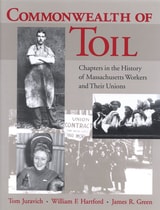
Commonwealth of Toil
Chapters in the History of Massachusetts Workers and Their UnionsThomas Juravich
University of Massachusetts Press, 1996
Over the past two centuries, Massachusetts workers have fought for many important advances that would later be enjoyed by other Americans. The right to organize, restrictions on work hours and child labor, and workers' compensation were all pioneered in the Commonwealth. From the 1825 strike of Boston carpenters for a ten-hour day to recent victories in hospitals and universities, Massachusetts workers and their unions have been in the forefront of the battle for dignity and justice.
This book tells their story. In eighteen chapters, beginning with the first industrial workers in the nation—the Lowell “mill girls”—the authors describe the struggles of working men and women to improve their lives. In the process, the book provides a valuable perspective on the development of the American labor movement.
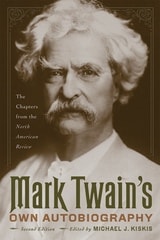
Mark Twain's Own Autobiography
The Chapters from the North American ReviewMark Twain; Edited by Michael J. Kiskis; Foreword by Sheila Leary
University of Wisconsin Press, 2010
More than the story of a literary career, this memoir is anchored in the writer’s relation to his family—what they meant to him as a husband, father, and artist. It also brims with many of Twain’s best comic anecdotes about his rambunctious boyhood in Hannibal, his misadventures in the Nevada territory, his notorious Whittier birthday speech, his travels abroad, and more.
Twain published twenty-five “Chapters from My Autobiography” in the North American Review in 1906 and 1907. “I intend that this autobiography . . . shall be read and admired a good many centuries because of its form and method—form and method whereby the past and the present are constantly brought face to face, resulting in contrasts which newly fire up the interest all along, like contact of flint with steel.”
For this second edition, Michael Kiskis’s introduction references a wealth of critical work done on Twain since 1990. He also adds a discussion of literary domesticity, locating the autobiography within the history of Twain’s literary work and within Twain’s own understanding and experience of domestic concerns.
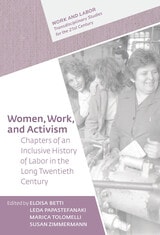
Women, Work, and Activism
Chapters of an Inclusive History of Labor in the Long Twentieth CenturyEloisa Betti
Central European University Press, 2022
The thirteen critical and well-documented chapters of Women, Work and Activism examine women’s labor struggle from late nineteenth-century Portuguese mutual societies to Yugoslav peasant women’s work in the 1930s, and from the Catalan labor movement under the Franco dictatorship to workplace democracy in the United States. The authors portray women's labor activism in a wide variety of contexts. This includes spontaneous resistance to masculinist trade unionism, the feminist engagement of women workers, the activism of communist wives of workers, and female long-distance migration, among others. The chapters address the gendered involvement of working people in multiple and often precarious and unstable labor relations and in unpaid labor, as well as the role of the state and other institutions in shaping the history of women’s labor.
The book is an innovative contribution to both the new labor history and feminist history. It fully integrates the conceptual advances made by gender historians in the study of labor activism, driving home critiques of Eurocentric historiographies of labor to Europe while simultaneously contributing to an inclusive history of women’s labor-related activism wherever to be found. Examining women’s activism in male-dominated movements and institutions, and in women’s networks and organizations, the authors make a case for a new direction in gender history.