Results by title
5 books match the query 'Charity in literature'
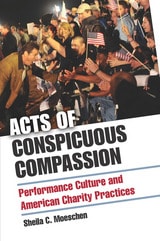
Acts of Conspicuous Compassion
Performance Culture and American Charity PracticesSheila C. Moeschen
University of Michigan Press, 2016
Sheila C. Moeschen sheds new light on the legacy and involvement of disabled people within charity—specifically, the articulation of performance culture as a vital theoretical framework for discussing issues of embodiment and identity, a framework that dislodges previously held notions of the disabled existing as passive “objects” of pity. This work gives rise to a more complicated and nuanced discussion of the participation of the disabled community in the charity industry, of the opportunities afforded by performance culture for disabled people to act as critical agents of charity, and of the new ethical and political issues that arise from employing performance methodology in a culture with increased appetites for voyeurism, display, and complex spectacle.
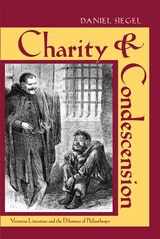
Charity and Condescension
Victorian Literature and the Dilemmas of PhilanthropyDaniel Siegel
Ohio University Press, 2012
Charity and Condescension explores how condescension, a traditional English virtue, went sour in the nineteenth century, and considers how the failure of condescension influenced Victorian efforts to reform philanthropy and to construct new narrative models of social conciliation. In the literary work of authors like Dickens, Eliot, and Tennyson, and in the writing of reformers like Octavia Hill and Samuel Barnett, condescension—once a sign of the power and value of charity—became an emblem of charity’s limitations.
This book argues that, despite Victorian charity’s reputation for idealistic self-assurance, it frequently doubted its own operations and was driven by creative self-critique. Through sophisticated and original close readings of important Victorian texts, Daniel Siegel shows how these important ideas developed even as England struggled to deal with its growing underclass and an expanding notion of the state’s responsibility to its poor.

Love's Quarrels
Reading Charity in Early Modern EnglandEvan Gurney
University of Massachusetts Press, 2018
Early modern English writers often complained that “charity had grown cold,” lamenting the dissolution of society's communal bonds. But far from diminishing in scope or influence, charity generated heated debates, animated by social, political, and religious changes that prompted urgent questions about the virtue's powers and functions. Charity was as much a problem as it was a solution, a sure sign of trouble even when invoked on behalf of peace and community.
Love's Quarrels charts charity's complex history from the 1520s to the 1640s and details the ways in which it can be best understood in biblical translations of the early sixteenth century, in Elizabethan polemic and satire, and in the political and religious controversies arriving at the outset of civil war. As key works from Edmund Spenser, Ben Jonson, and John Milton reveal, “reading charity” was fraught with difficulty as early modern England reconsidered its deepest held convictions in the face of mounting social disruption and spiritual pressure.
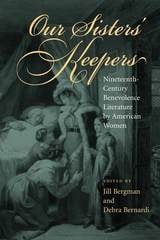
Our Sisters' Keepers
Nineteenth-Century Benevolence Literature by American WomenEdited by Jill Bergman and Debra Bernardi
University of Alabama Press, 2005
American culture has long had a conflicted relationship with assistance to the poor. Cotton Mather and John Winthrop were staunch proponents of Christian charity as fundamental to colonial American society, while transcendentalists harbored deep skepticism towards benevolence in favor of Emersonian self-reliance and Thoreau’s insistence on an ascetic life. Women in the 19th century, as these essays show, approached issues of benevolence far differently than their male counterparts, consistently promoting assistance to the impoverished, in both their acts and their writings.
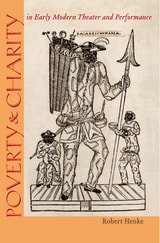
Poverty and Charity in Early Modern Theater and Performance
Robert Henke
University of Iowa Press, 2015
The actor-based theatre and performance traditions examined in this study, which persistently explore felt connections between the itinerant actor and the vagabond beggar, evoke the poor through complex and variegated forms of imagination, thought, and feeling. Early modern theatre does not simply reflect the social ills of hunger, poverty, and degradation, but works them through the forms of poverty, involving displacement, condensation, exaggeration, projection, fictionalization, and marginalization. As the critical mass of medieval charity was put into question, the beggar-almsgiver encounter became more like a performance. But it was not a performance whose script was prewritten as the inevitable exposure of the dissembling beggar. Just as people’s attitudes toward the poor could rapidly change from skepticism to sympathy during famines and times of acute need, fictions of performance such as Edgar’s dazzling impersonation of a mad beggar in Shakespeare’s King Lear could prompt responses of sympathy and even radical calls for economic redistribution.